
When Thinking Becomes Interference: The Performance Cost of Overanalysis
An analytical essay on how athletes can undermine performance by thinking at the wrong time, in the wrong way, or toward the wrong problem. This piece examines overanalysis, self-focus, interference, and the importance of organizing thought so that preparation supports performance rather than disrupting it.
Steven Bradley
7/5/20265 min read
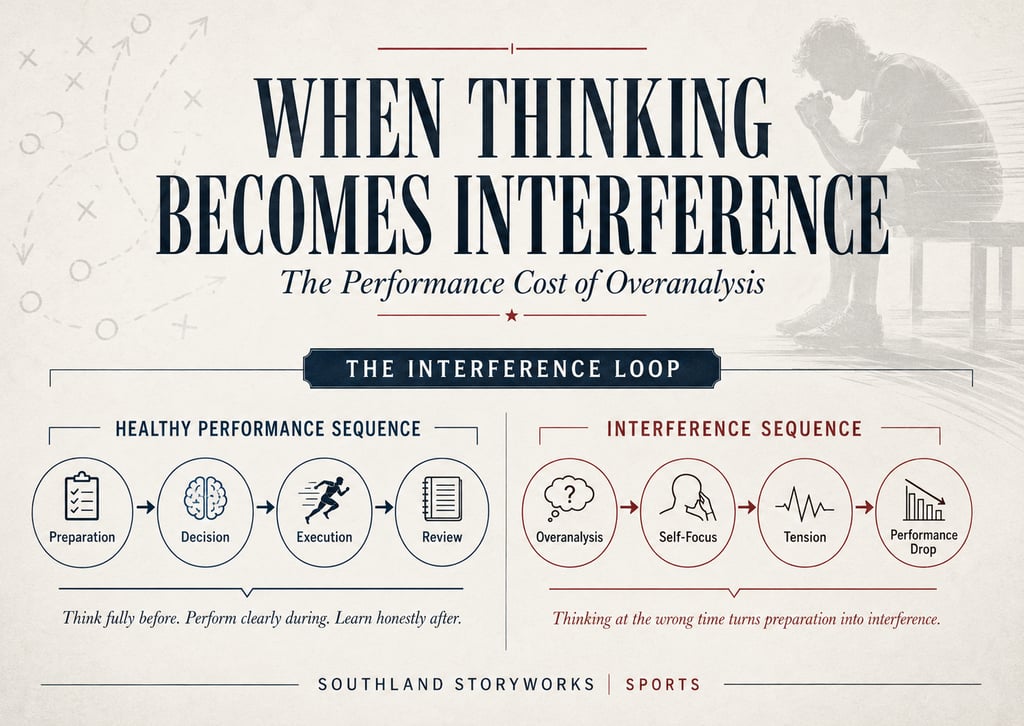
In most areas of life, thinking carefully is an advantage. Analysis helps people plan, evaluate, adjust, and improve. It allows students to learn, professionals to solve problems, and leaders to make better decisions in the face of uncertainty. Sport, however, complicates that assumption. In competition, thinking can either sharpen performance or disrupt it. The difference is not intelligence. The difference is timing, attention, and control.
Athletes rarely fail because they think. They fail because they think in the wrong way at the wrong moment.
This distinction is especially clear in sports that provide time between actions. A basketball player reacts inside a flowing sequence. A soccer player receives pressure from opponents, teammates, space, and time all at once. A golfer, pitcher, free-throw shooter, tennis server, or placekicker faces a different kind of challenge. The action begins from relative stillness. The athlete has time to plan, anticipate, rehearse, worry, doubt, and interfere.
That space is both a gift and a trap.
The stillness before performance creates room for intelligent decision-making. The athlete can assess conditions, select a strategy, commit to a target, and prepare the body for execution. Yet the same stillness also creates room for self-consciousness. The athlete may begin monitoring mechanics, imagining consequences, revisiting past failures, or trying to control a movement that should be trusted. In this way, thought moves from preparation into interference.
Rick Jensen’s performance formula, often summarized as talent minus interference, provides a useful way to understand this problem. Talent represents the athlete’s available capacity: skill, training, physical ability, perception, and experience. Interference represents whatever prevents that capacity from being expressed. Poor performance is not always proof that the athlete lacks ability. Sometimes, it is evidence that the athlete could not access their ability under pressure.
That idea should change the way coaches, athletes, and observers talk about failure. A missed shot, a poor decision, or a late-game collapse may look like a technical mistake. It may even contain a technical component. But beneath the visible error often lies an attentional one. The athlete’s focus has shifted away from the task and toward the self.
This is the central danger of overanalysis. The athlete attempts to solve performance in real time. Instead of committing to the target, the mind begins managing the body. Instead of seeing the field, court, course, or opponent clearly, the athlete becomes occupied by internal commentary. The performer starts thinking about how the action looks, what it means, what might happen if it fails, or which mechanical piece must be controlled.
The body rarely performs freely under that kind of supervision.
Sport psychology has long recognized this problem. Under pressure, performers may reinvest conscious attention into skills that have already been learned. A movement that normally operates automatically becomes crowded when explicitly instructed. The athlete tries to steer, guide, force, or protect the action. What appears to be carefulness becomes constraint.
Choking is one version of this breakdown. Panic is another. Choking often involves too much control. The athlete becomes hyper-aware, mechanical, and cautious. Panic, by contrast, involves emotional overload. The athlete rushes, abandons routine, or reacts to a threat rather than a task. Though different in feel, both problems share a common root: attention has left the performance demand and collapsed inward.
This is why the popular phrase “mental toughness” is often too vague. The issue is not simply toughness. The issue is cognitive organization. Great performers are not those who think the most. They are those who know where thought belongs.
Critical thinking belongs before execution. It belongs in preparation, practice design, film study, strategy, scouting, course management, and reflection. It belongs in the questions that shape the performance plan: What is the task? What matters here? What is the best decision? What outcome is acceptable? What risk is worth taking? What pattern has the evidence shown?
Once execution begins, the question changes. The athlete no longer needs more analysis. The athlete needs clarity.
This principle applies across sports. A pitcher does not benefit from debating mechanics after beginning the delivery. A basketball player does not benefit from evaluating shooting form in the middle of a release. A golfer does not benefit from solving swing structure while standing over the ball. A tennis player does not benefit from thinking through every technical component of the serve after the toss has begun.
There is a time to think and a time to perform. The problem begins when athletes confuse the two.
The best routines protect this boundary. A routine is not merely a habit or superstition. It is a cognitive structure. It gathers necessary information, narrows attention, establishes commitment, and then closes the door on further analysis. Once that door closes, the athlete’s task is not to keep thinking. It is to act.
This is why strong routines often look simple from the outside but perform complex work internally. They regulate time. They reduce cognitive noise. They prevent unnecessary decisions from leaking into execution. They remind the athlete that preparation has already occurred.
The coaching implication is significant. Coaches should not merely ask athletes what went wrong. They should ask when the athlete first realized they were solving the wrong problem. Did the analysis enter the performance window too late? Did the athlete confuse worry with concentration? Did the performer try to control an automated movement? Did the athlete mistake self-monitoring for discipline?
Those questions reveal more than the box score.
They also help distinguish between useful feedback and destructive criticism. A technically informed athlete may be tempted to treat every failure as a mechanical emergency. But not every miss requires a rebuild. Sometimes the athlete made the correct decision and executed poorly. Sometimes the decision was poor, but the execution was sound. Sometimes the outcome was unlucky. Sometimes the problem was neither skill nor luck, but interference.
The mature performer learns to separate these categories. That separation is where real improvement begins.
Data can help, but data cannot replace judgment. Statistics, video, launch monitors, wearable technology, and performance tracking can all clarify patterns. But information becomes useful only when interpreted wisely. Too much information, delivered at the wrong time, becomes another form of interference. The goal is not to create athletes who know every number. The goal is to create athletes who know which information matters and when to stop processing it.
This is where coaching becomes more than correction. It becomes attention design.
A good coach teaches athletes how to think upstream, commit clearly, and perform freely. A good coach distinguishes between reflection and rumination. Reflection produces action. Rumination produces tension. Reflection asks, “What did this teach me?” Rumination asks, “What does this say about me?” The first question leads to growth. The second protects fear.
Sport rewards clarity under pressure. It rewards athletes who can prepare intelligently without becoming trapped inside their own analysis. It rewards performers who know that thought is powerful, but not always welcome.
Thinking is not the enemy of performance. Misplaced thinking is.
The athlete’s task is not to become mindless. It is to become disciplined about attention. Think fully when the moment calls for thinking. Decide clearly when the moment calls for a decision. Then let the body perform what it has already been trained to do.
That is not anti-intellectual. It is the highest form of practical intelligence in sport.
Selected References
Baumeister, R. F. (1984). Choking under pressure: Self-consciousness and paradoxical effects of incentives on skillful performance. Journal of Personality and Social Psychology, 46(3), 610–620.
Eysenck, M. W., Derakshan, N., Santos, R., & Calvo, M. G. (2007). Anxiety and cognitive performance: Attentional control theory. Emotion, 7(2), 336–353.
Gallwey, W. T. (1981). The inner game of golf. Random House.
Jensen, R. (2008). Easier said than done: A life in sport. Human Kinetics.
Masters, R. S. W., & Maxwell, J. P. (2008). The theory of reinvestment. International Review of Sport and Exercise Psychology, 1(2), 160–183.
Rotella, B., & Cullen, B. (1995). Golf is not a game of perfect. Simon & Schuster.
Southland Storyworks
Narrative. Performance. Meaning.
Home-Sports
Inquiries
news@southlandstoryworks.com
Based in the American South
Submissions welcome via email
© 2026 Southland Storyworks-An independent publication exploring the psychological frameworks of competition.
Narrative architecture & performance psychology