
The World Cup Has Reached the Throne Room
The biggest World Cup ever has produced the most exclusive final four imaginable
SPORTS
Steven Bradley
7/14/202615 min read
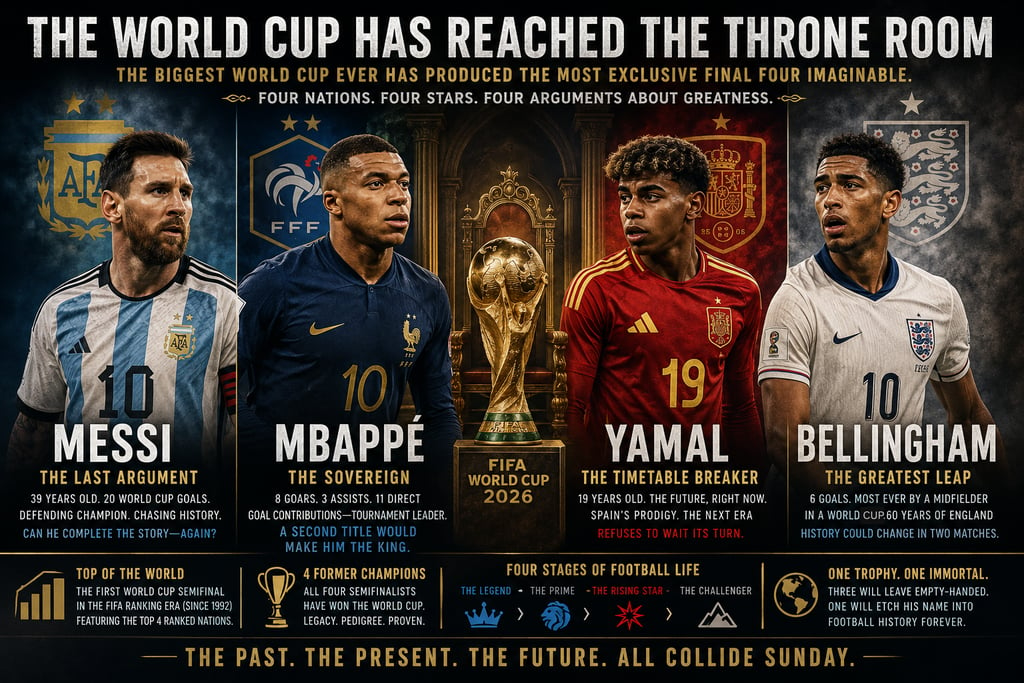
The largest World Cup ever staged has somehow narrowed itself to the smallest possible circle of power.
That is the strange beauty of this semifinal round.
The 2026 World Cup expanded the field to 48 teams, added a Round of 32, stretched the tournament’s geography across North America, and opened the front door wider than any men’s World Cup before it. More nations. More matches. More paths into the knockout stage. More stories, more noise, more possibilities. FIFA’s own format explanation made clear that the tournament moved from 32 teams and eight groups to 48 teams arranged into 12 groups of four, with the top two from each group and the eight best third-place teams advancing to the Round of 32.
And after all that expansion, all that democratized opportunity, all that additional room for disorder, the tournament has arrived at something almost impossibly exclusive.
Argentina. France. Spain. England.
Four nations. Four former World Cup champions. Four undefeated semifinalists. Four of the deepest and most scrutinized football cultures on earth. One report on the semifinal field noted that all four remaining teams are previous World Cup winners, and that Argentina, France and Spain have combined to win three of the past four tournaments.
More striking still, FOX Sports Research reported that this is the first World Cup semifinal round since FIFA introduced its rankings in 1992 in which each of the top four ranked teams entering the tournament reached the semifinals.
The biggest World Cup ever has produced the most exclusive final four imaginable.
The tournament has reached the throne room.
What remains is not merely a competition to decide a champion. It is a referendum on the current hierarchy of world football and the next transfer of power inside it. Lionel Messi, Kylian Mbappé, Lamine Yamal and Jude Bellingham do not enter this semifinal round carrying the same burden. That is what makes the field so rich. They are not four versions of the same story. They are four separate arguments about greatness arriving at the same locked door.
Messi is the last argument.
Mbappé is the heir who has already begun to rule.
Yamal is the future, trying to arrive early.
Bellingham is the challenger with the most history still available to seize.
Three of them will not lift the trophy on Sunday. That is the cruelty that gives the whole week its force. The World Cup is generous in buildup and ruthless in memory. It allows many players to enter history’s frame, then gives only one team the photograph everyone keeps.
The tournament of the many became the tournament of the few
The expanded World Cup was always going to be judged in stages.
At the beginning, expansion is about access. It creates new games, new flags, new supporters, new improbable moments, new television windows, and new emotional geography. It gives countries that rarely receive the sport’s central stage a chance to occupy it. It creates a tournament that feels more global, even when the competitive balance is uneven.
In the middle, expansion is about chaos. A larger field and a 32-team knockout bracket produce more routes, more bracket accidents, more fatigue, more travel, more heat, more refereeing pressure, more chances for a favored team to stumble into inconvenience. Tournament design researchers have noted that the 48-team format introduces real structural complexity, including the challenge of populating a 32-team knockout bracket from 12 groups and selecting the eight best third-placed teams.
But at the end, expansion may be about depth.
A longer tournament can give lesser teams more opportunities to create a moment. It can also give great teams more time to survive one. More matches may initially widen the story, but they may also reward the squads with the most elite reserves, the broadest tactical options, the most tournament experience, the most problem-solving capacity and the greatest margin for error.
That is what this World Cup has delivered. The early and middle stages may have created breadth. The semifinal round has revealed hierarchy.
This is not an indictment of expansion. It is one of its more interesting consequences. The tournament allowed more countries to be seen. Then, at the end, it asked who could still remain.
The answer is almost embarrassingly aristocratic.
France, the deepest talent machine in the sport. Spain, the restored ideas nation. Argentina, the defending champion and keeper of the Messi epic. England, the wealthiest football culture still trying to reconcile its power with its trophy cabinet.
The field is not merely strong. It is symbolic.
Each semifinalist represents a different kind of football authority.
Messi: what happens after the perfect ending?
Lionel Messi was supposed to have completed the story in Qatar.
There are few endings in modern sport as clean as Argentina in 2022: the aging genius, the long national ache, the ghost of Diego Maradona, the final against France, the penalty kicks, the lifted trophy, the sense that the greatest player of his generation had finally filled the only space left in his argument.
That title did not end the debate, because nothing does. But it changed the terms of resistance. Before Qatar, Messi’s critics could still point to the World Cup as the missing exhibit. After Qatar, the argument against him had to become more specialized, more academic, more dependent on preference.
Now, four years later, the story has refused to remain closed.
Messi is 39. FIFA chronicled his record-making 2026 tournament earlier in the competition, including his move beyond Miroslav Klose’s World Cup goals record and his continued accumulation of appearances, wins and goal contributions. Argentina’s road to the quarterfinals was powered by Messi’s eight goals, according to FIFA, as the holders pursued the rare possibility of repeating as champions.
That is the real Messi story now. Not the first completion of the myth. The attempt to improve the perfect ending.
A second consecutive World Cup would not create his claim to being the greatest player ever. It would harden it culturally. It would make the counterargument feel less like an equal position than a private preference. It would turn Qatar from the long-awaited conclusion into the opening act of a final dynasty.
There is an additional Argentina layer here that matters. If Messi wins again, the story is not only that Messi conquered the World Cup twice. It is that Lionel Scaloni’s Argentina became something more durable than a vehicle for one man’s unfinished quest.
Scaloni’s work has often seemed quiet beside Messi’s mythology, but Argentina’s post-2018 transformation is one of the central international football stories of this era. Reuters described Scaloni’s leadership as a “quiet revolution,” noting that he helped convince Messi to return after the turmoil of 2018, then led Argentina through Copa América glory in 2021 and the World Cup title in 2022.
That matters because dynasties require more than sentiment. Argentina are no longer simply trying to provide Messi with a final platform. They are trying to prove that Qatar's emotional force has become a sustainable international program.
That is why the England semifinal is not merely another Messi match. It is the next test of whether Argentina can keep history under control.
The image is almost too clean. Messi, the Argentine who completed the post-Maradona argument, now faces England, the country against which Maradona authored perhaps the most mythologically dense match in World Cup history. England and Argentina do not share the most frequent rivalry in world football, but they share one of its most haunted ones.
For Messi, that history is not the burden it was for Maradona. It is the stage he inherited.
What happens after the perfect ending?
Messi tries to improve it.
Mbappé: from heir to sovereign
Kylian Mbappé no longer needs to be introduced as the future.
That was the old frame. The fast teenager who scored in a World Cup final. The obvious successor to the Messi-Ronaldo age. The prince of football’s next era. The player for whom inevitability arrived early.
That language now undersells him.
Mbappé has already won a World Cup. He has already scored a hat trick in a World Cup final that his team lost. He has already turned tournament football into his most natural stage. The Houston Chronicle’s semifinal preview noted that France captain Mbappé has 20 goals in 20 career World Cup matches, while FIFA’s Mbappé records page similarly placed him among the central statistical figures of the competition.
The question is no longer whether Mbappé will inherit the sport.
The question is whether he has already become its defining tournament player.
There is a difference between being the best player in the world and becoming the central figure in World Cup history across multiple cycles. The first can be temporary. It can depend on form, club context, injuries, awards, and the arguments of a season. The second becomes harder to dislodge. World Cups organize memory differently. They compress careers into images that outlast league campaigns.
France give Mbappé the platform to become permanent.
That is the deeper French story. They are not merely talented. They are structurally formidable. They have stars, replacements for stars, tactical flexibility, transition violence, physical depth and a manager who has lived inside the final week of World Cups for much of the past decade. The Guardian’s pre-semifinal power rankings placed France first and framed their attack around the difficulty of silencing Mbappé and Ousmane Dembélé for an entire match.
France now resemble something closer to an international club dynasty than a national team caught in one golden generation. They reached the final in 2018 and 2022, and AP reported before the Spain semifinal that France were attempting to reach a third straight final, something that would place them in rare historical company.
This is where Mbappé’s individual legacy and France’s national argument merge.
A second Mbappé World Cup would not merely confirm him as the obvious post-Messi figure. It would allow France to claim the era itself. Not just the best talent factory. Not just the most frightening team sheet. The country that converted elite production into repeated global authority.
That is sovereignty.
And yet Spain represent the kind of opponent that can make France look almost anti-aesthetic by comparison. Spain can make the match feel as if France are winning moments while losing the idea. They can force the argument toward possession, structure, patience and control. They can ask whether football’s future belongs to the side that organizes the match or the side that can destroy the organization.
Mbappé is the perfect answer to that question because he is not dependent on the match’s logic.
He can break it.
Yamal: the future before the present is over
Lamine Yamal’s story is not the same as Mbappé’s, because it is not yet about possession of the throne.
It is about time.
Yamal turned 19 on July 13, just as Spain prepared to face France in the semifinal. Reports around his birthday placed his rise in the context of the sport’s great teenage prodigies, and the comparison is unavoidable because World Cups have always been especially sensitive to youth that looks too young for the moment and then behaves as if age were somebody else’s problem.
The strongest Yamal framing is not “teenager wins World Cup,” though that would be extraordinary enough.
It is this:
The future arrived before the present was ready to leave.
That is what gives France-Spain its generational charge. Mbappé is not old. He is in his footballing prime, still terrifying, still expanding his international record. He should be the age’s answer. Yet here comes Yamal, not asking to wait his turn politely, not fitting neatly into a succession plan, not arriving after Mbappé’s era, but crashing directly into it.
Spain make that possible because Yamal does not have to carry the whole structure alone.
That is important. It would be tempting to write Spain’s story as a Messi-like youth epic, one brilliant attacker dragging a country toward destiny. That is not quite right. Spain are more collective than that, and the collective nature of their success strengthens the broader argument.
AP reported that France and Spain entered the semifinal undefeated and that neither had trailed in the tournament; the same report noted Spain’s defensive strength and the tournament-record scoreless run of goalkeeper Unai Simón. The Houston Chronicle highlighted Spain’s one goal conceded and the repeated impact of Mikel Merino, whose winning goals off the bench against Portugal and Belgium became part of Spain’s late-tournament identity.
This is not a team waiting for a teenager to rescue it every night. It is a functioning football system with a teenager brilliant enough to become its face.
That matters for Spain’s historical claim. Spain’s 2008-2012 era did not merely win trophies; it made a stylistic argument. It insisted that control could be not only defensive but imperial. That possession could become a pressure system. That a national team could make opponents spend entire matches chasing the idea of the ball before ever confronting the ball itself.
The years after that golden period made the Spanish question more complicated. Could Spain adapt? Could the idea become aggressive again? Could possession avoid becoming a museum exhibit?
Yamal’s emergence gives Spain a different kind of edge. He supplies rupture inside the structure. He can make a positional team feel suddenly improvisational. He gives a system associated with control, a player associated with instability.
That is why a Spanish title would not merely introduce Yamal as the next chosen one. It would announce that Spain have found a way to restore the old national idea without simply imitating it.
If Messi is the perfect ending trying to extend itself, and Mbappé is the current ruler trying to formalize his reign, Yamal is the calendar problem.
He is what happens when football’s future refuses to wait for the present to be finished.
Bellingham: the greatest available leap
Jude Bellingham may have more to gain than anyone left.
That sounds strange because Messi’s stakes are cosmic, Mbappé’s are dynastic and Yamal’s are generational. But each of them already occupies a relatively fixed public category.
Messi is already Messi.
Mbappé is already the central figure of the post-Messi present.
Yamal is already understood as the future.
Bellingham is the one whose category remains most negotiable. He is already one of the sport’s most important players, already a Real Madrid superstar, already the face of an England team that now increasingly bends around his authority. But he is not yet locked into the historical tier this World Cup could open for him.
That is why England’s semifinal feels so large.
FIFA’s statistical feature on Bellingham noted that he has scored 6 goals at this World Cup, making him the first midfielder to score more in a single tournament. The Houston Chronicle reported that he scored both goals in England’s 2-1 extra-time quarterfinal win over Norway, and that he became the second-youngest player after Pelé to score braces in consecutive knockout-stage matches.
Those are not ordinary midfield numbers. They are tournament-author numbers.
And England is not an ordinary national-team platform.
A strange imbalance between cultural weight and trophy return defines England’s football history—no country talks about football with more inherited seriousness. No domestic league has become more globally dominant as a commercial and cultural machine. No national-team discourse is more self-referential, more haunted, more aware of its own disappointments. England have wealth, infrastructure, audience, tradition, player development, media attention and the Premier League’s gravitational pull.
Yet the men’s national team still lives under 1966.
Every promising generation has been forced to negotiate with that year. Every deep run becomes either evidence of progress or a new form of national therapy. Every elimination becomes an argument about psychology, coaching, Englishness, penalties, pressure, arrogance, fear or fate.
A Bellingham-led World Cup title would not merely improve England’s record.
It would create an English football immortal in real time.
That is the scale of the available leap. Messi can add to the greatest-ever argument. Mbappé can deepen the tournament-player argument. Yamal can accelerate the succession argument. Bellingham can become the central English tournament hero for a country that has waited 60 years to produce one.
The larger England story is not that the country would suddenly become a football superpower. England already is one, structurally. The title would reconcile the structure with the record.
It would allow England to stop treating 1966 as both inheritance and accusation. It would allow the current era to be described not as another talented group trying to escape history, but as the group that finally altered it.
That is why England-Argentina feels almost unfairly loaded. Argentina already knows how to turn footballers into national myth. England has been waiting for a modern player capable of doing the same.
Bellingham has two matches left to become that player.
Haaland and the absent fifth throne
Erling Haaland’s absence sharpens the story rather than weakening it.
Norway’s elimination prevents this final four from becoming a clean assembly of every individual superstar. But Haaland’s tournament still matters because it helps define the difference between proof and history.
He scored enough to remain part of the tournament’s Golden Boot conversation and forced England to solve one of the great individual threats in world football. But Norway went out before the final image could include him. The Houston Chronicle’s quarterfinal account noted England held Haaland in check throughout the 2-1 victory over Norway, while The Guardian’s ranking piece described Norway’s inability to find him and the lack of a Plan B as part of its limitation.
That is the World Cup’s enduring cruelty to individual greatness.
A striker can score relentlessly and still leave the tournament before history takes the photograph. A player can prove superiority in one category and still be absent from the final argument. The World Cup is not a talent ranking. It is a tournament, and only when the team survives long enough does it convert individual excellence into collective memory.
Haaland leaves with proof.
The others remain with possibility.
That distinction is why the final week matters so much.
France-Spain: control or destruction
The first semifinal is the cleaner tactical argument.
France and Spain are both undefeated. Neither had trailed entering the match. France had outscored opponents 14-2, according to AP, while Spain arrived with one of the tournament’s strongest defensive records and the young star power of Yamal meeting Mbappé directly.
On paper, the match is Mbappé versus Yamal.
On the field, it is more than that.
France represent depth, athletic power, transition threat, tournament memory and the ability to win matches that do not unfold according to any ideal aesthetic. They can allow stretches of discomfort because they possess players who can turn one transition, one duel, one half-yard into a match’s permanent event.
Spain represent control, spacing, technical security and the belief that possession can still be aggressive rather than ornamental. Their best version does not merely keep the ball; it moves opponents into submission. Spain’s question is whether they can impose enough structure to prevent France from turning the match into a series of breakpoints.
So the underlying question becomes:
Does this tournament belong to the team that controls the match or the team most capable of destroying control?
That question has haunted modern football for years. The sport has oscillated between positional control and transition violence, between system and explosion, between the side that makes the field predictable and the side that waits for predictability to become arrogance.
France can win without seeming to own the match.
Spain can lose despite seeming to understand it.
That is the danger on both sides.
England-Argentina: the countries that remember too much
The second semifinal is less clean tactically and more haunted historically.
England and Argentina carry one of the densest World Cup relationships in the sport: 1966, 1986, 1998, 2002. Politics, fouls, send-offs, penalties, revenge, Maradona, Beckham, Simeone, Owen, Batistuta, redemption and resentment all collect around the fixture. It does not need to be frequent to feel heavy.
The 2026 version arrives with a different cast but the same symbolic density.
Messi faces the country that helped define Maradona’s World Cup mythology. England face the defending champions and the player whose Argentina career has finally escaped tragedy. Bellingham faces the opportunity to become the kind of tournament figure England usually watches other countries produce.
The Guardian reported that Declan Rice was expected to start against Argentina after illness concerns, while Jordan Pickford stressed England’s need to control emotion in a rivalry carrying obvious historical weight.
That last phrase may decide more than the teams admit.
Control emotion. Control Messi. Control the match. Control the memory.
The problem with England-Argentina is that memory does not always stay controlled. It enters every empty space. It turns a foul into a reference. It turns a missed chance into a national omen. It turns an ordinary refereeing decision into the next chapter of an old grievance.
Argentina know how to live inside that emotional weather. England have spent decades trying to master it.
This semifinal will test whether Bellingham’s England are finally old enough to stop playing against ghosts.
The four possible finals
The final will inherit whatever argument the semifinals leave behind.
France-Argentina would be the rematch almost too obvious to avoid: 2022 revisited, Messi against Mbappé, succession reopened and perhaps settled in the most direct way possible.
Spain-Argentina would connect past and future through an almost literary Barcelona thread: Messi, the old deity, against the Spanish team, fronted by Yamal, the prodigy whose rise inevitably invites comparison, even when it is unfair.
England-Spain would revive recent European frustration and give England another chance to turn a modern near-miss into a claim of arrival.
England-France would be the cleanest argument between the two great modern European talent systems: Premier League power and English burden against French production, French speed and Mbappé’s sovereignty.
Every version works.
That is the mark of a great final four. There is no weak final. No awkward narrative. No undercooked matchup that requires a broadcaster to manufacture significance. The tournament has reached a stage where every possible ending is legible.
It can crown the past again.
It can ratify the present.
It can accelerate the future.
It can create an immortal.
One trophy, four arguments
The World Cup does not always give us this.
Sometimes a semifinal field has a clear favorite, a survivor, a tactical outsider and a sentimental story. Sometimes the last week is compelling because of contrast, imbalance or surprise. Sometimes the bracket opens, and a team reaches the threshold before anyone fully understands how it got there.
This one is different.
This semifinal round feels less like a bracket accident than a council of football power. The sport’s hierarchy has assembled itself with almost suspicious neatness: Argentina, France, Spain, England; Messi, Mbappé, Yamal, Bellingham; past, present, future and possibility.
The expanded tournament promised more.
The final four have given us fewer.
Fewer teams. Fewer excuses. Fewer illusions about where power still resides when the field has been narrowed to the final week.
That does not make the earlier rounds meaningless. It gives them shape. The great promise of a larger World Cup is that more nations can enter the story. The hard truth of the World Cup is that only a few can finish it.
Now the tournament has reached the room where finishing happens.
Messi is trying to improve the perfect ending.
Mbappé is trying to make inheritance official.
Yamal is trying to outrun the calendar.
Bellingham is trying to give England a new mythology.
Three will leave with a version of disappointment that history will eventually simplify. One will leave with the trophy and the right to have this summer remembered through his face.
That is what the World Cup does at the end.
It gathers the world, expands the field, multiplies the stories, and invites everyone to imagine a path.
Then it closes the door and lets only one argument survive.
Southland Storyworks
Narrative. Performance. Meaning.
Home-Sports
Inquiries
news@southlandstoryworks.com
Based in the American South
Submissions welcome via email
© 2026 Southland Storyworks-An independent publication exploring the psychological frameworks of competition.
Narrative architecture & performance psychology