
The Team Before Memory Hardens
Our World Cup Team of the Tournament — So Far
SPORTS
Steven Bradley
7/7/202610 min read
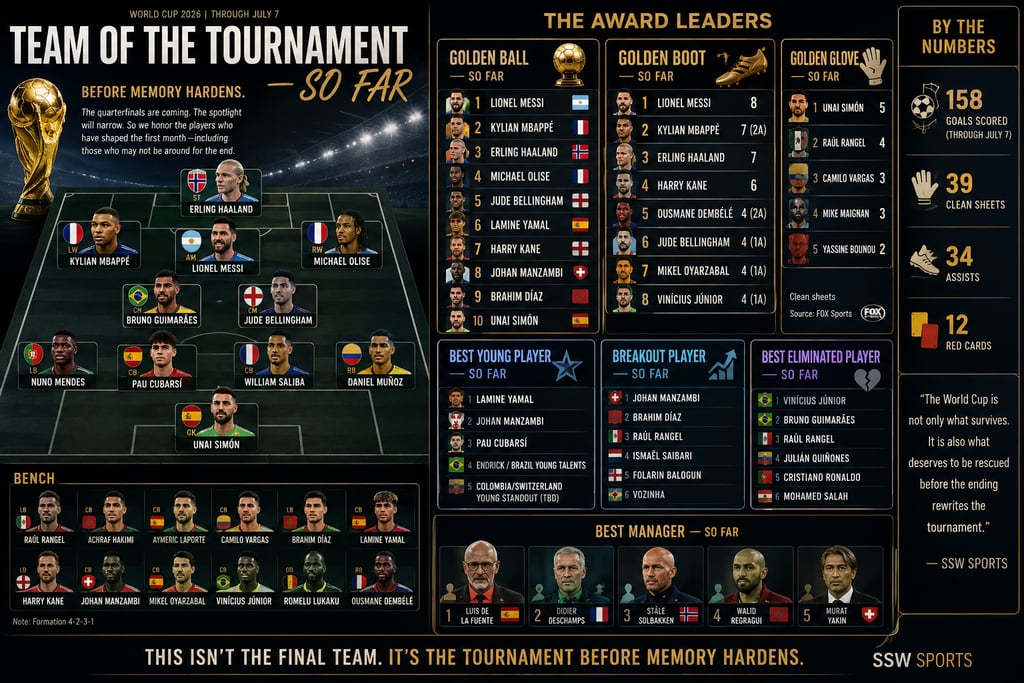
The World Cup has a memory problem.
Not because people forget the tournament. They remember it intensely. They remember the winner, the final, the penalty shootout, the late goal, the broken favorite, the tearful superstar, the breakout teenager, the goalkeeper who became briefly unbeatable, the manager who got everything right until he didn’t.
But they do not remember evenly.
By the time a World Cup reaches the quarterfinals, the tournament begins to shrink. The field narrows. The television windows grow larger. The stakes become cleaner. The players still alive receive more oxygen, more attention, more replay, more myth. The players who carried the first three weeks — the eliminated stars, the heroic keepers, the fullbacks who played four excellent matches and went home, the midfielders whose teams ran out of story before they ran out of quality — begin to fade.
That is why this list exists now.
It is not the final Team of the Tournament. It is not meant to predict the official awards. It is not a permanent judgment on a World Cup that still has its largest matches ahead.
It is a snapshot before memory hardens.
The timing matters. Argentina had just survived Egypt in one of the tournament’s great escapes, coming from 2-0 down with goals from Cristian Romero, Lionel Messi and Enzo Fernández to reach the quarterfinals. Reuters described Messi as the figure who “orchestrated” the late revival, scoring the equalizer and providing the cross for Romero’s first goal in the comeback. The final Round of 16 match, Switzerland against Colombia in Vancouver, had just kicked off, with Colombia bringing a loud traveling support and Switzerland missing breakout attacker Johan Manzambi, who had already produced three goals and two assists before a knee injury ruled him out.
That is the exact moment when a “so far” team makes the most sense.
Once the remaining eight teams kick off, the tournament changes shape. The World Cup becomes less about the field and more about the survivors. Spain, France, Argentina, England, Norway, Belgium, Morocco and the Switzerland-Colombia winner will own the next act. That is how tournaments work. The deeper a team goes, the more its players appear inevitable in retrospect.
But tournaments are not only made by the teams that last longest.
They are also made by the players who lifted a lesser team into relevance, gave an eliminated side four excellent performances, dragged a nation into a new memory, or forced the world to pay attention before disappearing from the bracket.
This is our attempt to hold that first tournament in place before the second one begins.
Why “So Far” Is the Honest Category
Every World Cup produces two versions of itself.
There is the tournament as it happens: wide, chaotic, generous, crowded with storylines. In that version, a goalkeeper from Mexico can matter as much as a forward from France. A Cape Verde veteran can become a tournament character. A Swiss attacker can look like one of the event’s breakout stars before injury interrupts the story. A Brazilian creator can finish among the assist leaders and still be gone by the quarterfinals.
Then there is the tournament as it is remembered: compressed, polished, shaped by the final rounds. That version belongs to the champions, the finalists, the Golden Ball winner, the decisive goalscorer, the manager with the medal, the goalkeeper who saved the penalty that everyone remembers.
Both versions are real.
But the second version often erases the first.
That is especially true in this expanded World Cup. The 2026 format brought 48 teams, 12 groups, a new Round of 32 and a larger knockout field, with the top two teams from each group joined by the eight best third-place finishers. FIFA’s own tournament rules made this the broadest World Cup field ever, increasing the number of teams and the number of early stories competing for attention. Reuters has already noted that the expanded format created more room for shocks, even if the structure still tends to favor the heavyweight nations built to survive the long march.
That creates a strange effect.
There are more stories than ever, but the final rounds may still reduce the tournament back to familiar power. The expanded World Cup gives more players a stage. The closing rounds decide which players history keeps.
A Team of the Tournament — So Far is a way of resisting that compression. It does not pretend that the quarterfinals, semifinals and final will not change the conversation. They will. They should. The highest-pressure matches deserve extra weight.
But before they arrive, there is value in asking a different question:
Who defined the World Cup before the World Cup became small again?
The Selection Principle
The guiding principle here is simple: performance first, survival second.
A player should not have to reach the quarterfinals to be recognized. That is the whole point. If the exercise becomes merely “best players from the teams still alive,” then it fails before it starts. A proper “so far” team should include players whose tournaments are already over if their work deserves to survive the elimination.
That is why Nuno Mendes belongs in the conversation even though Portugal are gone. It is why Bruno Guimarães belongs even though Brazil are gone. It is why Raúl Rangel and Vinícius Júnior deserve sidebars even though Mexico and Brazil will not own the final week. It is why Johan Manzambi matters even if Switzerland’s tournament moves on without him.
The team also cannot simply become a Golden Boot list.
Lionel Messi, Kylian Mbappé, Erling Haaland and Harry Kane have made this tournament feel like a summit meeting of superstar forwards. Messi’s late goal against Egypt moved him to the front of the race, while Mbappé, Haaland and Kane remain close enough that the scoring title is still alive. But an XI has to be a team, not only a leaderboard. It needs defenders, midfield balance, width, creation, goalkeeping and positional honesty.
That is why the 4-2-3-1 shape works. It lets the team acknowledge the tournament’s scoring explosion without pretending that clean sheets, ball progression, defensive control and chance creation are lesser forms of influence.
The goalkeeper is straightforward. Spain’s Unai Simón has become one of the defining defensive figures of the tournament. The Associated Press reported after Spain’s Round of 32 win over Austria that he had set a World Cup record with a 519-minute scoreless streak and that Spain had yet to allow a goal in the tournament at that point. Spain then beat Portugal 1-0 in the Round of 16, with Mikel Merino scoring in stoppage time and Lamine Yamal again central to the attacking story.
The attacking midfield and forward line are crowded, but the logic is clear. Messi remains the Golden Ball leader because he is not only producing goals; he is still shaping Argentina’s emotional and tactical existence. Mbappé is the obvious counterweight, the player most capable of making any “so far” judgment look outdated by the final. Haaland’s brace against Brazil is a tournament-defining act, with Al Jazeera reporting that his two late goals sent Norway into their first World Cup quarterfinal and eliminated the five-time champions. Olise earns his place not because France need another famous name, but because creation matters, and FIFA’s assist tracker has him at the top with five assists.
That is the balance: reward the stars, but not only the stars; honor the survivors, but not only the survivors; preserve the eliminated, but not sentimentally.
This is not nostalgia. It is accounting.
Sidebar: The Eliminated Player Problem
The hardest players to judge are often the ones whose teams have already gone home.
A player on an eliminated team has no future evidence left to offer. That can make his case feel smaller as the tournament continues. The quarterfinals add pressure. The semifinals add mythology. The final creates permanent memory. An eliminated player’s résumé stops moving while everyone else’s keeps growing.
But that is exactly why a mid-tournament recognition matters.
Vinícius Júnior’s tournament should not vanish because Brazil fell to Norway. Bruno Guimarães’ creative output should not disappear because the team around him failed to survive. Raúl Rangel’s clean sheets should not be downgraded simply because Mexico’s bracket ended. Cristiano Ronaldo’s performance should be judged separately from the symbolic weight of what may have been his final World Cup exit. Mohamed Salah’s Egypt should be remembered not only for losing to Argentina, but for being eleven minutes away from one of the great modern World Cup upsets.
This is the mercy and cruelty of knockout football.
One match can end a tournament. It should not erase it.
Sidebar: Spain’s Defensive Case
Spain’s tournament has produced a useful reminder: control is not only aesthetic.
Spain are easy to discuss through the ball. That is the national football vocabulary now: possession, rhythm, spacing, circulation, midfield authority, wide threat, technical superiority. But this tournament has also been built on denial. Spain’s defensive record has been so clean that it risks becoming boring, and boring defensive excellence is often underrated until the final whistle of the final.
Simón is the obvious symbol. Cubarsí is the arrival story. Laporte, Cucurella, Rodri and the collective structure matter too. Spain have not simply been a team that keeps the ball. They have been a team that reduces the opponent’s access to meaningful danger.
That is why Simón and Cubarsí both belong. The goalkeeper gets the statistical crown. The young center back gets the tournament-arrival profile. Together, they represent one of the strongest cases in the field: Spain have made the most volatile World Cup in history feel strangely controlled.
Sidebar: The Golden Ball Race Is Not Just the Golden Boot Race
The Golden Ball — So Far begins with Messi, but it should not be reduced to goals alone.
Goals matter enormously, and Messi’s production is central to the case. But his advantage comes from the nature of his influence. Argentina’s tournament still bends around him. Against Egypt, when the holders were approaching a stunning exit, the comeback ran through his cross, his equalizer and the emotional pressure he still places on a match.
Mbappé is the most dangerous challenger because his case can still expand. France remain alive, and his blend of production, fear and knockout inevitability gives him the highest ceiling. Haaland’s case is more concentrated but spectacular: seven goals and the brace that removed Brazil. Olise is the creator’s case. Bellingham is the midfielder’s case. Lamine Yamal is the influence-over-statistics case.
That is the right award conversation.
Golden Boot asks who scored most.
Golden Ball asks whose presence most shaped the tournament.
So far, those questions overlap.
They are not identical.
Sidebar: The Breakout Player Is a Different Award
The breakout player award should not simply go to the best young player or the highest scorer outside the usual superstar class. It should go to the player whose tournament changed the way the wider football public sees him.
That is why Johan Manzambi belongs at the top of the list. Three goals, two assists, a central role in Switzerland’s run, and then the brutal timing of a knee injury before the Colombia match: that is the shape of a World Cup breakout. The tournament introduced him, elevated him and then, at least temporarily, removed him from the stage.
Brahim Díaz is a different kind of breakout: less unknown, but newly central in a Morocco side that has again pushed deep into the tournament. ESPN’s Morocco-Canada report noted that Díaz set up the stoppage-time goal in Morocco’s 3-0 Round of 16 win, giving him a fourth assist and an African World Cup record. Raúl Rangel belongs because goalkeepers rarely get star treatment unless they produce undeniable results. Ismaël Saibari, Folarin Balogun and Vozinha belong because tournaments are built not only from champions, but from characters.
Breakout is not the same as best.
It is the award for arrival.
Sidebar: The Manager Race
The manager category has a danger: it can become too attached to expectation.
If Spain control matches, we say Spain are supposed to control matches. If France look structurally safe, we say France are supposed to look structurally safe. If Argentina survive chaos, we credit Messi before we credit the staff. If England win narrowly, we argue about the players. If Morocco or Norway win, we more readily see the manager.
The fairer approach is to ask what each manager has made possible.
Luis de la Fuente has Spain in the quarterfinals without conceding. Didier Deschamps has France in a familiar tournament posture: controlled, difficult to break, and terrifying in moments. Ståle Solbakken belongs near the top because Norway’s win over Brazil was not merely a Haaland story; it was a national breakthrough. Walid Regragui has Morocco back in another quarterfinal conversation, extending the country’s recent tournament identity. Murat Yakin’s case depends on Switzerland’s ability to survive Colombia without Manzambi.
The best manager award will probably belong to whoever reaches the final.
The “so far” version should leave room for the managers who changed what seemed possible before the final bracket settled.
What This Team Says About the Tournament
The team itself tells the story of the World Cup so far.
Spain have provided the defensive spine. France have provided elite balance and creation. Argentina have provided the central myth through Messi. Norway have provided the great shock through Haaland. England have provided the midfield scorer in Bellingham and the lurking finisher in Kane. Brazil and Portugal, despite elimination, still demand representation because talent does not become irrelevant when the bracket says goodbye.
That is the tournament’s first truth: the stars have been worthy of the stage.
Messi, Mbappé, Haaland and Kane are not merely famous names being forced into a list for attention. They have produced. They have scored. They have bent matches. They have given this expanded World Cup a rare top-heavy scoring race at the very moment the tournament’s broader format has tried to make room for more stories.
But the tournament’s second truth is just as important: the margins have mattered.
The best goalkeeper race includes Mexico and Colombia. The young player race includes Switzerland and Spain. The breakout list includes Morocco, Cape Verde and the United States. The eliminated-player sidebar has to include Brazil, Mexico, Portugal and Egypt. The story has not belonged only to the favorites, even if the favorites may still own the ending.
That is why this list should exist now.
The final rounds will tell us who endures.
This list is for who already mattered.
Closing Note: Before the Tournament Becomes Its Ending
There is nothing wrong with the final rounds taking over. That is the logic of a World Cup. The point of a tournament is to intensify until only one team remains. The last matches should matter most.
But the last matches are not the only matches.
A World Cup is also a month of accumulation: group-stage shocks, first-time memories, impossible saves, doomed brilliance, breakout players, upset bids, emotional exits, late goals, tactical surprises and performances that deserve more than a footnote. If we wait until the end to name the tournament, we risk naming only the ending.
So this is the team before memory hardens.
The players still alive may make new cases. The quarterfinals may reorder everything. The semifinals may turn one of these names into the tournament’s central figure. The final may make today’s ranking look temporary, because it is.
That is not a weakness.
That is the point.
This is the World Cup as it feels right now: wider than the bracket that remains, richer than the teams still alive, and filled with players whose tournaments deserve to be remembered before the final act teaches everyone what to forget.
Selected Sources
FIFA. World Cup 2026 knockout-stage qualification and Round of 32 format.
FIFA. World Cup 2026 top assisters tracker.
Reuters. Tearful Messi inspires Argentina to stunning comeback win over Egypt.
Reuters. De la Fuente sings Lamine’s praises as Spain reach World Cup quarter-finals.
Associated Press. Spain goalkeeper Unai Simón sets World Cup record with 519 straight scoreless minutes.
Al Jazeera. Haaland scores twice as Norway stun Brazil 2-1 in World Cup 2026 last 16.
The Guardian. Switzerland v Colombia: World Cup 2026 last 16 — live reporting and team news.
ESPN. Canada 0-3 Morocco match report.
Southland Storyworks
Narrative. Performance. Meaning.
Home-Sports
Inquiries
news@southlandstoryworks.com
Based in the American South
Submissions welcome via email
© 2026 Southland Storyworks-An independent publication exploring the psychological frameworks of competition.
Narrative architecture & performance psychology