
The System That Sells Opportunity
What America’s Youth Soccer Debate Gets Right — and What It Still Has to Prove
SPORTS
Steven Bradley
7/9/202616 min read
After the United States lost 4-1 to Belgium and exited another men’s World Cup in the Round of 16, the familiar American soccer autopsy began again.
Some of it was tactical. Some of it was emotional. Some of it was aimed at Mauricio Pochettino, some at the players, some at U.S. Soccer, some at Major League Soccer, some at the usual American discomfort with a sport the country can host, market, monetize and still not fully master.
Then Dan Wetzel, writing for ESPN, went at the foundation. The problem, he argued, was not that America’s best athletes play other sports. That explanation has always been too easy. The problem was deeper: a youth soccer system powered by expensive travel clubs, suburban access, parental money, customer satisfaction, early results and a culture that may produce technically competent players without producing enough of the competitive severity international soccer requires.
It was a strong column because it was angry in the right direction.
But anger is not a development model.
That matters because the youth soccer argument is too important to leave at the level of catharsis. It is easy to say the United States is too rich, too soft, too suburban, too comfortable or too commercial to become a serious men’s soccer nation. It is also too broad. Rich kids can learn soccer. Suburban kids can compete fiercely. Poor kids are not automatically creative. Expensive clubs are not automatically bad. European academies are not moral paradises. American players are not all coddled consumers drifting toward commercial shoots and comfortable exits.
The truth is more complicated and more useful.
Wetzel’s critique is strongest when it attacks the structure and weakest when it becomes a psychological diagnosis. The evidence does not prove that affluent players cannot become elite soccer players. It does not prove that a player from a pay-to-play background is necessarily less competitive than a player from a working-class or street-soccer environment. It does not prove that the United States lost to Belgium because its players grew up with orange slices, SUVs and showcase tournaments.
But the evidence does support a serious version of the critique.
America’s youth soccer economy almost certainly narrows the effective talent pool, raises the cost of being seen, filters opportunity through family resources, distorts talent identification, rewards early physical maturity, encourages clubs to chase customers as much as players, and too often confuses exposure with formation.
That is the real problem.
Not that rich kids cannot play soccer.
The problem is that America has built too much of its soccer pathway around the ability to purchase proximity to opportunity.
I. The Easy Excuse Is Dead
The old excuse has always been tempting.
America would be great at soccer, the argument goes, if its best athletes played it. If LeBron James, Tyreek Hill, Anthony Edwards, Mookie Betts, Patrick Mahomes, Ja Morant, Justin Jefferson and a few five-star defensive backs had spent their childhoods with a ball at their feet, the U.S. would eventually overwhelm the world.
There is a small truth in the argument. Athlete selection matters. Soccer in the United States competes with a crowded sports marketplace. American boys with speed, coordination, competitiveness and unusual physical gifts are often pulled toward football, basketball, baseball, track, lacrosse, wrestling or whatever sport their family, school and local culture make most available.
But as a primary explanation, the argument is lazy.
Belgium has roughly 12 million people. Norway has fewer than six million. Croatia, Uruguay, Portugal, Morocco, Switzerland and the Netherlands do not have access to an American-scale population. They do not have 350 million people from which to draw. They do not have America’s economy, facilities, college system, private training industry, suburban field space, or corporate sports infrastructure.
If the United States still cannot produce enough men’s players capable of consistently beating elite international teams, the problem cannot simply be a shortage of athletes.
It is more likely a shortage of formation.
That word matters. Formation is different from participation. It is different from exposure. It is different from athleticism. It is different from the family’s ability to pay for a tournament three states away. Formation is the long process by which a player’s technical skill, tactical perception, decision-making, competitiveness, creativity, resilience and game intelligence are built under pressure.
The United States has many players.
The question is whether it forms enough of the right ones.
II. The System That Sells Opportunity
Pay-to-play soccer is not one thing.
It includes recreational leagues, private clubs, travel teams, tournament circuits, elite leagues, showcases, ID camps, private trainers, recruiting services, video platforms, strength programs, futsal add-ons, goalkeeper training, college exposure events, uniforms, hotels, flights, gas, meals, and the less visible cost of parental time.
At the highest levels, it is not merely a participation system. It is a marketplace of ambition.
Families are not only buying coaching. They are buying proximity. Proximity to better teammates. Proximity to better opponents. Proximity to college coaches. Proximity to national leagues. Proximity to scouts. Proximity to the language of “elite.” Proximity to hope.
That does not make every club predatory. Many coaches care deeply. Many clubs are trying to solve hard logistical and financial problems. Many families willingly pay because their children love the sport, find community in it, and grow through it. Travel soccer can be meaningful, rewarding and developmentally useful.
But the market structure still matters.
A club that depends on family fees is not just a developmental institution. It is also a business. It must attract players, retain players, satisfy parents, fill rosters, market success, justify costs, and compete with rival clubs for customers. That does not mean it cannot develop players. It means development is forced to coexist with customer logic.
That is where the incentives become dangerous.
If parents are paying thousands of dollars, they expect access, communication, playing time, status, visibility and a sense of progress. If a player is unhappy, the family can leave. If the team is not winning, the club may lose prestige. If the club loses prestige, it may lose families. If it loses families, it loses revenue. In that environment, the coach is not only forming players. The coach is managing customers.
A youth system built around customers will always struggle to tell those customers the truth.
III. Access Is the Part We Can Prove
The strongest part of the pay-to-play critique is access.
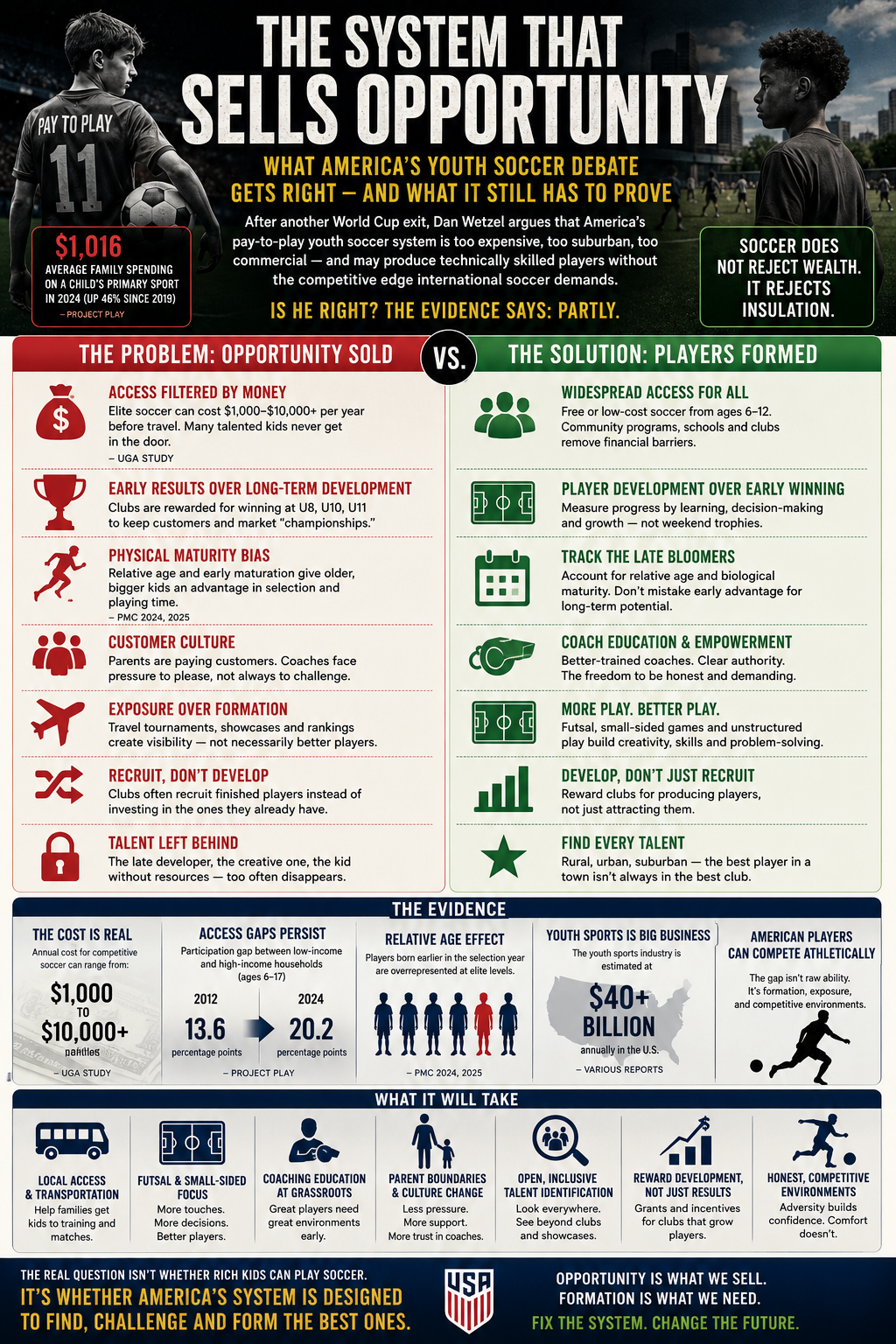
This is not speculative. The cost of youth sports has risen sharply, and the burden is not evenly distributed. The Aspen Institute’s Project Play reported that the average U.S. sports family spent $1,016 on a child’s primary sport in 2024, a 46% increase from 2019. When families estimated spending on the same child’s other sports teams, the total approached $1,500 annually.
Those are averages. Competitive soccer can cost far more.
University of Georgia research coverage noted that private club soccer can cost between $1,000 and $10,000 annually once league registration and fees are included. A Journal of Policy History article on Georgia youth soccer made the same point more specifically: for children to play at the highest levels, parents often pay the highest fees, with elite league participation costs ranging from $1,000 to $10,000 when registration, tournaments, uniforms, travel, equipment and related expenses are considered.
That is before accounting for everything the invoice does not fully capture: gas, hotels, meals, missed work, sibling logistics, parent time, private lessons, supplemental training, recruiting video, camps, tournament parking and the emotional cost of keeping a child inside a system that quietly tells families more is always required.
The broader youth sports participation gap also supports the concern. Project Play’s 2025 State of Play report found that significant access gaps remain by household income, and its participation trends section reported that the gap between children ages 6-17 from households under $25,000 and those from households earning $100,000 or more grew from 13.6 percentage points in 2012 to 20.2 percentage points by 2024.
That is not just a fairness problem.
It is a talent problem.
A serious soccer country cannot afford to make development depend too heavily on family purchasing power. The best player in a town is not always the child whose parents can pay for the best club. The most creative player may not be the one whose family can afford the showcase. The most competitive player may not have access to the league where scouts are watching. The late-developing player may never survive the financial ladder long enough to be discovered.
Pay-to-play does not merely decide who plays.
It helps decide who is seen.
IV. Development Is the Part We Can See
The second part of the critique is less directly measurable but still visible: pay-to-play changes developmental incentives.
In a healthy development system, the question is long-term: What kind of player can this child become? What does the player see? How does she solve pressure? Can he receive the ball under stress? Does she scan before receiving? Can he combine? Can she manipulate space? Does he understand when to dribble, pass, carry, press, recover, delay, foul, switch, turn, shoot or simply keep the ball moving?
In a customer-driven system, short-term signals can overwhelm those questions.
Does the team win?
Did the club beat the rival club?
Did the player make the top team?
Did the family get enough playing time?
Did the club qualify for the prestigious event?
Did the tournament produce social media photos?
Did the coach respond to the parent’s email?
Did the child remain on the “elite” path?
Those signals are not meaningless. Winning matters. Competition matters. Team placement matters. But they can become distortions when they dominate the developmental environment too early.
The risk is that clubs begin selecting for what helps win at U10, U11 and U12 rather than what predicts high-level soccer at 18, 21 or 25. The biggest child. The fastest child. The early-maturing child. The child who can physically dominate a youth game. The child whose current advantage is easiest to see.
Research on relative age and biological maturation effects supports this concern. Studies continue to show that talent identification in soccer can favor players who are relatively older within selection-year cutoffs or more biologically mature, particularly in elite youth environments. A 2024 study of U.S. youth female soccer found relative-age effects across parts of the talent identification process, while a 2025 study in football reported that relative age and maturation significantly affect talent identification and development, with academy systems often favoring relatively older and more mature players.
This is not uniquely American. It is a global soccer problem. But pay-to-play can make it harder to correct because losing the wrong player early is easier when the family is also a customer.
A late-developing player placed on the B team may not receive the same coaching, competition or attention. A smaller but more creative player may be treated as less valuable than a physically dominant peer. A family that can afford extra training may help its child survive the system. A family that cannot may disappear.
That is how a pathway loses players it never fully understood.
V. The Missing American Player
The missing American player is not necessarily LeBron James in cleats.
That fantasy misunderstands the sport.
Soccer does not simply reward vertical leap, sprint speed, size or strength. Those traits help, but the best players are not merely athletes who happen to kick a ball. They are problem-solvers inside a continuous, low-scoring, spatially complex game. They perceive early. They decide quickly. They disguise intention. They manipulate defenders. They understand pressure, timing, angle, tempo and collective movement.
The missing American player may be something more ordinary and more tragic.
He may be the late-developing 11-year-old whose family could not afford the better team.
She may be the technically gifted player stuck in a low-resource environment with no serious coaching.
He may be the small midfielder who saw the game beautifully but was passed over because he could not yet win footraces.
She may be the rural player who never lived close enough to the right league.
He may be the urban player whose family could not manage the transportation burden.
She may be the creative risk-taker corrected into safety because her coach needed weekend results.
He may be the player who needed futsal, street play and honest pressure but instead got adult-managed tournaments and sideline instruction.
That is the harder loss to measure.
A country knows when it loses a World Cup match.
It does not know when it loses a player at 12.
VI. The Grit Claim Is Real — But Slippery
Wetzel’s most provocative claim is not about access. It is about competitive character.
He argues, in effect, that the American system may not produce enough players who need to win, who can handle pressure, who have been hardened by real adversity, who will not wilt when the opponent is more serious, more ruthless and more comfortable in the game’s deepest competitive demands.
There is something to this.
Soccer does reject certain kinds of entitlement. It is not a sport that easily rewards the player who needs constant adult intervention. The game flows too continuously. The coach cannot script every possession. There are few timeouts. Scoring is scarce. A player can do many things well and receive no visible reward. A team can dominate and lose. A young player must learn to interpret ambiguity, endure frustration, solve problems with limited instruction and continue competing when the game refuses to provide validation.
In that sense, soccer is unusually hostile to entitlement.
But the claim needs care.
Soccer does not reject wealth. It rejects insulation.
A rich player who is challenged honestly, coached hard, held accountable, exposed to better opponents, forced to solve problems, allowed to fail, and required to compete without parental protection can become excellent. A less affluent player who is poorly coached, underchallenged, overpraised or placed in weak environments may never develop the necessary habits. Class matters because access matters, but class is not destiny.
The key variable is not whether a player’s parents have money.
The key variable is whether the player repeatedly experiences meaningful adversity, honest feedback and unscripted problem-solving.
That is why the “soft suburban kid” critique is too blunt. It may identify a cultural risk, but it can easily become caricature. The more precise question is whether the American youth soccer marketplace produces enough environments where players are not treated primarily as customers, brands, prospects, scholarship projects, roster assets or parental investments — but as players being formed by the game itself.
That is a different question.
And it is the better one.
VII. Soccer’s Uncomfortable Education
Soccer development requires both structure and freedom.
Players need coaching. They need feedback. They need technical repetition. They need tactical language. They need competitive matches. They need strength, speed, coordination, physical literacy and professional environments as they advance.
But they also need play.
Research on soccer development continues to emphasize the importance of deliberate play, deliberate practice, futsal and varied developmental activities in shaping decision-making and creativity. A 2026 review of developmental activities in soccer described sustained engagement in soccer-specific activities, including deliberate play and deliberate practice, as important to development. A 2023 study examining soccer and futsal experiences found positive relationships between developmental activity involvement and offensive decision-making quality during stages of formation.
Even U.S. Soccer’s grassroots coaching materials recognize this tension. Its Play-Practice-Play model describes deliberate play as a stage in which coaches create environments that guide players toward objectives while appreciating that learning does not always require direct instruction.
That matters because adult-controlled youth soccer can produce a false sense of development. A team can be organized, instructed, managed, transported and exposed without players becoming truly adaptive. The game can become something done around children more than something children learn to own.
Parents drive. Coaches instruct. Clubs schedule. Tournaments rank. Platforms record. Trainers correct. Adults interpret every outcome.
But soccer still requires the player to decide.
That is where unstructured and semi-structured play matters. Not because “street soccer” is magic, and not because formal coaching is bad. The point is that players need environments where they experiment, negotiate, fail, improvise, compete, self-regulate and solve the game without every action being immediately explained by an adult.
The more youth soccer becomes a purchased service, the harder it becomes to preserve that uncomfortable education.
VIII. MLS Has Improved the Top — But the Base Still Matters
It would be unfair to pretend American soccer has not changed.
MLS academies have professionalized parts of the pathway. MLS NEXT provides elite competition for players from U13 to U19 and describes its mission as offering high-level training, development, education and competition opportunities. MLS NEXT has also expanded access through initiatives such as a 2025-26 scholarship requirement, with each club required to provide at least one full-cost scholarship equivalent, and through development grants that compensate certain MLS NEXT Elite Academies for their role in player development.
Those are meaningful steps.
But they do not fully solve the foundational problem.
If the elite pathway begins seriously at U13, then much of the early developmental sorting has already happened. By the time the most professional environments enter a child’s life, the player may already have been filtered by geography, cost, coaching quality, club politics, transportation, parent knowledge and early physical maturity.
That is why the base matters.
The key ages are not only 15, 16 and 17. They are 6 through 12, when children fall in love with the ball, build coordination, develop comfort under pressure, play freely, experience failure, learn to compete and begin to see themselves as soccer players. If that foundation is uneven, expensive or overly adult-managed, the later academy layer inherits an already narrowed pool.
A professional top cannot fully compensate for a distorted base.
IX. What the System Gets Wrong
The current system fails in several specific ways.
First, it filters talent through money. That does not mean only wealthy children play. It means the most visible and prestigious routes often require financial and logistical resources that many families do not have.
Second, it confuses exposure with development. Showcases, tournaments and travel can be useful, but being seen is not the same as being formed. A player can spend years chasing visibility without receiving the right daily training environment.
Third, it rewards early physical advantage. Relative age and maturation effects are not unique to American soccer, but they are especially damaging when a player’s team placement influences coaching access, confidence, competition level and future opportunity.
Fourth, it incentivizes recruitment over development. If a club can improve its team by attracting already-formed players from elsewhere, it may have less reason to patiently develop the players it already has.
Fifth, it weakens coach authority. When parents are paying customers, hard truths become harder to deliver. A coach may still be demanding, but the system around him creates pressure to retain rather than confront.
Sixth, it overstructures childhood. Players need serious training, but they also need freedom, experimentation and ownership. A tournament-heavy calendar can crowd out the very play that builds creativity.
Seventh, it narrows the country’s soccer imagination. If the dominant image of serious youth soccer is the travel team, the showcase, the hotel weekend and the parent-managed pathway, then the sport becomes culturally associated with families who can afford to keep buying the next rung.
That is not how the world’s game becomes a country’s game.
X. What Would Actually Help
The solution is not simply to yell at travel soccer.
Some travel soccer is excellent. Some clubs do serious development work. Some paid environments are better than underfunded alternatives. Some families choose travel because the local recreational system cannot provide enough challenge. A serious critique has to admit that pay-to-play did not emerge from nowhere. It grew partly because American soccer lacked a universal, high-quality, community-based development structure.
The question is how to reduce the damage.
Several reforms would matter.
Build more free and low-cost access from ages 6 to 12. The early years should not depend so heavily on family money. Community programs, school partnerships, municipal fields, foundation support, club scholarships and professional-club outreach matter most before the elite pathway begins.
Invest in local play before national travel. Younger players need more high-quality local environments and fewer expensive long-distance status tournaments. Travel should serve development, not define it.
Expand futsal and small-sided play. The American player needs more touches, more pressure, more decisions, more tight spaces and more creative repetition. Futsal is not a cure-all, but it directly attacks many of the technical and perceptual deficits American development often produces.
Track late developers intentionally. Clubs and federations should account for relative age and biological maturation. The system should identify players who may be temporarily behind physically but ahead technically, tactically or competitively.
Reward clubs for developing players, not only recruiting them. Development grants, solidarity-style mechanisms and pathway payments can help align incentives so that the club that forms a player is not punished when a bigger club takes him.
Improve grassroots coach education. The country needs more adults who understand how to design learning environments, not merely organize teams. Good coaching at young ages should not be a luxury product.
Create stronger parent boundaries. Parents matter enormously. But a serious development culture cannot allow parental anxiety, fees or status obsession to control the player’s entire experience.
Support transportation and logistics. Access is not only registration cost. A family may need help getting a player to training, managing school demands, accessing equipment or staying in the pathway long enough for talent to emerge.
Tell the truth earlier. Not every child is on a professional path. Not every “elite” label means elite development. Not every tournament is necessary. Not every showcase is worth the cost. Families deserve honesty, not endless upselling.
These are not glamorous solutions. They are not as emotionally satisfying as saying American players are soft.
But they are more useful.
XI. The Real Verdict
So was Wetzel right?
Broadly, yes — but not completely.
He is right that the “best athletes play other sports” excuse is insufficient. He is right that pay-to-play is a major structural problem. He is right that the American youth soccer economy is too expensive, too commercial and too dependent on family resources. He is right that the system can reward early winning, parental satisfaction, club branding and purchased exposure more than patient formation. He is right that America should be deeply uncomfortable with a model that prices out too much of its own potential.
But the argument becomes weaker when it turns too easily into class psychology.
There is no serious evidence that soccer cannot be learned by affluent children. There is no clean proof that suburban players are inherently less competitive. There is no simple line from travel soccer to mental softness. The world has produced elite players from comfort and hardship, from academies and streets, from wealthy families and poor ones, from cities and suburbs, from formal coaching and informal play.
The issue is not whether rich kids can play.
The issue is whether a country can become great when too much of its development system depends on selling opportunity to the families most able to buy it.
That is the distinction.
Soccer does not reject wealth. It rejects insulation. It rejects players who have not learned to solve the game. It rejects systems that confuse early dominance with long-term potential. It rejects pathways that miss the late developer, the underfunded creator, the quiet competitor, the player who needs better coaching but cannot afford better access. It rejects countries that mistake participation volume for formation quality.
The United States has enough athletes.
It may not yet have enough pathways that find, challenge, retain and form the right ones.
Conclusion: Opportunity Is Not Formation
The United States did not lose to Belgium because youth soccer is expensive.
World Cup losses do not have single causes. They come from player decisions, coaching choices, opponent quality, tactical matchups, injuries, pressure, luck, preparation and the ruthless emotional weather of knockout soccer.
But the Belgium loss reopened the right question.
What kind of player does America’s soccer system produce?
What kind does it miss?
What kind does it reward too early?
What kind does it lose too quietly?
What kind does it protect from the very adversity the game will later demand?
Those questions matter more than the old fantasy about LeBron James at striker.
The missing American future is not waiting in the NBA. It may be scattered across underfunded neighborhoods, rural counties, crowded parks, B teams, rec leagues, futsal courts, families priced out of elite travel, and children who were never seen clearly because the system mistook affordability for commitment.
Wetzel’s anger is useful because it points at a real failure.
But anger is not enough.
American soccer does not need a better excuse. It needs a better formation culture. One that is less dependent on family wealth, less addicted to exposure, less impressed by early physical dominance, less afraid of honest coaching, less structured around parental purchasing power and more serious about the long, uncomfortable work of developing players who can solve the game when the adults cannot help them.
The problem is not that America lacks children who can play soccer.
The problem is that too many of them must first buy their way to being found.
Selected References
Aspen Institute Project Play. (2025). Project Play survey: Family spending on youth sports rises 46% over five years.
Aspen Institute Project Play. (2025). State of Play 2025: Participation trends.
Finnegan, L., et al. (2024). Relative age effect across the talent identification process of youth female soccer players in the United States.
Machado, G., et al. (2023). The relationship between deliberate practice, play, and decision-making skills in soccer and futsal.
Machado, G., et al. (2026). Effects of developmental activities and interventions on soccer development.
MLS NEXT. (2025). MLS NEXT announces transformative sporting initiatives for the 2025-26 season.
MLS NEXT. (2026). MLS NEXT rules and regulations.
Suggs, D. W., Jr., et al. (2026). Congestion on the Pitch: Growth and Conflict in Georgia Youth Soccer.
University of Georgia. (2026). Pay-to-play system prices out young soccer talent.
U.S. Soccer. (2021). Grassroots Coach Education: Play-Practice-Play model.
Wetzel, D. (2026). World Cup losses will continue until America fixes its youth soccer system.
Southland Storyworks
Narrative. Performance. Meaning.
Home-Sports
Inquiries
news@southlandstoryworks.com
Based in the American South
Submissions welcome via email
© 2026 Southland Storyworks-An independent publication exploring the psychological frameworks of competition.
Narrative architecture & performance psychology