
The Price of More
Expansion, Access, and Who Gets to Belong at the World Cup
SPORTS
Steven Bradley
7/7/202614 min read
Will Vickers wanted to follow the World Cup.
Not in theory. Not as a casual viewer drifting in and out of highlights. He wanted the thing itself: the shared ritual, the public viewing, the national colors, the noise before kickoff, the strangers briefly turned into countrymen by ninety minutes of possibility. For a certain kind of supporter, the World Cup is not merely watched; it is lived. It is entered.
But the 2026 World Cup was being played across the United States, Canada, and Mexico, and entry had become something more complicated than devotion.
The flights were expensive. The tickets were expensive. The hotels were expensive. The tournament spanned a continent rather than a single country. A supporter could follow a team emotionally from anywhere, but to follow one physically required money, documents, planning, patience, and geographic endurance. The world’s game had widened its field, but the doorway into the event had narrowed in other ways.
So Vickers created a different World Cup. According to Reuters, he traveled through seven European countries in seven days, watching matches not from the stadiums of North America but with local fans across the continent. It was an improvised pilgrimage built around absence. He could not afford the tournament as FIFA had staged it, so he found the tournament where football has always lived: in bars, squares, neighborhoods, and borrowed communities of attention.
There is something almost too clean in that image. One fan priced out of the official spectacle goes searching for the people’s game outside the gates of the people’s game.
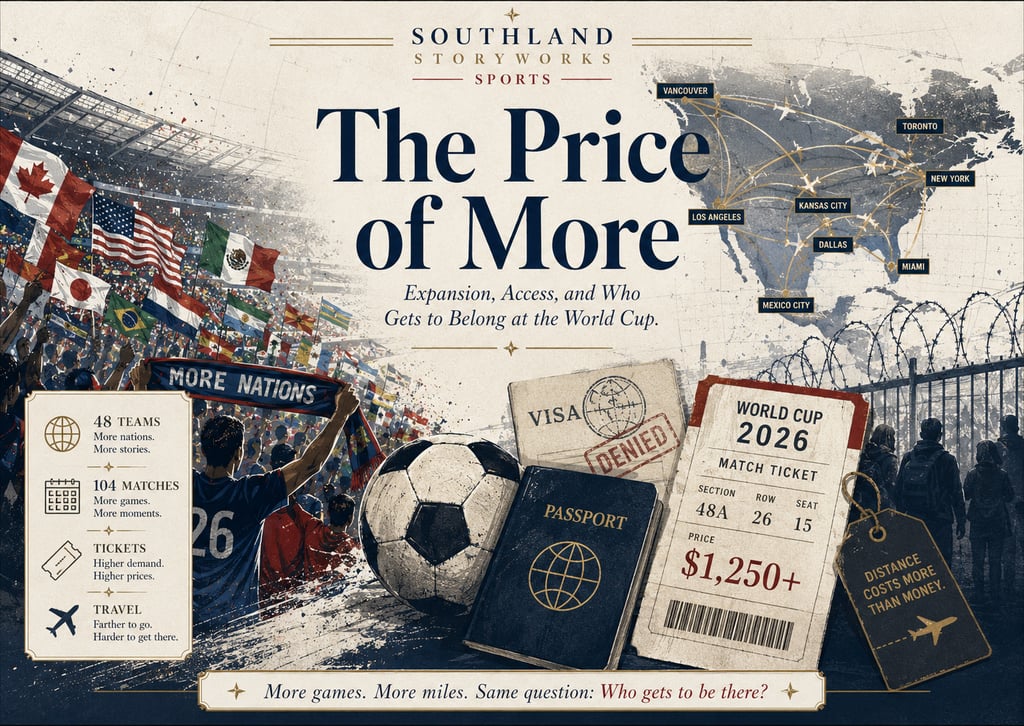
At the same time, the World Cup itself had never been larger. The 2026 tournament expanded to 48 teams and 104 matches, adding a new Round of 32 and opening the field to countries that had never before stood on football’s biggest stage. For Cabo Verde, Curaçao, Jordan, and Uzbekistan, expansion was not a bureaucratic adjustment or a television inventory strategy. It was history. It was national memory being made in real time. It was proof that the World Cup’s old center could still be widened.
That is the contradiction at the heart of the modern tournament.
The World Cup has become more inclusive on the field and more difficult to access around it. More nations can enter the competition, but fewer ordinary supporters may be able to enter the experience. FIFA has enlarged the idea of belonging, while the market has raised the price of participation.
This is not simple hypocrisy. It is more interesting than that.
The expanded World Cup really does matter. It gives smaller football nations a path into visibility, pride, and collective memory. It allows players from the margins of the global game to become part of the tournament’s central story. It creates first appearances, new flags, new anthems, and new rituals of belief. A country does not need to win the World Cup for its presence there to matter.
But the same tournament also reveals the modern cost of belonging. Tickets become assets. Flights become barriers. Hotels become speculation. Visas are added to the fixture list. Borders, passports, income, and geography quietly shape who gets to participate in the World Cup as a lived event rather than a broadcast product.
The old saying still holds that football is the people’s game.
The expanded World Cup asks a harder question:
Which people can still afford to be there?
I. The Promise of More
FIFA did not expand the World Cup by accident. It expanded it as a statement.
The tournament had long been soccer’s most powerful global ritual, but it still carried the shape of an older hierarchy. Thirty-two teams meant scarcity. Scarcity meant heartbreak. Whole regions could experience qualification as a narrow gate controlled by confederation strength, economic power, travel burdens, and the inherited advantages of countries with deeper football infrastructure.
A larger tournament promised to change the emotional map.
Forty-eight teams meant more national dreams reaching the main stage. It meant more flags in the opening weeks, more players hearing their anthems before the whole world, more children in smaller football nations seeing their country not as a qualifying story but as a World Cup participant. It meant the tournament could more plausibly call itself global in practice, not only in branding.
The argument has force.
For supporters of Cabo Verde, Curaçao, Jordan, and Uzbekistan, a World Cup debut is not an abstract formatting decision. It is a collective memory that will survive the standings. Families remember where they watched the first match. Children remember the first shirt. Commentators remember the first anthem. Players become reference points. A country’s football imagination changes.
That is the most generous and important defense of expansion. The World Cup should not exist merely to protect the traditional powers from inconvenience. If football is truly global, the tournament should sometimes feel unfamiliar to the countries that have historically assumed it belongs to them.
A World Cup that always returns the same nations, the same myths, and the same commercial center cannot fully justify its own name.
In that sense, “more” is not automatically cynical. More can mean recognition. More can mean discovery. More can mean a nation seeing itself for the first time in the game’s central ceremony. More can mean the story is not finished being written by Europe and South America.
But every expansion also asks a second question.
More of what, and for whom?
II. Inclusion on the Field
The clearest moral achievement of the 48-team World Cup is its representational value.
The old 32-team format produced great tournaments, but it also created a familiar pattern of exclusion. Strong football nations missed out, developing football nations stayed peripheral, and entire regions could feel that the World Cup was global in television reach but narrower in competitive access. Expansion cannot solve every inequity in global soccer, but it can alter the field of imagination.
That matters because national-team football operates differently from club football.
Club football is increasingly transnational. A player may be born in one country, developed in another, contracted in a third, and watched by fans everywhere. The Champions League produces elite football, but it does not produce the same kind of national recognition. The World Cup lets a player stand inside a story that belongs to grandparents, schoolchildren, local pitches, diaspora communities, and people who may never watch his club.
For a debut nation, its presence itself can become proof.
Cabo Verde’s appearance tells a different story from Brazil’s. Curaçao’s appearance tells a different story from Germany’s. Jordan and Uzbekistan's arrival at the tournament does not merely add four more teams to the schedule. They add four different histories of migration, development, regional ambition, and footballing self-definition.
This is the romantic case for expansion, and it should not be dismissed by those who worry about dilution. The World Cup has always depended on more than elite quality. It depends on whether football can still surprise its own center. It depends on the idea that a country can become visible through the game, that a goalkeeper can become a national figure, that a first goal can become a generational memory, and that a tournament can briefly rearrange how a people see themselves.
The expanded format gives more nations access to that possibility.
But representation at the team level does not automatically create access at the individual level.
That is the first crack in the promise.
III. The Bracket as a Moral Machine
Tournament formats are often treated as administrative details. They are not.
A format is a moral machine. It decides what kinds of effort are rewarded, what kinds of risk are punished, which teams have clarity, which teams wait in uncertainty, and how randomness is distributed across the field. The structure of a tournament does not merely organize competition. It shapes the meaning of achievement.
The 2026 World Cup’s 48-team structure contains a new Round of 32. The top two teams from each of the 12 groups advance, along with the eight best third-place teams. On one level, that is simple enough: more teams enter, more teams survive, and the knockout stage becomes larger.
But the details are more complicated.
Research on the 48-team design has already raised concerns about competitive fairness and bracket complexity. One recent paper argued that selecting eight best third-place teams from 12 groups creates a “global coupling” problem, with many possible bracket configurations, unequal selection dynamics, and less predictable paths for group winners. The criticism is not that expansion is immoral. It is that expansion creates new structural problems that must be solved rather than assumed away.
This matters because fairness in soccer is never pure. The sport is already filled with unequal group draws, uneven rest, travel differences, climate variation, injuries, officiating judgments, and the randomness of small samples. The World Cup has never been a laboratory of perfect justice. But format design can make the unfairness more legible or more opaque.
A traditional 32-team format had a certain clarity. Finish first or second in the group and advance. Win the knockout match and continue. The 48-team format preserves some of that clarity while adding a layer of comparative uncertainty. A third-place team’s fate may depend not only on its own group but on what happens elsewhere. A group winner’s path may not be as straightforward as competitive reward would suggest.
This does not make the tournament meaningless. It makes the tournament more modern.
The expanded World Cup is larger, richer, more inclusive, more complex, and more difficult to explain. That is not only a sporting condition. It reflects the institution that created it.
FIFA has enlarged the field. Now the tournament must carry the consequences of its own size.
IV. The Price of Attendance
If expansion opens the field to more nations, the lived experience of attendance reveals another kind of narrowing.
Reuters reported before the tournament that high costs, visa hurdles, and logistics across 16 host cities in three countries were discouraging some overseas fans and softening demand for hotels and airlines. That detail is important because it complicates the assumption that World Cup demand is limitless. The tournament remains enormous, but the traditional model — thousands of international supporters crossing borders, following teams, spending heavily, and filling host cities — becomes harder when the cost of doing so rises beyond the reach of ordinary fans.
A World Cup spread across North America is logistically different from one contained within a smaller geographic footprint. The distances are immense. A supporter following a team may have to move not from one city to another within a compact national rail system, but from one region of a continent to another. Flights replace trains. Hotels multiply. Domestic transportation is included in the cost. Weather delays, airport systems, border questions, and unfamiliar local pricing all become part of the tournament.
The phrase “host city” can make this sound elegant. In practice, host cities are separated by money and time.
The problem is not only that tickets are expensive. It is that tickets are only the first purchase. A match ticket without affordable transport, lodging, food, and legal entry is not full access. It is partial permission. It lets the supporter imagine attendance before the rest of the market explains the true price.
That is how the people’s game becomes a premium itinerary.
This does not mean stadiums are empty or the tournament has failed. Many matches remain powerful civic events. Fan zones, watch parties, diaspora communities, and local gatherings produce genuine atmosphere. Some supporters will pay because the World Cup is worth the sacrifice. Others will stretch finances because the event feels once-in-a-lifetime.
But the economic meaning of attendance changes when the sacrifice becomes too large.
At some point, the World Cup stops being a public festival that ordinary supporters can enter and becomes an event many people can only orbit.
V. Visas, Borders, and the Unequal Freedom to Move
The World Cup likes to speak in the language of unity. Borders blur. Fans gather. Flags mix. The world comes together.
But the modern World Cup also depends on borders.
To attend the 2026 tournament in the United States, many international fans need visas. That requirement turns bureaucracy into part of the fan journey. The U.S. Department of State created the FIFA Priority Appointment Scheduling System, known as FIFA PASS, for eligible ticket holders who bought directly through FIFA and opted in. The system was designed to help ticket holders access visa appointments more efficiently.
Even that support system reveals the deeper issue.
A World Cup ticket does not erase the state. It does not equal entry. It does not make all supporters equally mobile. It simply places the supporter inside another process: forms, interviews, appointment availability, documentation, uncertainty, and the possibility of denial.
That makes the World Cup a strange lesson in global inequality.
Some fans can move almost freely. Their passports open borders. Their income absorbs price shocks. Their employers allow time away. Their location makes travel feasible. For others, attendance requires a sequence of permissions and purchases that can collapse at any point. The same tournament that invites the world also sorts the world by passport, income, geography, and administrative capacity.
This is not only an American issue. Every World Cup involves borders, visas, policing, and unequal mobility. But the 2026 tournament’s scale and geography make the problem especially visible. A supporter may be emotionally close to the World Cup and legally or financially far from it.
The contradiction is simple but severe:
The tournament says the world belongs here.
The border asks for paperwork.
VI. The Hospitality World Cup
Every major sporting event has tiers. There have always been ordinary seats and privileged seats, public gates and private entrances, supporters in the stands and powerful people behind glass. The World Cup has never been economically innocent.
But the modern tournament has refined stratification into an experience design.
FIFA’s official hospitality program markets ticket-inclusive packages with premium seating, food and beverage, entertainment, lounges, and private suites. The language is not accidental. It does not simply sell a match. It sells elevation. It offers the World Cup as comfort, access, exclusivity, and insulation from inconvenience.
There is nothing inherently wrong with hospitality. Premium buyers help fund major events. Corporate guests, wealthy fans, and luxury travelers are part of the modern sports economy. A stadium can hold many kinds of spectators at once.
But hospitality changes the symbolic texture of the people’s game.
In one part of the city, a supporter calculates whether a ticket and hotel are possible. In another, a premium guest buys a package designed to remove friction from the day. One fan worries about visa timing, public transportation, and resale prices. Another enters through a controlled experience where food, view, comfort, and status have already been bundled.
Both are watching the same match. They are not attending the same World Cup.
That is the deeper issue. The modern tournament does not merely include inequality around its edges. It builds inequality into the architecture of the experience. The ordinary fan enters through uncertainty. The premium fan enters through design.
Football may still be the people’s game on the field, but around it, it increasingly resembles the world it once allowed people to escape.
VII. The Broadcast as Democratic Substitute
There is one obvious answer to the access problem: most fans have never attended the World Cup in person.
This is true. The World Cup has always been a broadcast event for the vast majority of its audience. Families gather around televisions. Workers stream matches on phones. Bars fill. Public squares become temporary stadiums. The tournament’s emotional force has never depended entirely on physical attendance.
In that sense, the broadcast does democratize belonging. A child in Amman, Praia, Willemstad, or Tashkent can watch his country play in a World Cup without crossing an ocean. A supporter priced out of the stadium can still join the national experience through a screen. Diaspora communities can create their own sites of belonging far from the host cities.
Will Vickers’ improvised European viewing tour shows the power of that alternative. He was not inside the official tournament, but he was inside football. He found communion not by entering FIFA’s most expensive spaces, but by moving through the game’s ordinary ones. The screen did not replace the stadium entirely, but it preserved something important: the shared attention that makes football social.
That is why the World Cup remains resilient. It can be over-commercialized and still emotionally real. It can be expensive and still communal. It can be inaccessible in one form and deeply accessible in another.
But broadcast belonging is not the same as event belonging.
A screen can carry the match. It cannot fully recreate the pilgrimage, the anthem inside the stadium, the feeling of being among thousands who have traveled for the same impossible hope. When the official event becomes too expensive for ordinary supporters, something is lost even if the match remains widely watched.
The people’s game survives outside the gates.
That does not absolve the gates.
VIII. The Moral Problem of Scale
The expanded World Cup is not one thing.
It is, simultaneously, a genuine act of inclusion, a commercial expansion, a logistical challenge, a sporting experiment, a broadcast product, a hospitality platform, a visa problem, and a global ritual. Its contradictions are not accidental. They are the result of trying to make one event carry too many meanings at once.
FIFA wants the World Cup to be universal and premium, democratic and exclusive, global and controlled, expansive and profitable, emotionally public and commercially managed. The tournament is expected to represent the world while also serving sponsors, broadcasters, host cities, security systems, tourism industries, hospitality partners, and national governments.
That is why “more” is such a revealing word.
More teams.
More matches.
More markets.
More inventory.
More first-time participants.
More travel.
More tickets.
More hospitality.
More complexity.
More revenue.
More stories.
More strain.
The word contains the promise and the problem.
A smaller tournament can exclude too many nations. A larger tournament can include more nations while excluding more people from the lived event. A compact tournament can be easier to attend but less representative. A continental tournament can feel grand and global while becoming financially and logistically punishing.
There is no perfect solution. But there is a necessary honesty.
Expansion should not be judged only by how many teams enter the bracket. It should also be judged by how many people can reasonably enter the experience. If the World Cup grows upward into spectacle and outward into new markets while ordinary supporters are pushed farther away, then the tournament’s inclusive language becomes incomplete.
The world’s game should not require the world’s wealth to attend.
IX. What Belonging Really Means
Belonging at the World Cup operates on several levels.
A nation belongs when it qualifies. A player belongs when he stands on the field. A supporter belongs when she can follow, gather, sing, travel, watch, and feel part of something larger than herself. A host city belongs when the tournament enters its streets rather than only its luxury boxes. A diaspora belongs when its flag appears in a public square thousands of miles from home.
The 2026 World Cup expanded one form of belonging dramatically. It gave more national teams access to the central stage. That matters profoundly. It should be celebrated.
But the tournament also exposed the fragility of other forms of belonging. A supporter may belong emotionally but not financially. A fan may belong culturally but not bureaucratically. A country may belong competitively, while its people cannot afford to follow. A city may host the World Cup while many of its residents experience it mainly as traffic, security, and higher prices.
This is the central paradox:
The expanded World Cup has made belonging more possible for nations, but less affordable for many people.
That sentence should trouble anyone who cares about football beyond content.
The sport’s deepest power has always been its ability to make people feel included in something beyond private life. Football can turn a street into a congregation, a bar into a chapel, a national team into a temporary language, a goal into a shared memory. The World Cup is the highest expression of that power.
But when the event becomes harder to attend, harder to afford, harder to move through, and harder to access across borders, the ritual begins to separate from the people who give it meaning.
Conclusion: More Is Not the Same as Open
The 2026 World Cup is bigger than any before it.
That fact is not trivial. More nations have entered the story. More players have touched the stage. More supporters have seen their flags in places they had never appeared. For debut countries, expansion has already produced something beyond money or format. It has produced memory.
But more is not the same as open.
A tournament can expand while access contracts. It can welcome more teams while pricing out more supporters. It can speak the language of global belonging while forcing fans through the filters of income, geography, passports, hotel markets, resale platforms, and visa appointments. It can be the people’s game on the field and a premium experience around it.
Will Vickers’ seven-country viewing journey captures the contradiction better than any policy statement. He did not reject the World Cup. He chased it. He found it in the places where football still belongs most naturally: among people, in shared rooms, in improvised communities of attention. His workaround was not a failure of fandom. It was a quiet indictment of the official version.
The World Cup has always been larger than its stadiums.
That is why the price of entering those stadiums matters.
If FIFA wants to build the World Cup of more, it must eventually answer the question more honestly. More teams are not enough. More matches are not enough. More markets are not enough. More hospitality is not enough.
The tournament’s future should not be measured only by how large it becomes.
It should be measured by who can still find a way in.
Selected References
Csató, L., Becker, M., Devriesere, K., & Goossens, D. (2026). On the non-uniformity of the 2026 FIFA World Cup draw.
FIFA. (2025). FIFA World Cup 2026 ticket holders prioritised for visa appointments in the United States.
FIFA. (2026). FIFA World Cup 2026 match schedule, fixtures, results and teams.
FIFA. (2026). Host countries and cities: FIFA World Cup 2026.
FIFA. (2026). Official Hospitality: FIFA World Cup 2026.
Qi, C. (2026). A Four-Section Bracket for the 48-team World Cup.
Reuters. (2026, June 11). Pricey World Cup keeps fans away, hits U.S. hotels, airlines.
Reuters. (2026, June 26). World Cup tickets were too expensive. He’s traveling to seven countries instead.
Reuters. (2026, June 27). At the most expensive World Cup, wealthier fans find ways to pay.
U.S. Department of State. (2026). FIFA World Cup 2026 visas.
Southland Storyworks
Narrative. Performance. Meaning.
Home-Sports
Inquiries
news@southlandstoryworks.com
Based in the American South
Submissions welcome via email
© 2026 Southland Storyworks-An independent publication exploring the psychological frameworks of competition.
Narrative architecture & performance psychology