
The Opportunity Cost of Opportunity: Youth Sports, Travel Ball, and the Developmental Promise We Keep Chasing
A researched essay on the modern youth-sports opportunity economy and the tension between access, exposure, travel, cost, and actual development. This piece examines how families, athletes, and coaches can better evaluate whether competitive opportunities are producing meaningful growth — or merely adding expense, pressure, and activity without enough developmental return.
Steven Bradley
7/5/202614 min read
Introduction: When Opportunity Becomes a System
The promise is almost always opportunity.
A stronger team. A better league. A more visible tournament. A showcase with the right coaches in attendance. A club environment that claims to offer a clearer pathway. A weekend where a young athlete might be seen, challenged, evaluated, or moved closer to some imagined next level.
For families inside modern youth sports, opportunity has become both aspiration and anxiety. Parents may not believe every claim made by every club, academy, tournament organizer, ranking service, recruiting platform, or showcase operator. But they understand the fear beneath the sales pitch: if their child is not there, someone else’s child will be.
That fear has reshaped youth sports.
In club soccer, families may drive for hours to matches that yield few touches and uncertain feedback. In AAU basketball, a weekend can become a rotation of gyms, hotels, schedules, scouting sheets, and condensed performances. In travel baseball and softball, entire weekends may be organized around a handful of at-bats, innings, or defensive chances. In volleyball, lacrosse, hockey, tennis, and golf, families often treat development as a logistical enterprise. The child becomes an athlete, the parent becomes a scheduler, the family becomes a travel unit, and the sport becomes not merely something played but something managed.
This is not an argument that travel sports are inherently harmful. Some travel programs provide excellent coaching, stronger competition, meaningful friendships, and developmental environments that local recreational systems cannot always offer. For some athletes, especially those in weak local ecosystems or with serious long-term ambitions, traveling to compete may be appropriate and valuable.
The concern is more specific: when the appearance of opportunity — mileage, tournaments, uniforms, rankings, showcases, hotel stays, fees, and “elite” branding — begins to stand in for the slower developmental work of practice, feedback, rest, autonomy, physical literacy, and age-appropriate challenge.
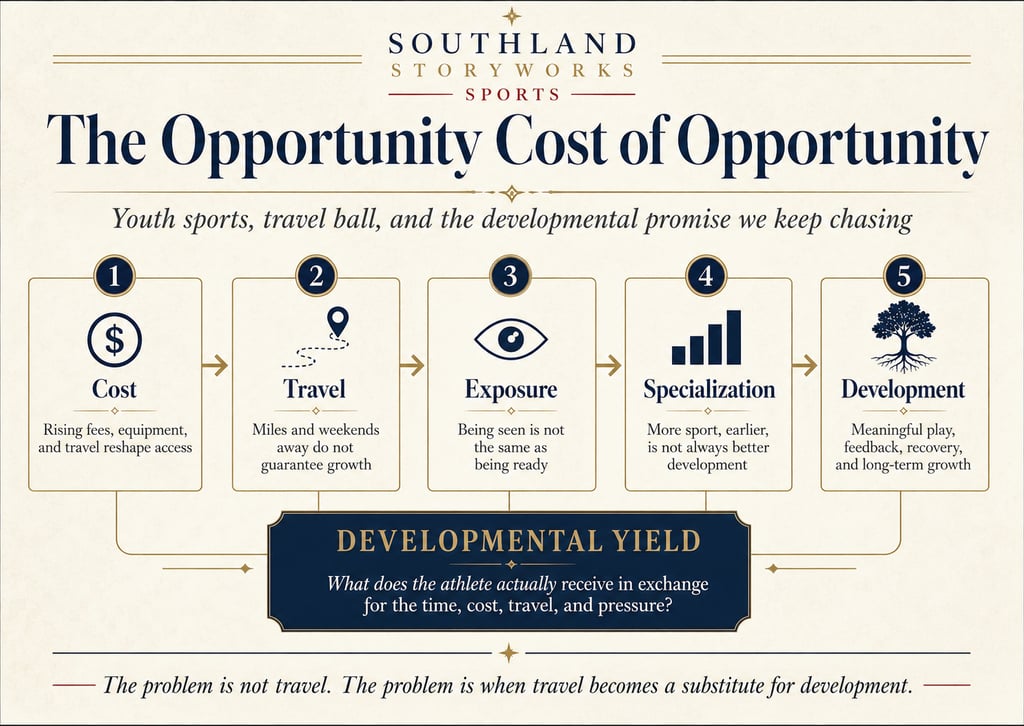
The problem is not travel itself. The problem is when travel becomes a substitute for development.
That distinction matters because modern youth sports often treat the two as if they are the same. More tournaments are assumed to mean more progress. More miles are treated as proof of commitment. More expense is interpreted as an investment. More exposure is sold as opportunity. But development is not measured by the distance a family drives, the number of hotel rooms booked, or the logo on the uniform. Development is measured by what the athlete actually receives in exchange for the time, cost, fatigue, emotional pressure, and alternatives given up.
That is the missing question in much of the youth-sports economy:
What is the developmental yield?
I. The New Economics of Youth Sports
The Aspen Institute’s Project Play has become one of the most useful public sources for understanding youth sports because it treats participation not simply as a matter of motivation, but as a system shaped by access, cost, policy, culture, coaching, and family capacity. In 2025, Project Play reported that the average U.S. sports family spent $1,016 on a child’s primary sport in 2024, a 46 percent increase from 2019. Project Play’s broader State of Play reporting has also emphasized that costs continue to rise while access gaps remain significant across family-income levels.
Those figures matter because they quantify what many families already experience. Youth sports are not merely becoming more competitive. They are becoming more expensive, more privatized, and more stratified.
The language of youth sports still leans heavily on character. Sports are said to teach discipline, teamwork, resilience, confidence, humility, accountability, and perseverance. Much of that remains true. At their best, sports provide one of the most powerful developmental environments available to young people. They place effort, failure, cooperation, competition, and emotion into a visible public setting. They teach children how to respond when something matters.
But access to those benefits is increasingly mediated through family resources.
A child with access to club fees, private coaching, reliable transportation, flexible parental work schedules, tournament travel, camps, equipment, and recruiting support is not simply “more committed” than a child without those advantages. That child is operating inside a different opportunity structure. When youth sports are described as a pure meritocracy, the price of entry is often left outside the frame.
This is where the opportunity economy becomes morally complicated. Parents are not wrong to want more for their children. Coaches are not wrong to create serious development environments. Clubs are not wrong to organize competitive pathways. But when improvement becomes increasingly pay-to-play, opportunity begins to reflect family capacity as much as athletic readiness.
The result is a quiet inversion of the older youth-sports ideal. Rather than sport fitting within childhood, childhood is often reorganized around sport.
II. Travel, Time, and the Hidden Burden of Participation
Money is only one cost. Time is another, and it is often measured less honestly.
A tournament weekend may appear on a schedule as three or four games. In lived experience, it may include packing, driving, hotel check-in, late meals, early warmups, long gaps between games, emotional waiting, disrupted sleep, rushed schoolwork, and a return trip that leaves the athlete exhausted before the next week begins.
A 2021 analysis based on GameChanger data offered one concrete picture of this hidden burden. The data, drawn mainly from club baseball and softball teams, found that the average team traveled roughly 1,200 miles per year for games and tournaments. Teams in Colorado averaged more than twice that distance. The figure is not a universal measure across all youth sports, but it gives statistical form to something many families already understand: youth sports are no longer only played; they are transported.
The developmental question is not simply how far families travel. It is what the child receives after arriving.
A soccer player may spend much of a weekend on the road for limited minutes and few meaningful touches. A basketball player may play several games but receive little individualized feedback. A baseball player may wait through long tournament gaps for three plate appearances. A goalkeeper may travel to a high-level event and face only a handful of consequential actions. A young substitute may be part of a prestigious environment while receiving fewer developmental repetitions than they would receive locally.
None of those examples proves that travel competition is without value. Athletes can learn from travel, independence, team life, pressure, stronger opponents, and unfamiliar environments. Exposure to higher standards can be formative. But those benefits should be named honestly rather than assumed automatically.
A more serious youth-development culture would ask what the athlete actually gained. Did the event provide meaningful playing time, useful feedback, appropriate challenge, emotional learning, tactical growth, or a clearer practice priority? Did the athlete leave with more than fatigue and a result? Did the experience develop the child, or did it merely place the child inside a system that looked developmental from the outside?
These questions do not reject opportunity. They discipline it.
III. Two Developmental Stories: Tiger and Federer
David Epstein opens Range by contrasting two famous stories of athletic development: those of Tiger Woods and Roger Federer. Woods represents the story almost everyone knows. He appeared on national television as a toddler, was attached to golf unusually early, and became the most famous example of prodigious specialization in modern sport. Federer’s path was different. Epstein presents him as a child who sampled widely, playing multiple sports before eventually narrowing toward tennis.
The contrast is useful not because one story cancels the other. Tiger Woods happened. His story is real, extraordinary, and central to modern golf. But that is exactly the problem with using him as a developmental model. The exceptional case is easily mistaken for the general rule.
Federer’s story complicates the anxiety that early narrowing is the only serious path. The sampling model does not argue that future elite performers avoid hard work. Federer became one of the greatest tennis players in history because he eventually trained with seriousness and depth. But his childhood did not require immediate athletic foreclosure. He was allowed to explore, move, play, and develop broadly before the sport became a singular professional project.
Jean Côté’s developmental model of sport participation provides a research framework for this contrast. In Côté’s framework, the sampling years allow children to develop broad movement skills, experience deliberate play, and build motivation before specializing more deeply. The model does not deny that specialization eventually matters in many sports. It questions whether early specialization is always the best route to long-term participation or elite performance.
This is the kind of nuance modern youth sports often loses. Families are not usually choosing between unserious play and professional discipline. They are choosing between developmental timelines. The Tiger story tells families that the future belongs to the child who starts earliest and narrows fastest. The Federer story, and much of the developmental literature, suggests a more complicated possibility: broad early experience can become part of later excellence.
In a youth-sports economy built on urgency, that is a radical idea.
IV. Developmental Yield as a Better Standard
The phrase “opportunity cost” is an economic concept, but it applies naturally to youth sports because every athletic choice excludes other possibilities. A weekend tournament may mean no informal play, no family rest, no second sport, no recovery window, no unstructured creativity, no open afternoon, no school rhythm, and no time away from evaluation. A summer of showcases may mean less practice. A year-round schedule may mean fewer chances to sample other sports or develop a broader athletic base.
Developmental yield asks whether the return is worth the cost.
This concept does not reduce youth sports to efficiency. Children are not investments in the narrow financial sense, and not every meaningful experience can be quantified. A weekend with teammates may matter even if the athlete’s stat line does not. A difficult loss may teach resilience. A long trip may become a family memory. A higher-level tournament may expand a child’s sense of what is possible.
Still, a developmental standard is necessary because the modern youth-sports marketplace often uses the language of opportunity without substantiating its developmental claims.
A high-yield youth-sports experience usually includes appropriate challenge, meaningful participation, useful feedback, emotional safety, recovery, and connection to future practice. A lower-yield experience may be expensive, exhausting, status-driven, and light on actual learning. The athlete may be present in a high-level environment without being meaningfully shaped by it. The family may leave with photos, exposure, and fatigue, but little clarity about what improved.
This distinction is important because activity and development are not the same thing. A child can be constantly busy and still underdeveloped. A family can be deeply invested and poorly informed. A player can be seen often and still not be taught well.
Exposure may support development, but exposure is not development. Competition may support development, but competition is not development. Travel may support development, but travel is not development. Expense may support development, but expense is not development.
The essential question is whether these things are connected to learning.
V. The Specialization Pressure
The travel-sports economy intensifies the pressure to specialize early.
Parents are told that the game is getting more competitive, that other children are training year-round, that selection windows close quickly, that college recruiting begins sooner, and that time spent elsewhere may become time lost. The result is a culture in which “getting serious” often means narrowing too soon.
Sports-medicine researchers have spent years warning that early specialization can carry developmental costs. Neeru Jayanthi and colleagues have associated early specialization with increased risks of overuse injury and burnout, while noting that the evidence does not support early specialization as necessary for elite success in most sports. The American Academy of Pediatrics’ updated clinical reporting on overuse injuries, overtraining, and burnout similarly emphasizes the risks of excessive training without sufficient recovery.
This research should not be read as an argument against serious training. Nor does it suggest that specialization is always harmful. The issue is timing, volume, recovery, readiness, and the child’s own ownership of the process. A 17-year-old athlete with clear goals, physical maturity, emotional investment, and a carefully managed training plan is not the same as a 9-year-old whose identity has already been narrowed into one sport, one pathway, and one family investment strategy.
The sports world is full of examples that resist simple interpretation. Tiger Woods specialized early and became Tiger Woods. Federer sampled broadly and became Federer. Wayne Gretzky has often spoken about the value that other sports, especially lacrosse, brought to his hockey sense. Jordan Spieth played other sports before becoming one of the defining golfers of his generation. These stories do not produce a formula. They warn against pretending there is only one path.
The youth-sports marketplace often rewards the early bloomer, the early specialist, and the early résumé. Development does not always follow that schedule.
VI. Parents Inside the Opportunity Economy
No serious discussion of youth sports can ignore parents.
Parents are often blamed for the excesses of modern youth-sports culture, sometimes fairly and sometimes too simplistically. The sideline critic, the coach-chaser, the recruiting obsessive, and the ranking watcher are familiar figures. But the deeper truth is that many parents are responding to a system that makes anxiety feel rational.
When opportunities appear scarce, parents become investors. When selection seems opaque, they become advocates. When schedules expand, they become chauffeurs. When outcomes become public, they become emotional co-owners. The child’s sport becomes not only an activity but a financial line item, a social world, a weekend structure, and sometimes a household mood regulator.
This is where family life can quietly change. A child may feel excitement, gratitude, pressure, pride, guilt, and exhaustion simultaneously. Parents may feel the same. The family may continue because the child loves the sport, has potential, or because the peer group matters. After all, quitting feels like wasting prior investment, or stepping back feels riskier than continuing.
Research on parental involvement in youth sports has long emphasized balance. Children benefit from emotional support, transportation, encouragement, resources, and help in interpreting success and failure. But over-involvement can reduce autonomy and increase pressure, while under-involvement can limit access and support. The healthiest role is neither absence nor control. It is a steady, perspective-rich involvement.
That kind of parental role requires a different set of postgame and post-tournament questions. Rather than treating every event as proof of progress or failure, parents can help children interpret experience. What did the athlete learn? Was the challenge appropriate? Did the child compete with effort and attention? Was there feedback to carry into practice? Is the athlete’s interest being strengthened or drained? Does the family still understand why this opportunity is worth the cost?
Those questions protect the child from becoming merely the carrier of adult investment.
VII. The Exposure Myth
Exposure is one of the most powerful words in youth sports because it is never entirely false.
Athletes do need to be seen at certain stages. College coaches, scouts, academy directors, and elite programs cannot evaluate athletes who never enter their field of view. For older athletes with legitimate competitive ambitions, exposure may become part of the pathway.
The problem comes when exposure is sold as a substitute for readiness.
Being seen is valuable only if the athlete is prepared to be seen. A showcase cannot create skills that practice has not built. A tournament cannot replace coaching. A ranking cannot make a child love the game. A recruiting event cannot repair burnout. Visibility without development may make the athlete’s limitations more public.
This distinction is especially important for families navigating club soccer, AAU basketball, travel baseball, and other competitive youth-sports systems. The fear of missing out on exposure can draw families into events before the athlete has the skills, maturity, role, or readiness to benefit. The child becomes a product before becoming a fully developed player.
A more developmentally sound model would place preparation before visibility. It would not reject exposure, but it would treat exposure as a later-stage tool rather than an early-stage substitute for learning.
Opportunity must be timed. Too little challenge can limit growth. Too much too early can distort it.
VIII. What Developmental Models Add to the Conversation
Long-term athlete development models, including Canada’s Long-Term Athlete Development framework and the American Development Model, offer a healthier vocabulary for youth sports because they begin with the child’s developmental stage rather than the marketplace’s competitive structure.
These models emphasize physical literacy, broad-based movement, age-appropriate challenge, fun, flexible progression, and lifelong participation. They do not reject competition. They place competition inside a developmental sequence. That distinction is crucial.
A developmental framework does not ask only whether an athlete is on a strong team. It asks whether the athlete is building movement skill, motivation, tactical understanding, emotional resilience, autonomy, and an enduring relationship with sport. It does not treat childhood as a race to be selected early. It treats childhood as a period of formation.
This approach is not soft. In fact, it may be more demanding than the tournament-chasing model because it requires adults to think carefully. Coaches and parents must consider biological development, psychological readiness, learning design, recovery, family context, and the athlete’s own motivations. They must resist the false simplicity of rankings and weekend results.
A youth-sports program that claims to be developmental should be able to explain what it develops. Does it provide meaningful playing time? Does it offer feedback beyond selection and substitution? Does it support late developers? Does it educate parents? Does it encourage multi-sport participation where appropriate? Does it monitor fatigue and burnout? Does it define success beyond winning?
Those answers matter more than the uniform.
IX. Reframing Opportunity
The strongest argument against the excesses of travel sports is not that families should care less. Caring is not the problem. Ambition is not the problem. Seriousness is not the problem. Many young athletes love the challenge. Many parents sacrifice because they believe in their children. Many coaches are trying to build better environments than local structures provide.
The problem is when the system turns love into fear.
Fear of falling behind. Fear of being unseen. Fear of choosing the wrong club. Fear of missing the right event. Fear of not spending enough. Fear of discovering too late that everyone else understood the pathway better.
Fear makes poor development look like opportunity.
A better youth-sports culture would ask a more disciplined question: Which opportunities actually develop the child?
That question does not eliminate travel. It places travel in context. It does not reject competition. It asks whether competition is developmentally appropriate. It does not shame parents. It gives them a better standard. It does not romanticize an older neighborhood-sports model, which had its own exclusions and limitations. It asks whether modern youth sports can recover a clearer sense of purpose.
Children should not have to choose between serious development and a healthy childhood. The best systems should make both possible.
Conclusion: Opportunity Should Serve Development
Youth sports remain one of the most important developmental spaces in American life. They can teach effort, courage, teamwork, patience, leadership, humility, accountability, and resilience. They can give children friendships, identity, confidence, and memories that last long after the final game.
But these benefits are not guaranteed by travel, cost, exposure, or competition alone.
The youth-sports opportunity economy has convinced many families that more is safer: more games, more miles, more tournaments, more showcases, more private training, more specialization, more commitment. Sometimes more is necessary. Often, more is more.
The task for parents, coaches, and communities is to recover the developmental question beneath the opportunity pitch: What is this experience actually building?
If the answer is skill, joy, resilience, decision-making, confidence, physical literacy, autonomy, belonging, and long-term engagement, then the opportunity may be worth the cost. If the answer is fatigue, pressure, debt, confusion, limited feedback, and a child slowly losing the love of the game, then the system has asked too much and returned too little.
Travel competition may have value—there are so many showcases, tournaments, clubs, academies, and elite teams. But none of them should be mistaken for development by themselves.
Opportunity should open childhood, not consume it.
Selected References
American Academy of Pediatrics. (2024). Overuse injuries, overtraining, and burnout in young athletes. Pediatrics.
Aspen Institute Project Play. (2025). Project Play survey: Family spending on youth sports rises 46% over five years.
Aspen Institute Project Play. (2025). State of Play 2025.
Balyi, I., Way, R., & Higgs, C. (2013). Long-Term Athlete Development. Human Kinetics.
Brenner, J. S. (2016). Sports specialization and intensive training in young athletes. Pediatrics.
Côté, J., & Vierimaa, M. (2014). The developmental model of sport participation: 15 years after its first conceptualization. Science & Sports.
Côté, J., Lidor, R., & Hackfort, D. (2009). ISSP position stand: To sample or to specialize? Seven postulates about youth sport activities that lead to continued participation and elite performance. International Journal of Sport and Exercise Psychology.
Deci, E. L., & Ryan, R. M. (2000). The “what” and “why” of goal pursuits: Human needs and the self-determination of behavior. Psychological Inquiry.
Epstein, D. (2019). Range: Why generalists triumph in a specialized world. Riverhead Books.
Fraser-Thomas, J., Côté, J., & Deakin, J. (2008). Understanding dropout and prolonged engagement in adolescent competitive sport. Psychology of Sport and Exercise, 9(5), 645–662.
GameChanger. (2021). Youth sports travel data, as reported in coverage of club baseball and softball travel mileage.
Jayanthi, N. A., et al. (2019). Health consequences of youth sport specialization. Journal of Athletic Training.
Jayanthi, N. A., Pinkham, C., Dugas, L., Patrick, B., & LaBella, C. (2013). Sports specialization in young athletes: Evidence-based recommendations. Sports Health.
Project Play. (2025). Youth sports facts: Challenges.
U.S. Olympic & Paralympic Committee. (2019). American Development Model.
Weiss, M. R. (2000). Motivating kids in physical activity. President’s Council on Physical Fitness and Sports Research Digest.
Wiersma, L. D. (2000). Risks and benefits of youth sport specialization: Perspectives and recommendations. Pediatric Exercise Science.
Southland Storyworks
Narrative. Performance. Meaning.
Home-Sports
Inquiries
news@southlandstoryworks.com
Based in the American South
Submissions welcome via email
© 2026 Southland Storyworks-An independent publication exploring the psychological frameworks of competition.
Narrative architecture & performance psychology