
The Learning Illusion: Why Athletes Mistake Comfort for Mastery
A researched essay on how athletes, students, and performers often confuse familiarity with competence. This piece examines why durable learning requires productive difficulty, honest feedback, and guided autonomy — and why real improvement often begins when comfort stops being trusted automatically.
Steven Bradley
7/5/202611 min read
Introduction: The Confidence of the Almost-Learned
The most difficult learner to reach is not always the beginner. The beginner is often awkward, uncertain, and aware of the gap between wanting and knowing. The beginner may be embarrassed by mistakes, but at least the mistakes are obvious. Something is missing, and everyone can see it.
The harder learner is the one who already feels competent.
This is true in school, at work, in leadership, in coaching, and in sport. A person can know enough vocabulary to sound informed, possess enough experience to feel confident, and have enough intermittent success to resist deeper examination. An athlete may have played for years, practiced hard, listened to coaches, watched elite performers, and absorbed the language of development. The result may be real knowledge. It may also be something more fragile: the illusion of knowledge.
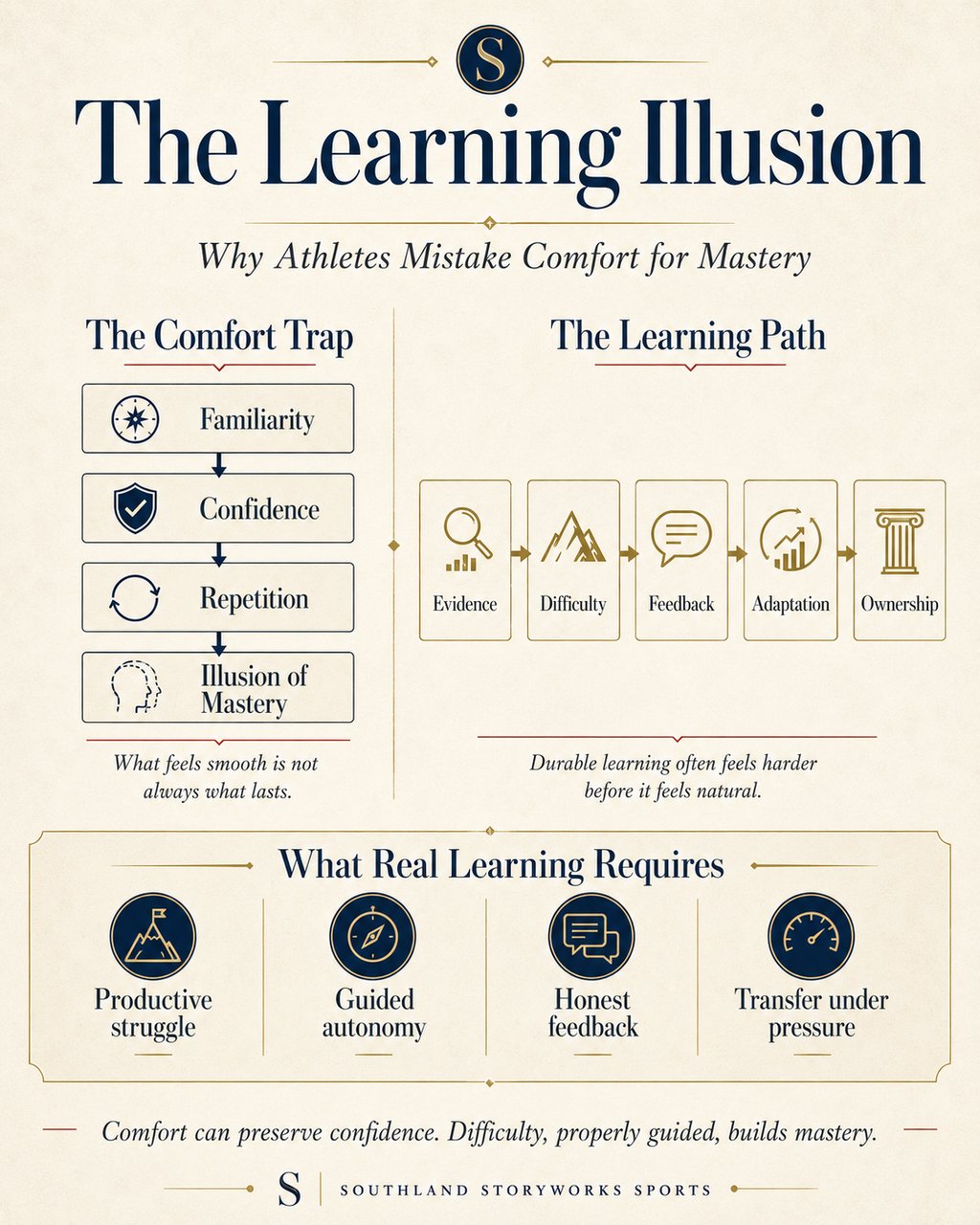
That illusion is one of the central problems in learning. It occurs when people mistake familiarity for mastery, fluency for understanding, repetition for development, and comfort for competence. The motion feels natural, so the athlete trusts it. The explanation sounds plausible, so the athlete believes it. The practice routine produces short-term success, so the athlete assumes it is building durable skill. The player has done something for years, so it seems less like a habit and more like an identity.
But learning is not the same as feeling familiar. In many cases, real learning begins precisely when familiarity becomes suspect.
This is why athletic development is often so emotionally difficult. Sport gives evidence. The score, the shot, the time, the touch, the miss, the pattern, the fatigue response, and the pressure moment all reveal something. They may not reveal everything or be poorly interpreted, but they refuse to remain theoretical. The athlete eventually has to confront what happened.
The learning illusion survives by turning away from that confrontation. It protects the familiar explanation. It defends the old pattern. It tells the athlete that because something feels right, it must be right.
The work of learning asks for a more disciplined question: What does the evidence actually show?
I. When Ease Feels Like Learning
Learning researchers have long challenged the assumption that smoothness is the sign of progress. In Make It Stick, Peter Brown, Henry Roediger, and Mark McDaniel argue against passive, fluent study habits that feel productive in the moment but fail to produce durable learning. Their work is not specifically about sport, but athletes should recognize the problem immediately. The practice that feels best is not always the practice that transfers best.
Robert and Elizabeth Bjork’s idea of “desirable difficulties” gives language to a truth that good coaches often observe before athletes accept it. Some learning conditions that make practice harder in the short term can make skills more durable in the long term. Retrieval, spacing, variation, and interleaving often feel less comfortable than blocked repetition, but they require the learner to work, recall, adjust, and reconstruct. They expose weaknesses rather than hide them.
This is where the illusion begins. The athlete leaves a clean practice feeling confident because the conditions were familiar. The same athlete may leave a more variable practice feeling frustrated because the work was less predictable. Yet the frustrating session may have done more to build adaptable skills.
That distinction matters because sport is not a memory test in stable conditions. A player does not perform in the same emotional, tactical, environmental, and competitive setting every time. Opponents adjust. Weather changes. Pressure rises. Fatigue alters movement. A crowd shifts the emotional temperature. A match situation changes risk. The athlete must transfer skill, not merely repeat it.
Easy practice can produce what appears to be competence. Difficult practice, properly designed, tests whether competence is real.
That does not mean all difficulties are useful. Confusion is not automatically growth. Punishment is not pedagogy. A chaotic practice environment can overwhelm the learner, leaving little more than frustration. The word “desirable” in desirable difficulty matters. The challenge must be appropriate to the learner, connected to feedback, and organized around a purpose.
Still, the athlete who only trusts practice that feels good may never reach the learning that matters most. Comfort can preserve confidence while quietly protecting limitations.
II. The Expert Problem: Knowing Enough to Stay Wrong
The learning illusion becomes more powerful as the athlete gains experience.
Beginners expect instruction to feel strange. They do not yet have a strong attachment to their habits. More experienced athletes often do. A movement pattern becomes familiar enough to feel natural, and natural enough to feel correct. The athlete may not simply resist change because of arrogance. He resists because the old pattern has become part of his embodied sense of truth.
Fitts and Posner’s classic model of motor learning helps explain why changing an established skill feels so disruptive. In their framework, learners move from a cognitive stage, where performance requires conscious attention, through an associative stage, and eventually toward an autonomous stage, where the skill can be executed with less conscious control. The problem is that correcting a foundational pattern may force an experienced performer back into conscious learning.
That can feel like regression.
A basketball player rebuilding shooting mechanics may suddenly feel less fluid. A soccer player learning to scan before receiving may feel slower. A tennis player adjusting the serve toss may feel as if the entire motion has been disturbed. A golfer changing a grip may feel as if he has never held a club before. The athlete interprets this discomfort as a decline, when it may simply be the re-opening of a learning process that had become automated around the wrong pattern.
This is one reason athletes often prefer surface fixes. They want the benefit of change without the cost of disorientation. They want to improve while preserving the exact feels that define their current game. But deep learning rarely permits that bargain. Sometimes the learner must temporarily become less comfortable to become more capable.
The emotional challenge is not trivial. A skilled performer does not merely lose ease when a pattern is rebuilt. He may feel as if he has lost evidence of who he is. The old movement, however flawed, belonged to him. The new one feels borrowed, foreign, imposed. This is why coaching change requires more than technical correctness. It requires judgment about timing, language, dosage, and trust.
The athlete must believe that discomfort is not humiliation. It is contact with a deeper layer of learning.
III. Difficulty Is Not the Enemy of Engagement
Paulo Freire wrote that “the teacher and the taught together create the teaching.” The line belongs to education, but it fits sport because athletic learning is never simply the transfer of information from expert to novice. The coach may know more, but the athlete must still perceive, attempt, fail, interpret, and adapt. Learning has to be built from the inside as well as guided from the outside.
That means difficulty cannot be eliminated from the process. It has to be organized.
The best coaches do not protect athletes from every mistake. They also do not leave them alone in confusion. They design environments where mistakes become informative. They provide enough structure to keep the learner oriented and enough space to allow the learner to struggle productively.
This is the difference between difficulty and abandonment.
An athlete who fails without feedback may become discouraged. An athlete who is corrected after every attempt may never develop perception. The useful zone lies between those extremes. The learner tries, receives evidence, makes a small adjustment, tries again, and gradually forms a more accurate relationship between intention and outcome.
A memorable coaching principle captures this well: give the player a few attempts, let the player struggle, then guide. That is not permissiveness. It is pedagogy. The athlete needs enough time to experience the problem before the coach solves it. Otherwise, the player may learn only to wait for rescue.
This matters because constant correction can create dependence. The athlete becomes good at being coached but not necessarily good at learning. He performs well when the coach is present, the drill is familiar, the instructions are fresh, and the environment is controlled. But in competition, when the situation changes, and the coach is not inside the action, the athlete may struggle to adapt.
Difficulty, properly framed, builds ownership. It asks the athlete to become a participant in the process rather than a recipient of instruction.
IV. Authority, Autonomy, and the Coach’s Judgment
The debate between teacher-centered and student-centered learning is often treated as a choice between old and new, control and freedom, instruction and discovery. In practice, especially in sport, the issue is more complicated.
Maryellen Weimer’s work on learner-centered teaching helped shift attention toward student responsibility, engagement, and ownership. Constructivist and ecological approaches to learning similarly emphasize that knowledge is not merely delivered; it is built through interaction with an environment. In athletic terms, a player does not become skilled by memorizing a coach’s explanation. The player becomes skilled by learning how to perceive, decide, and act in changing conditions.
Yet there are moments when direct instruction is necessary. A novice does not always benefit from pure discovery. Beginners need clarity. They need guardrails. They need language and structure. A young athlete learning a foundational movement pattern may not have enough perception to self-correct meaningfully. Too much autonomy too early can produce confusion or reinforce ineffective habits.
The opposite problem is equally real. Too much authority for too long produces athletes who outsource judgment. They wait for the coach to diagnose every error. They associate improvement with external correction. They may learn to comply, but not to understand.
The best coaching is not teacher-centered or athlete-centered in a simplistic sense. It is learning-centered.
Learning-centered coaching asks: What does this athlete need at this stage, for this task, under these conditions? Sometimes the answer is direct instruction. Sometimes it is guided discovery. Sometimes it is a constraint that forces adaptation. Sometimes it is a question. Sometimes it is silence.
Guadagnoli and Lee’s challenge point framework is useful here because it reminds coaches that optimal learning depends on the interaction among task difficulty, performer skill, and available information. A task that is too easy may not stimulate learning. A task that is too hard may create noise. The coach’s job is to locate the productive challenge point and adjust it as the athlete changes.
This requires humility from the coach. The goal is not to display knowledge. The goal is to create learning.
V. Practice Theater and the Comfort of Looking Good
One of the subtle failures of modern development is a practice that looks better than it is.
An athlete repeats a familiar drill, performs cleanly, receives praise, and leaves with confidence. The session appears disciplined. The coach has material to point to. The parent or observer sees progress. The athlete feels reassured. But the practice may have protected the player from the very conditions that competition will demand.
This is practice theater.
Practice theater is not laziness. It often looks like hard work. The athlete may be sweating, concentrating, and repeating. But the design of the work protects comfort. The player rehearses what already feels manageable. The environment rewards visible competence. The session avoids the weak foot, the awkward lie, the contested decision, the variable target, the pressure consequence, or the uncomfortable correction.
The danger is that athletes may become fluent in practice and fragile in performance.
Sport psychology offers a useful warning here. Masters and Maxwell’s theory of reinvestment explains how performers under pressure may bring conscious control back into skills that normally operate automatically. When the athlete becomes self-focused, performance can tighten. The player starts managing the body instead of solving the task.
That breakdown often begins before competition. It begins when practice has not required the athlete to organize attention under realistic demands. The player has learned a movement, but not the conditions under which it must survive.
The goal is not to make practice ugly for the sake of toughness. The goal is to make practice honest. Honest practice includes enough variability, consequence, decision-making, and feedback to reveal whether the athlete is learning or merely repeating.
VI. Feedback Without Identity Judgment
Athletes not only learn movements. They learn how to interpret themselves.
This is why feedback is so powerful and so dangerous. A coach may intend to correct a behavior, but the athlete may receive the correction as a judgment of identity. A missed shot becomes “I am not clutch.” A poor decision becomes “I am not smart.” A technical flaw becomes “I am broken.” Once feedback becomes identity judgment, learning becomes harder because the athlete is no longer simply solving a problem. The athlete is defending the self.
Good learning environments separate evidence from shame.
A mistake should not be ignored, but it should be classified. Was the problem technical, tactical, attentional, emotional, or random? Was the decision sound, but the execution poor? Was the outcome bad, but the process reasonable? Was the athlete prepared but unlucky? Or did the result reveal a recurring pattern that requires deliberate work?
These distinctions matter because athletes often collapse them. A bad outcome becomes a bad performance. A bad performance becomes a bad identity. The emotional spiral prevents clear learning.
Reflection is the alternative. Reflection asks what happened, what it means, and what should be done next. Rumination asks what the failure says about the person. Reflection creates action. Rumination creates tension.
A serious coach teaches the difference.
Feedback should help athletes become better observers of reality. The point is not to make them dependent on correction, but to help them develop judgment. The mature athlete can receive evidence without panic, notice patterns without defensiveness, and distinguish useful discomfort from unproductive confusion.
That is ownership.
VII. Learning Beyond Sport
The learning illusion is not confined to athletic fields, courts, courses, or gyms.
Students reread notes and mistake recognition for understanding. Professionals repeat familiar routines and mistake experience for growth. Leaders use the language of accountability while avoiding the feedback that would require change. Organizations produce activity and call it progress. People learn to sound competent before they become capable.
The pattern is the same: ease becomes evidence.
The solution is not constant doubt. A person who distrusts everything cannot perform freely. The solution is calibrated confidence — confidence that is strong enough to act but humble enough to be corrected. The learner must become willing to ask: What do I know? How do I know it? What does the evidence show? Where am I protecting comfort? What difficulty am I avoiding because it might reveal the truth?
These are not merely academic questions. They are performance questions. They are leadership questions. They are human questions.
Learning requires a disciplined relationship with reality. It asks the learner to accept that a familiar pattern may be limiting, that an uncomfortable task may be useful, and that the teacher’s role is not to provide permanent answers but to help the learner become more capable of finding them.
The best teachers, coaches, and leaders do not simply transmit knowledge. They design encounters with truth.
Conclusion: The Discipline of Productive Uncertainty
The learning illusion tells the athlete: I know this because it feels familiar.
Real learning asks: What does the evidence show?
That question is uncomfortable because it threatens the old system. It asks the athlete to loosen his grip on easy explanations. It asks the learner to accept that progress may first feel like confusion, awkwardness, or temporary decline. It asks the coach to organize difficulty rather than eliminate it. It asks both the teacher and the learner to treat mistakes not as verdicts but as information.
Mastery is not built by avoiding uncertainty. It is built by moving through uncertainty with structure, feedback, and attention.
Comfort has its place. Fluency has its place. At the highest levels, athletes must perform with freedom. But that freedom is not created by protecting every familiar feeling. It is earned through honest practice, guided difficulty, and the gradual transfer of ownership from coach to athlete.
The athlete who only wants comfort may preserve confidence for a while.
The athlete who learns how to struggle well becomes more difficult to break.
Selected References
Baumeister, R. F. (1984). Choking under pressure: Self-consciousness and paradoxical effects of incentives on skillful performance. Journal of Personality and Social Psychology, 46(3), 610–620.
Bjork, R. A., & Bjork, E. L. (2011). Making things hard on yourself, but in a good way: Creating desirable difficulties to enhance learning. In M. A. Gernsbacher, R. W. Pew, L. M. Hough, & J. R. Pomerantz (Eds.), Psychology and the real world: Essays illustrating fundamental contributions to society. Worth Publishers.
Brown, P. C., Roediger III, H. L., & McDaniel, M. A. (2014). Make it stick: The science of successful learning. Belknap Press.
Davids, K., Button, C., & Bennett, S. (2008). Dynamics of skill acquisition: A constraints-led approach. Human Kinetics.
Ericsson, K. A., Krampe, R. T., & Tesch-Römer, C. (1993). The role of deliberate practice in the acquisition of expert performance. Psychological Review, 100(3), 363–406.
Fitts, P. M., & Posner, M. I. (1967). Human performance. Brooks/Cole.
Freire, P. (1968). Pedagogy of the oppressed. Herder and Herder.
Guadagnoli, M. A., & Lee, T. D. (2004). Challenge point: A framework for conceptualizing the effects of various practice conditions in motor learning. Journal of Motor Behavior, 36(2), 212–224.
Lea, S. J., Stephenson, D., & Troy, J. (2003). Higher education students’ attitudes to student-centered learning: Beyond “educational bulimia”? Studies in Higher Education, 28(3), 321–334.
Masters, R. S. W., & Maxwell, J. P. (2008). The theory of reinvestment. International Review of Sport and Exercise Psychology, 1(2), 160–183.
Weimer, M. (2013). Learner-centered teaching: Five key changes to practice (2nd ed.). Jossey-Bass.
Wood, D., Bruner, J. S., & Ross, G. (1976). The role of tutoring in problem solving. Journal of Child Psychology and Psychiatry, 17(2), 89–100.
Southland Storyworks
Narrative. Performance. Meaning.
Home-Sports
Inquiries
news@southlandstoryworks.com
Based in the American South
Submissions welcome via email
© 2026 Southland Storyworks-An independent publication exploring the psychological frameworks of competition.
Narrative architecture & performance psychology