
The Game That Outlived Genius
Chess After Fischer, Engines, and the Connected World
SPORTS
Steven Bradley
7/7/202615 min read
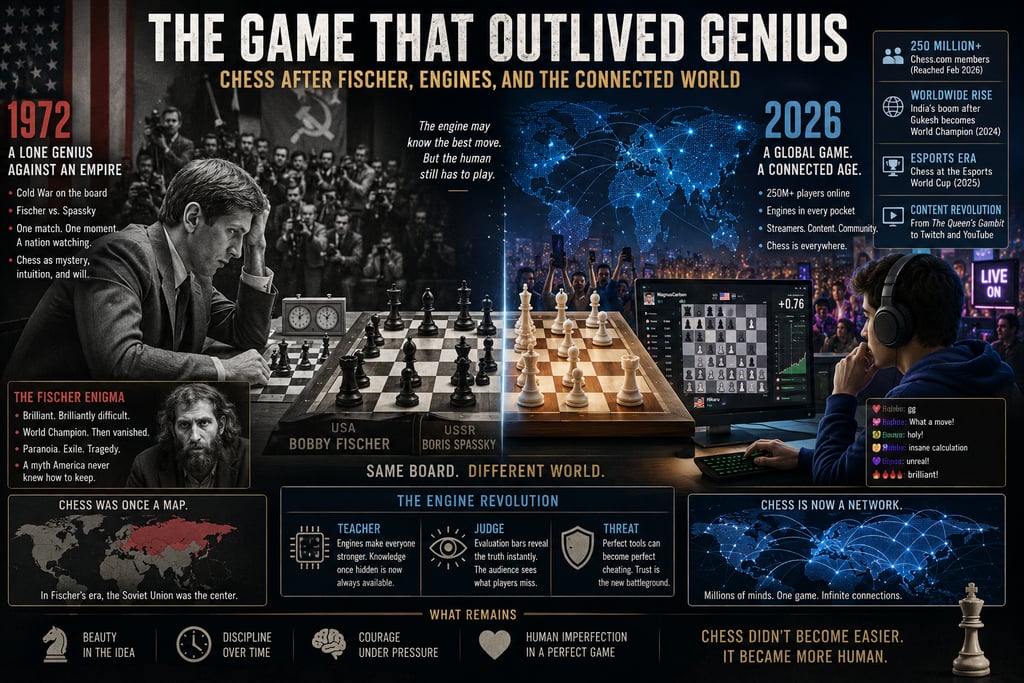
Bobby Fischer sat at the board in Reykjavík in 1972 and made chess look like a matter of world history.
That was part of the illusion, and part of the truth. The match against Boris Spassky was officially a world championship, but almost no one experienced it only as sport. Fischer was the American challenger. Spassky was the Soviet champion. The board became a Cold War surface. Every pawn seemed to carry ideology. Every delay, demand, complaint, and move became part of a psychological contest larger than the pieces themselves.
For the United States, Fischer offered something almost too perfect to resist: the lone American genius against the Soviet machine.
The Soviet Union had built chess as a cultural institution. It had schools, coaches, state support, theory, prestige, and generations of grandmasters who treated the game not as a hobby but as a national intellectual project. Fischer came from a country that admired individual brilliance but had never quite known what to do with chess. He was self-made, obsessive, combative, suspicious, and almost impossibly gifted. He did not represent an American chess system. He seemed to represent the absence of one.
That made his triumph irresistible.
Fischer defeated Spassky and became world champion. He broke a long period of Soviet dominance. He made chess front-page news in a country that had rarely treated it as mass culture. For a moment, the United States did not merely have a chess player. It had a chess myth.
Then the myth curdled.
Fischer did not defend his title in 1975. He disappeared from serious competitive chess. Over time, the eccentricity that had once been folded into the romance of genius became something darker: paranoia, isolation, antisemitic and anti-American rants, legal trouble, exile, and the sad spectacle of a man increasingly trapped inside the wreckage of his own mind.
The American chess boom that had gathered around him faded. The game remained, but the moment passed. Fischer had made chess briefly visible to America, but he had not made America a chess country.
That is the first irony.
The second is stranger.
Half a century later, chess has finally become something like a mass global game — but not because another Fischer arrived. The modern boom did not come from one genius sitting alone against an empire. It came from servers, streamers, engines, algorithms, pandemics, Netflix, smartphones, esports, online ratings, national prodigies, and millions of anonymous players clicking “new game” from bedrooms, classrooms, offices, airports, and kitchen tables around the world.
Fischer made chess look like the triumph of one mind over an empire.
The modern chess boom makes it look like millions of minds trying to understand themselves under the judgment of machines.
I. The Lonely American
Fischer remains the unavoidable figure because he gave American chess its central mythology.
Before Fischer, the United States had great players and important chess history. Paul Morphy had been a nineteenth-century marvel. Samuel Reshevsky had been a prodigy and long-term elite competitor. The country had clubs, tournaments, writers, enthusiasts, and pockets of serious culture. But it did not have the Soviet Union’s chess civilization. It did not organize chess as a national intellectual project.
Fischer’s greatness therefore seemed to violate structure.
He was not the product of an obvious system. He was the boy from Brooklyn who studied obsessively, became a grandmaster at fifteen, devoured books and games, taught himself Russian well enough to read Soviet chess literature, and climbed toward the world championship with a ferocity that felt both heroic and unstable.
That instability was always part of the story. In Reykjavík, Fischer’s demands and complaints nearly derailed the match before it had begun. He objected to cameras, lighting, conditions, money, and procedures. He forfeited the second game. The match became not only Fischer versus Spassky, but Fischer versus the event, Fischer versus authority, Fischer versus his own intolerances.
And still, when the chess began to matter most, he was magnificent.
That is why the myth survived so long. The difficult genius is a familiar figure in American culture. He is excused because he is brilliant, romanticized because he is impossible, and interpreted as proof that greatness need not be orderly. Fischer fit that story too well. His flaws were treated, for a time, as part of the voltage around him.
But chess does not forgive disorder forever. Nor does life.
The man who won the world title became the man who would not defend it. The champion became a recluse. The hero of American chess became an exile from the country that had briefly celebrated him. In his later years, Fischer’s public statements became indefensible, his conspiracy thinking deepened, and the tragedy of his life became impossible to separate from the brilliance of his games.
This is where the American relationship with chess begins to feel strange.
The country wanted Fischer as proof of genius. It did not know how to build a culture from him.
II. The Country That Borrowed Chess
America has often loved chess more as symbol than as practice.
It uses chess to describe strategy, intelligence, masculinity, patience, foresight, rivalry, and control. Politicians play “three-dimensional chess.” Coaches speak of tactical chess matches. Business writers borrow the board as a metaphor for planning. Filmmakers use chess to signal genius, loneliness, obsession, or danger. The image of chess is everywhere.
The culture of chess is more complicated.
Unlike football, basketball, baseball, or even poker, chess has never fully settled into the American mainstream. It appears in waves. Fischer in 1972. The childhood-prodigy romance of Searching for Bobby Fischer. The occasional scholastic boom. The rise of the St. Louis Chess Club. The streaming era of Hikaru Nakamura, the Botez sisters, Levy Rozman, and online chess personalities. The Netflix surge after The Queen’s Gambit. The pandemic boom. The cheating scandals. The online platforms.
Each wave makes chess visible. Each also reveals how little the United States has historically known what to do with the game once the spectacle passes.
Part of the problem is cultural pace. Chess is slow, silent, abstract, and punishing. It does not naturally flatter the American appetite for visible athleticism, constant scoring, personality-driven narrative, and immediate explanation. The game can be dramatic, but its drama is often invisible to the untrained eye. The decisive mistake may be a quiet move that looks harmless. The most beautiful idea may require twenty minutes of explanation. The crowd cannot always see the violence.
That made chess difficult as mass entertainment before technology changed its presentation.
In Fischer’s day, the public could understand the national stakes more easily than the chess itself. America could understand Fischer versus the Soviets. It could understand eccentric genius. It could understand victory. But the actual game remained, for many, a sealed language.
That has changed.
The modern connected world did not make chess easier. It made chess more visible.
III. The Boom Without a Fischer
The modern chess boom is unusual because it does not have one center.
There are stars, of course. Magnus Carlsen became the dominant figure of the post-Kasparov world, a champion whose intuitive style, psychological confidence, and willingness to play online speed chess helped modernize elite chess’s public image. Hikaru Nakamura became not only an elite player but a streaming figure who translated blitz calculation into entertainment. The Botez sisters, Levy Rozman, and other creators helped make chess social, conversational, and discoverable to audiences who might never have entered a traditional chess club.
Then The Queen’s Gambit gave chess a glamour it had rarely possessed in American mass culture.
Netflix announced that the series reached 62 million households in its first 28 days, becoming its biggest scripted limited series at the time. The show did something important: it made chess beautiful to people who did not yet understand chess. It gave the game rooms, clothes, faces, addiction, ambition, gender politics, orphanhood, genius, and loneliness. It made the board cinematic.
But the boom did not belong only to television.
Chess.com reached 250 million members in February 2026, a figure that would have been almost impossible to imagine in Fischer’s world. Online chess had grown from a convenience into the dominant entry point for the game. The platform connected that growth to several forces: the post-2020 surge, India’s rise after Gukesh Dommaraju became world champion, massive online demand, and chess’s entrance into esports culture.
This is the new chess ecosystem.
A beginner can play a stranger in another country within seconds. A child can learn openings from YouTube, solve tactics on a phone, play bots modeled after personalities, watch a grandmaster stream bullet chess, analyze every move with an engine, and enter a global rating pool before ever joining a local club. The barriers that once made serious chess culture narrow — access to books, opponents, coaching, databases, and analysis — have been lowered dramatically.
That does not mean the game has become easy.
It means the staircase is visible.
IV. India and the New Geography of Chess
The modern boom is not simply American. In fact, one of the best ways to understand America’s strange relationship with chess is to compare it with India’s current one.
India has become one of the most important chess nations in the world. Viswanathan Anand gave the country its first great modern chess hero, and the generation that followed him has turned admiration into infrastructure, ambition, and expectation. Gukesh Dommaraju’s victory over Ding Liren in the 2024 world championship made him the youngest world champion in chess history and intensified the sense that chess’s geography had shifted.
This matters because India’s chess rise looks less like the Fischer model and more like a networked model.
Fischer was the solitary genius against the system. India’s rise suggests what happens when a country develops depth, coaching, digital access, peer competition, national pride, and a generation of players who can grow together. The story is not only one prodigy. It is an ecosystem.
That is one reason the modern chess world feels different. The old Cold War map centered the Soviet Union and its challengers. The current map is more dispersed: India, China, the United States, Russia’s complicated legacy, Europe’s enduring depth, online global communities, and a generation of players who grew up with engines as ordinary tools rather than exotic machines.
The rise of Gukesh is not merely the rise of another champion. It is evidence that the game’s center is no longer fixed.
The connected world did not flatten chess completely. Resources still matter. Coaching still matters. Federation support still matters. Family circumstance still matters. But the flow of chess knowledge is no longer controlled in the same way. Openings, games, training methods, commentary, and analysis travel instantly.
In Fischer’s time, finding the truth required obsession.
Now the truth is everywhere, and still almost impossible to play.
V. The Engine as Teacher
The most important change in modern chess is not streaming, Netflix, or online platforms.
It is the engine.
Computers did not merely become strong at chess. They became stronger than humans in ways that permanently altered how humans understand the game. Deep Blue’s victory over Garry Kasparov in 1997 was the public rupture, but the more profound transformation came later, when engines became widely available, unbelievably strong, and woven into ordinary chess life.
Stockfish, Leela Chess Zero, AlphaZero-inspired systems, NNUE evaluation, and neural-network methods changed preparation, opening theory, and middlegame understanding. ChessBase has described AlphaZero’s influence as part of a broader AI revolution that affected elite preparation and generated new ideas about piece activity, pawn sacrifice, king safety, and long-term compensation.
The engine changed the question.
For centuries, chess culture revolved around the search for the best move. Players studied openings, adjourned games, analyzed for hours, consulted seconds, wrote books, argued over variations, and built reputations on judgment. Truth was difficult to find.
Now truth often appears instantly after the move is made.
An amateur can finish a game and see that his beautiful attack was unsound. A grandmaster can spend hours preparing a novelty only to discover that the engine has already refuted its emotional logic. A commentator can display the evaluation bar and reveal to millions of viewers that a position has shifted before the players’ faces show they know it.
The engine is a teacher, but not a gentle one.
It gives answers without sympathy. It exposes the difference between what felt right and what was right. It turns intuition into data. It humiliates confidence. It rewards positions humans used to distrust. It shows defensive resources where the eye sees collapse. It finds quiet moves in violent positions and violent moves in quiet ones.
This has made chess better in one sense. The quality of preparation is higher. The training tools are extraordinary. Players at every level can learn from analysis once available only to elites.
But it has also changed the emotional relationship between player and game.
A mistake is no longer only something one gradually discovers. It is something the machine can name immediately.
VI. The Engine as Judge
The modern spectator watches chess with an authority earlier audiences did not possess.
A viewer may not understand the position deeply, but the evaluation bar does. That bar has become one of the most important storytelling devices in chess. It rises, falls, trembles, and swings. It turns invisible calculation into visible drama. It tells the audience when a player has blundered, even before the opponent sees the punishment.
This is a strange development.
For most of chess history, the audience knew less than the players. Spectators watched masters with awe because the masters could see what others could not. Now the audience often sees the engine’s truth before the players can process it. A 900-rated viewer can watch a super-grandmaster make a move and immediately know, because the bar says so, that the move is wrong.
That does not mean the viewer understands why.
This distinction is important. Engine access can create the illusion of understanding. The machine tells the spectator the evaluation, but not necessarily the human difficulty of finding the move. The viewer may know that a move lost three points of evaluation without appreciating the time pressure, fatigue, calculation burden, psychological fear, or practical complexity that produced the error.
In that sense, engine-era spectatorship creates a new kind of arrogance.
Chess has become more legible, but not always more understood. The audience sees the verdict before it knows the case. This is familiar in modern culture more broadly. Technology often gives people access to conclusions without giving them the discipline that produced the conclusion. The engine says “mistake,” and the crowd feels wise.
The irony is that chess, the game most associated with thought, has become a place where people can confuse machine feedback with human understanding.
That makes the game more democratic and more distorted at the same time.
VII. The Engine as Threat
The greatest tool in modern chess is also its greatest integrity problem.
Engines are teachers, analysts, sparring partners, commentators, and training companions. They are also perfect cheating devices. A phone can contain more chess strength than any human who has ever lived. A single engine suggestion at the right moment can change a game, a tournament, a career, or a reputation.
This has created a climate of suspicion unlike anything Fischer knew.
Chess always had paranoia. Fischer himself saw conspiracies everywhere. World championship history includes accusations, rumors, psychological warfare, and bizarre claims. But modern cheating suspicion is different because the technological possibility is real and immediate. The question is no longer whether someone could secretly receive superhuman help. Of course he could. The question is how to prove whether he did.
The Carlsen-Niemann controversy exposed this new condition. After Hans Niemann defeated Magnus Carlsen at the 2022 Sinquefield Cup, Carlsen withdrew from the tournament and later made clear that he suspected wrongdoing. Chess.com later released a report alleging that Niemann had likely cheated in more than 100 online games, while also stating it had found no direct evidence that he had cheated over the board in the Sinquefield game. The controversy became a global story because it touched the central anxiety of modern chess: once engines exist, trust becomes more fragile.
That fragility has not disappeared.
Recent chess culture has seen further public disputes around cheating accusations, statistical claims, online streaks, and reputational harm. The issue is not simply whether cheating occurs. It does. The issue is whether chess can build institutions, statistical tools, due process, and cultural norms strong enough to manage suspicion without letting paranoia consume the game.
This is another way the modern world has changed chess.
The old romance imagined chess as pure mind against pure mind.
The engine era asks whether we can still believe what we are watching.
VIII. Machines That Model Human Weakness
The most fascinating turn in chess AI may not be that machines became stronger than humans.
It may be that machines are now being designed to understand humans.
Maia, a neural-network chess project introduced by researchers including Reid McIlroy-Young, Siddhartha Sen, Jon Kleinberg, and Ashton Anderson, was built not simply to play the best move, but to predict human moves at different rating levels. The researchers argued that superhuman engines often do not predict human decisions well because they think in ways unlike people. Maia instead uses human online games to model what players actually do, including how they make mistakes.
That is a profound reversal.
The first great chess-machine story asked whether machines could defeat humans. Later, machines did. Then the question became whether humans could learn from machines. Now the question is whether machines can understand how humans fail.
This may be the richest metaphor in the modern game.
Chess is no longer only a benchmark for artificial intelligence. It is a mirror for human decision-making. Online chess creates enormous datasets of granular choices: when players blunder, how they respond to threats, which tactics they miss, how rating affects perception, how time pressure changes decisions, how humans behave when the truth is technically available but cognitively unreachable.
In Fischer’s world, chess knowledge was scarce and guarded.
In the modern world, every mistake becomes data.
That shift reaches beyond chess. It belongs to the age of platforms, analytics, AI tutors, behavioral modeling, and machine-mediated self-understanding. Chess is ancient, but it has become one of the cleanest laboratories for the modern condition: humans making decisions while machines watch, judge, predict, and teach.
The board has not changed.
The witness has.
IX. After the Best Move
What remains of chess once the best move is no longer mysterious?
This is the question beneath the modern boom.
One answer is that the game remains difficult because humans are not engines. We do not calculate perfectly. We become tired, proud, afraid, impatient, overconfident, attached to plans, seduced by beauty, repelled by ugliness, and vulnerable to time. We see patterns that are not there and miss patterns that are. We defend badly because defense feels passive. We attack badly because attacking feels righteous. We trade pieces to relieve pressure. We avoid complications when they are necessary. We seek simple answers in positions that punish simplicity.
The engine can show the best move. It cannot make us become the kind of person who finds it under pressure.
That is why chess survived the engine.
There was a time when some feared that computer dominance would kill the game’s mystery. If machines could solve everything better than humans, why would humans keep playing? The answer is now obvious. Humans do not play chess because they are the best entities at chess. They play because chess reveals them.
A beginner blunders a queen and learns about attention. A club player attacks too early and learns about patience. A strong player overpresses and learns about ego. A grandmaster misses a defensive resource and learns, publicly, that even brilliance has limits. A world champion sits at the board while millions watch an evaluation bar judge him in real time.
The game remains compelling because humans remain insufficient.
That insufficiency is not an embarrassment. It is the source of the drama.
X. Fischer in the Age of Engines
It is tempting to ask what Fischer would have done with engines.
The question is irresistible but impossible. Fischer’s obsession with truth suggests he might have used them ferociously. His paranoia suggests he might have hated what they did to trust. His suspicion of institutions suggests he would have found new enemies in platforms, algorithms, anti-cheating systems, federations, and engine-assisted preparation. His genius might have thrived. His instability might have deepened.
But the better question is not how Fischer would have used the modern game.
It is whether the modern game still needs a Fischer.
In one sense, it does. Chess still needs genius. It needs players who reveal what others cannot see. Carlsen, Gukesh, Nakamura, Ding, Nepomniachtchi, Caruana, Firouzja, Ju, Hou Yifan, Praggnanandhaa, Erigaisi, and many others give the game its human faces. The culture still needs style, courage, pressure, rivalry, and individual presence.
But the boom itself no longer depends on one solitary genius.
That is the difference.
Fischer’s moment was vertical: one man rose toward the summit and pulled the American public’s attention upward with him. The modern chess boom is horizontal: millions of players entering through platforms, videos, bots, puzzles, streamers, schools, national movements, and online communities. The game grows not because one figure contains it, but because the network distributes it.
This makes chess healthier in some ways. No single person has to carry the whole mythology. It also makes the culture stranger. The game is everywhere and nowhere, public and private, ancient and hypermodern, solitary and social, human and machine-mediated.
Fischer made chess feel like a secret world briefly exposed.
The connected age has made chess permanently open.
Conclusion: The Game That Survived Its Own Truth
Chess has survived kings, empires, revolutions, cafés, clubs, newspapers, radio, television, Cold War propaganda, computer conquest, streaming, scandals, and artificial intelligence.
That endurance is not accidental. The game is simple enough to learn, deep enough to never exhaust, and severe enough to expose the person playing it. Each era finds its own anxiety inside the board.
Fischer’s era found genius, nationalism, paranoia, and the Cold War.
The connected era finds access, engines, platforms, cheating fears, machine judgment, global learning, and the strange experience of being told the truth before we understand it.
That is why chess now feels newly modern. It is not because the game changed. It is because the world around it finally began to resemble the game: networked, analytical, surveilled, competitive, quantified, mistrustful, and obsessed with intelligence.
Bobby Fischer made chess famous in America by turning the board into a battlefield for one impossible mind.
The modern chess boom has made the board into something larger and less lonely. It is a global mirror in which millions of people test their attention, their pride, their memory, their impatience, their courage, and their willingness to learn from machines that do not care about their feelings.
The engine may know the best move.
But the human still has to play.
That is why the game outlived genius.
Selected References
Associated Press. (2025). Boris Spassky, Soviet chess champion who lost famed Cold War-era match to Bobby Fischer, dies at 88.
Chess.com. (2026). Chess.com reaches 250 million members.
ChessBase. (2022). How the AI revolution impacted chess.
Epstein, D. (2019). Range: Why generalists triumph in a specialized world. Riverhead Books.
McIlroy-Young, R., Sen, S., Kleinberg, J., & Anderson, A. (2020). Aligning superhuman AI with human behavior: Chess as a model system.
Netflix. (2020). From The Queen’s Gambit to a record-setting checkmate.
NPR / VPM. (2011). The troubled genius of Bobby Fischer.
World Chess Hall of Fame. (2022). 1972 Fischer/Spassky: The Match, Its Origin, and Influence.
World Chess Championship / FIDE reporting. (2024). Ding Liren vs. Gukesh Dommaraju, FIDE World Championship.
Zuckerman, M., & related reporting. (2022–2024). Coverage and analysis of the Carlsen–Niemann cheating controversy.
Southland Storyworks
Narrative. Performance. Meaning.
Home-Sports
Inquiries
news@southlandstoryworks.com
Based in the American South
Submissions welcome via email
© 2026 Southland Storyworks-An independent publication exploring the psychological frameworks of competition.
Narrative architecture & performance psychology