
The Dating-App Funnel
Why people don't want what they say they want
CULTURE
Steven Bradley
7/14/202613 min read
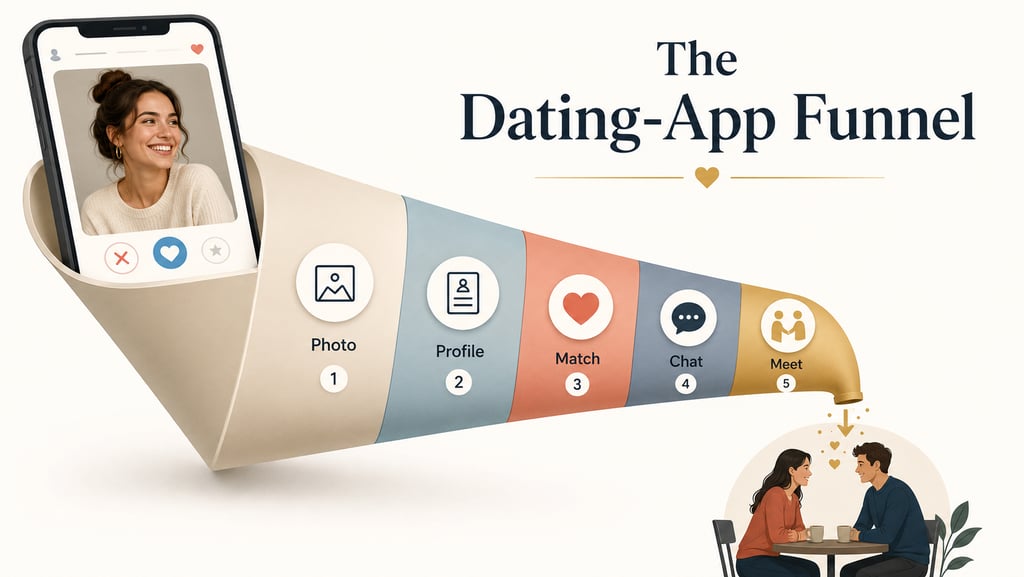
Dating apps encourage people to talk about partner selection as if it were one decision.
It usually is not.
A user does not simply inspect a profile and decide whether another person would make a good partner. More often, the decision is broken into stages. First, the profile has to be visually plausible enough to consider. Then the rest of the profile has to avoid obvious disqualification or offer some reason to continue. If a match occurs, the conversation has to feel worth maintaining. Only after that does actual human interaction begin to test whether the digital impression can survive reality.
That sequence matters because the traits that help someone pass one stage are not always the same traits that help at the next. A strong photograph may produce a like but no conversation. A good biography may help a profile that already crossed the visual threshold, but do little for someone who never did. Warmth, steadiness, trustworthiness and emotional intelligence may matter enormously in a relationship while being difficult to evaluate from a photograph and a few lines of text.
The research on online dating makes more sense when viewed through this stage-dependent model. Dating apps are not only revealing what people want. They are shaping which parts of desire get expressed first.
Online dating is now too important to treat casually
The subject matters because online dating is no longer a marginal social experiment. Rosenfeld, Thomas and Hausen found that meeting online had displaced meeting through friends as the most common way heterosexual couples in the United States met, based on nationally representative 2017 data. Pew Research Center has also found that 30 percent of U.S. adults have used a dating site or app, with higher usage among younger adults.
That means dating apps are not merely reflecting private romantic choices. They are increasingly involved in structuring the early stages of relationship formation. The design of the app, the visibility of the photograph, the availability of alternatives, the gender ratio, the cost of rejection, and the low effort required to express interest all become part of the social environment.
This is why app behavior should be interpreted carefully. A swipe is not a marriage preference. A match is not a full endorsement. A message is not a commitment. Each action belongs to a different filter in the selection process.
Women are generally more selective on apps, but exact ratios are not universal laws
There is good evidence that men and women often use different initial strategies on dating apps. A widely cited study of Tinder activity, using curated profiles and survey data, found that women accumulated matches much more rapidly than men, while men accumulated matches much more slowly. The same paper reported that grooming and profile effort mattered, especially for male users, but it should be understood as a platform-specific study rather than a universal law of male and female behavior.
Choice overload also appears to matter. In a set of studies on online dating, Pronk and Denissen found that participants became more rejection-oriented as they viewed more profiles, with an average 27 percent decline in acceptance probability from the first to the last option. For women, this rejection mind-set also reduced the likelihood of obtaining romantic matches.
Those findings help explain the self-reinforcing structure many users experience. Men may respond to lower match rates by liking more broadly. Women may respond to greater attention volume by filtering more aggressively. Broader male liking can create more volume for women, which can make women’s likes more provisional and more subject to later reconsideration.
That does not mean any single published ratio should be treated as fixed truth. Claims such as “men like X percent of profiles and women like Y percent” depend heavily on platform, location, age group, gender ratio, relationship intention and app design. The stronger conclusion is more modest: attention is uneven, many women can afford to be more selective at the liking stage, and a match often means only that the profile has passed the first filter.
The first filter is predominantly visual
The strongest evidence supports the idea that first-stage app selection is heavily visual.
A 2025 conjoint analysis by Witmer, Rosenbusch and Meral observed 5,340 swipe-like decisions made by 445 online daters. A one-standard-deviation increase in physical attractiveness increased selection success by about 20 percent. The same increase in perceived intelligence improved selection success by about 2 percent. Height, occupation, biography, intelligence and similarity generally moved in expected directions, but their effects were seven to 20 times smaller than the effect of attractiveness. The authors also found that men and women showed equal priorities and attribute effects in this decision context.
That finding does not mean every woman or man wants the same face or body. It means the photograph is the most powerful readily available signal in the app environment. The app presents a large image, limited text, minimal social context, numerous adjacent alternatives and almost no cost for rejecting someone. Under those conditions, appearance becomes a strong gatekeeping variable.
Research comparing visual and verbal information also supports this interpretation. Fink and colleagues found that adding descriptive text alongside photographs affected women’s attractiveness judgments more than men’s, but those gender differences were reduced when participants evaluated profiles on mobile devices rather than computers. In other words, when the device makes visual information more salient and reading less convenient, the photograph becomes even more dominant.
The implication is not that app behavior reveals everything people want in relationships. It reveals what people can judge quickly in a low-context interface.
A photograph carries more than facial attractiveness
Calling the first filter “visual” can make it sound as if the decision is only about facial structure or body type. That is too narrow.
A profile photograph bundles several impressions together: conventional attractiveness, grooming, health, clothing, confidence, social ease, lifestyle, warmth, status cues and authenticity. Those judgments are not necessarily accurate, but they are available immediately.
The research on filtered photographs shows the tension clearly. Appel and colleagues tested women’s responses to filtered and unfiltered versions of male Tinder profile photographs. The filtered photographs increased perceived physical attractiveness and dating intention, but decreased perceived trustworthiness. The attractiveness gain was strong enough to increase dating interest despite the trust penalty.
That finding is useful because it separates visual effectiveness from authenticity. A profile can become more attractive and less trustworthy at the same time. The photograph may win the first vote, while trust is postponed to a later stage.
The practical lesson is not to manipulate images deceptively. It is that visual presentation is part of communication in the app environment. A photo communicates not only what someone looks like, but whether the person appears socially aware enough to present himself or herself clearly.
Profile facts often work as thresholds
Height, employment, distance, politics, smoking, religion, desire for children and relationship goals can matter a great deal. But they may not function like attractiveness.
Attractiveness often works as a general ranking variable. A more attractive profile tends to perform better across many evaluators. Other traits may operate more like thresholds. They may be unimportant to one user and decisive to another. A political difference, smoking status, religious mismatch, long distance, incompatible family goals or uncertain employment situation may not increase desire, but can stop existing desire from continuing.
This distinction helps explain why some profile information appears statistically secondary while remaining practically important. In the Witmer conjoint study, height, occupation, biography, intelligence and similarity had measurable but much smaller average effects than attractiveness. But an average effect does not capture how a particular trait can serve as a disqualifier for a particular user.
That is one reason dating-app advice often becomes confused. One person says “height matters,” another says “personality matters,” another says “job matters,” and another says “photos are everything.” Each may be describing a different stage or a different kind of variable.
The biography is usually a differentiator, not the primary engine
A good biography matters, but usually after the profile has cleared the first visual threshold.
Van der Zanden and colleagues studied originality in online dating profile texts and found that more original profile writing was associated with more favorable impressions. Original profile texts made writers seem more intelligent and humorous, which in turn improved perceived attractiveness and dating intention. The study also found that originality was connected to features such as concrete self-disclosure and more distinctive expression rather than generic claims.
That finding helps clarify the role of humor. Humor in a profile is not simply entertainment. It can signal verbal intelligence, social calibration, originality, confidence, emotional lightness and an identifiable personality. It may also give the other person an easier path into conversation.
Generic profile writing does little because it provides little information. “I like traveling, music and laughing” could describe millions of people. A more concrete sentence gives the reader something to imagine and something to respond to. The goal of good profile writing is not to persuade a stranger that the writer possesses every desired trait. It is to help an already interested person imagine what interacting with this particular person might feel like.
This is why biography quality may matter most in the tiebreaker zone: users who are attractive enough to be considered but not so visually compelling that the photograph alone carries the decision.
Attention is concentrated, but the “top 20 percent” story is too crude
Popular commentary often claims that women pursue the same small group of high-value men while men distribute attention more realistically. The research supports some concentration of attention, but not the simplest version of that story.
Bruch and Newman analyzed heterosexual online dating markets in four large U.S. cities and found a clear hierarchy of desirability. Both men and women tended to pursue partners who were about 25 percent more desirable than themselves by the researchers’ measure. Response probability declined as the desirability gap between sender and recipient increased. In other words, aspirational pursuit was real, but it was not uniquely female.
A more recent study using data from a Czech mobile dating app complicated the stereotype further. Topinková and colleagues found that men tended to pursue women who were more desirable than themselves, while reciprocated contacts were more homophilous, meaning that mutual interactions were more likely between users of similar desirability. A public summary of the same study described the result plainly: men tended to “punch up,” while mutual matches mostly involved more similar desirability.
The better model separates three phenomena.
Initial attention is hierarchical. Some users receive far more interest than others.
Aspirational pursuit is common. Because expressing interest is cheap, users may reach upward more often than they would in a higher-cost social setting.
Reciprocity is more selective. Mutual interaction tends to pull people back toward similarity in desirability and other characteristics.
That does not mean men who feel ignored are imagining the problem. It means the underlying mechanism is more complicated than a single “women only want the top men” claim. Dating apps magnify visible signals, concentrate attention, and encourage low-cost aspiration from both sexes. They also create conditions in which receiving attention and securing reciprocal engagement are very different outcomes.
People’s ideals predict attraction only modestly
The most important finding for the “people do not want exactly what they say they want” argument comes from research on ideal partner preferences.
Eastwick and a large international team conducted a registered report with 10,358 participants across 43 countries and 22 languages, testing how strongly ideal-partner preference matching predicted evaluations of actual or potential partners. The study found significant preference-matching effects, but the effects were modest. The results suggest that ideals have some predictive value, but they do not operate like a precise checklist that reliably identifies which person will generate attraction.
The plain-language interpretation is that people often know the broad neighborhood of what they want better than the exact address. They can identify generally desirable qualities: attractive, warm, dependable, interesting, compatible, emotionally stable, intelligent, socially competent. But they are less precise at predicting which particular person, with which particular combination of traits, will become attractive in practice.
That does not mean stated preferences are fake. It means human attraction is not a simple weighted average of declared traits. Attraction emerges from combinations of visible cues, social context, timing, conversation, perceived availability, confidence, familiarity and embodied chemistry.
The mismatch between stated and revealed preferences should not be reduced to hypocrisy. People may report what they consciously endorse. They may confuse qualities needed for a lasting relationship with qualities that trigger immediate attraction. They may imagine traits in isolation rather than in real people. They may also prefer to give culturally respectable answers. The important point is that stated ideals are incomplete guides to actual attraction.
The checklist and the swipe belong to different stages
The most common error in dating-app discourse is treating relationship preferences and swipe preferences as if they are the same thing.
A person may sincerely value kindness more than appearance in a long-term relationship. That does not mean kindness will dominate the first two seconds of profile evaluation. Kindness is hard to perceive from a still photograph. Physical attraction is immediate.
A person may claim to want emotional intelligence, stability and shared values. Those traits may matter greatly over time. But at the first filter, the user may be deciding whether the profile is visually plausible, whether the person appears normal enough to continue, and whether anything in the profile creates an obvious reason to stop.
This is the central distinction: the qualities that help a profile win attention are not identical to the qualities that sustain a relationship.
The app is comparatively good at displaying photographs, basic facts and short prompts. It is much weaker at revealing trustworthiness, patience, generosity, long-term emotional steadiness, real-world chemistry, conflict style or whether two people actually feel good in each other’s presence.
The problem is not that people have standards. The problem is that dating apps ask people to make first-stage decisions with the language of final-stage compatibility.
Conversation is the next filter
Once a match exists, the selection problem changes. The matched person has already passed some threshold of interest. The next question is whether an interaction is worth continuing.
Here, research on conversation becomes relevant. Huang and colleagues found across multiple studies that people who asked more questions were better liked, and that follow-up questions were especially important because they signaled responsiveness. In a speed-dating setting, people who asked more follow-up questions were more likely to elicit agreement for a second date.
That finding pushes against the common tendency to treat the dating-app conversation as another opportunity for self-advertising. The goal is not simply to prove value. It is to create a reciprocal interaction. Good conversation signals attention, curiosity, social timing and comfort. Bad conversation can signal pressure, self-absorption, hostility, neediness or poor calibration.
Large-scale descriptive work on mobile dating communication supports the idea that many matches do not become meaningful exchanges. Zhang and Yasseri analyzed more than two million conversations from a mobile dating app and found that 39 percent of conversations consisted of just one unreciprocated message, with another 10 percent containing two or more unreciprocated messages. They also found that men initiated 79 percent of conversations; among mutual conversations, phone numbers were exchanged in about 19 percent, with successful conversations averaging roughly 29 messages and a median phone-number exchange around the 22nd message.
The exact number of messages should not be turned into a rule. The broader point is more useful: a match is not the end of selection. It begins another stage in which responsiveness, comfort and momentum matter.
What women appear to be evaluating after the match
For heterosexual men trying to understand women’s dating-app behavior, the match can be misleading. It is tempting to interpret the match as meaningful interest. It may be better understood as permission for further evaluation.
After the match, the question changes from “Is he visually plausible?” to something closer to “Is engaging with him likely to be enjoyable, safe, comfortable and worth the effort?”
Several findings fit that interpretation. Original profile text improves impressions of intelligence and humor. Filtered photographs can improve attractiveness while damaging trustworthiness. Follow-up questions increase liking by signaling responsiveness. Choice overload can increase rejection rather than openness.
This is why humor can help, but only in the right form. Good humor can signal intelligence, confidence, perspective and social ease. Poor humor can signal bitterness, sexual aggression, hostility, rehearsed pickup tactics or a need to dominate attention.
The relevant variable is not merely whether a man is funny. It is what the humor communicates about what interacting with him is likely to feel like.
The most defensible conclusions
The research does not support romantic idealism, but it also does not support the crudest forms of internet cynicism.
First, women are more visually motivated in app-based selection than conventional self-report often suggests. In the Witmer conjoint study, physical attractiveness dominated first-stage selection for men and women alike.
Second, the app exaggerates visual selection because its design makes photographs fast, salient and easy to compare. Fink and colleagues’ work on device effects suggests that mobile evaluation can reduce the gender difference in attention to verbal information, making visual signals more central.
Third, biography quality matters, but usually as a differentiator and conversation generator rather than the primary engine of attraction. Originality can improve perceptions of intelligence, humor, attractiveness and dating intention.
Fourth, greater female selectivity on apps does not prove universal female hypergamy. Attention is concentrated and many women possess more leverage because of message volume and gender-ratio dynamics, but both men and women pursue upward in some markets, and mutual interaction tends to become more assortative than initial attention.
Fifth, people’s checklists are less predictive than people imagine. Ideal partner preferences are not meaningless, but large cross-cultural evidence suggests that preference matching predicts attraction only modestly.
Finally, the qualities that sustain relationships are hard to display in swipe form. Warmth, dependability, trust, emotional steadiness and real compatibility become more visible through interaction, not through a profile card.
The fullest answer to “what do women want?”
Within heterosexual dating-app selection, women appear to evaluate different things at different stages.
Before the match, the profile has to create enough visual appeal to justify further attention.
While reading the profile, the user looks for disqualifiers, distinctiveness, compatibility cues and evidence that interaction would not be unpleasant.
During messaging, responsiveness, ease, intelligence, humor, attention and the absence of pressure or threat become more important.
Before meeting, trust and momentum matter.
After meeting, the app’s estimates begin to give way to embodied reality: chemistry, comfort, attraction, conversation, timing and the lived experience of being around the other person.
That sequence is less satisfying than a simple answer, but it is more accurate.
Dating apps encourage people to act as though partner selection is an exercise in identifying the highest-value bundle of traits. Actual attraction is less tidy. It is not merely height, income, photographs, humor, lifestyle markers or checklist alignment. Those variables matter, but they matter differently at different stages.
The app is good at deciding who gets an audition.
It is much less capable of predicting who should get the part.
Selected Sources
Witmer, J., Rosenbusch, H., & Meral, E. O. (2025). “The relative importance of looks, height, job, bio, intelligence, and homophily in online dating: A conjoint analysis.” Computers in Human Behavior Reports.
Eastwick, P. W., Sparks, J., Finkel, E. J., Meza, E. M., Adamkovič, M., Adu, P., et al. (2025). “A worldwide test of the predictive validity of ideal partner preference matching.” Journal of Personality and Social Psychology.
Pronk, T. M., & Denissen, J. J. A. (2019). “A Rejection Mind-Set: Choice Overload in Online Dating.” Social Psychological and Personality Science.
Fink, L., et al. (2023). “Do women and men click differently? Mobile devices mitigate gender differences in online dating.”
Appel, M., et al. (2023). “Swipe right? Using beauty filters in male Tinder profiles.” Computers in Human Behavior.
Van der Zanden, T., et al. (2022). “Originality in online dating profile texts: How does perceived originality affect impression formation and dating intention?”
Bruch, E. E., & Newman, M. E. J. (2018). “Aspirational pursuit of mates in online dating markets.” Science Advances.
Topinková, R., et al. (2025). “It takes two to tango: A directed two-mode network approach to online dating.”
Huang, K., Yeomans, M., Brooks, A. W., Minson, J., & Gino, F. (2017). “It Doesn’t Hurt to Ask: Question-Asking Increases Liking.”
Zhang, J., & Yasseri, T. (2016). “What Happens After You Both Swipe Right: A Statistical Description of Mobile Dating Communications.”
Rosenfeld, M. J., Thomas, R. J., & Hausen, S. (2019). “Disintermediating your friends: How online dating in the United States displaces other ways of meeting.” PNAS.
Pew Research Center. (2023). “Key findings about online dating in the U.S.”
Southland Storyworks
Narrative. Performance. Meaning.
Home-Sports
Inquiries
news@southlandstoryworks.com
Based in the American South
Submissions welcome via email
© 2026 Southland Storyworks-An independent publication exploring the psychological frameworks of competition.
Narrative architecture & performance psychology