
The Best Job He’ll Ever Have
NIL, the Portal, and the Athlete Whose Market Peaks Before the Pros
SPORTS
Steven Bradley
7/7/202616 min read
There was a time when the decision would have been obvious.
A college quarterback with a high enough profile, enough starts, enough production, and enough public attention would look toward the professional game as the inevitable next step. The NFL was the dream. College was the platform. The campus was the audition. A player who had already become a star on Saturdays was expected to chase Sundays because Sundays represented the real money, the real status, the real arrival.
Then the market changed.
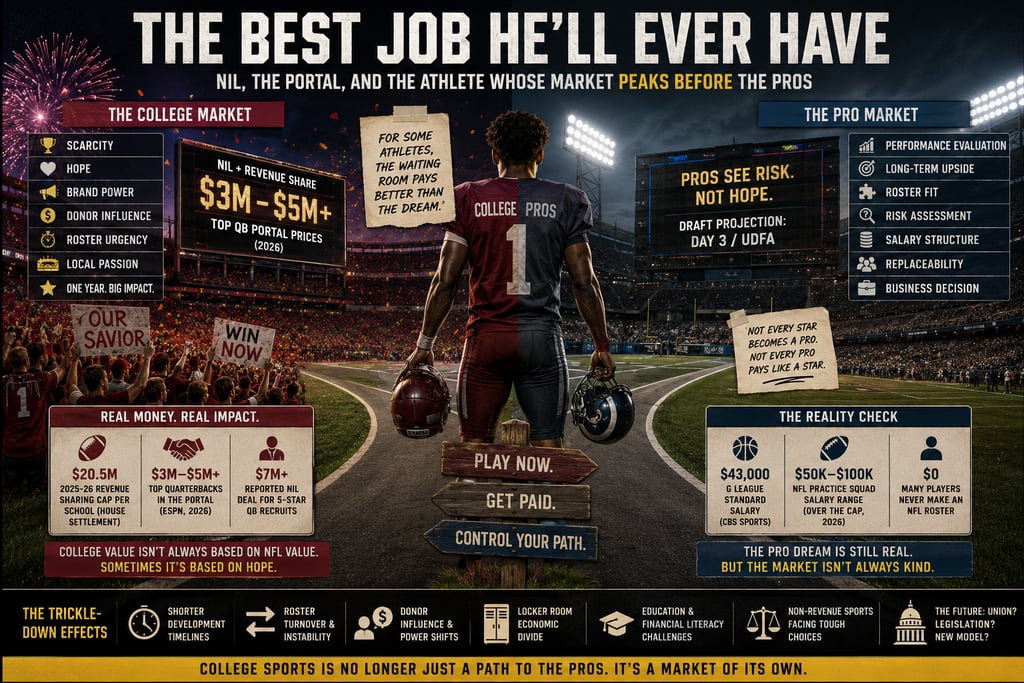
When Carson Beck left Georgia for Miami before the 2025 season, CBS Sports reported that his NIL package was expected to pay him $4 million. That number did not merely reflect his ability to throw a football. It reflected scarcity, timing, brand value, quarterback desperation, donor psychology, roster economics, and the emotional power of hope. Beck was not simply a player transferring from one school to another. He was an asset moving between two competing football economies.
That is the new college sports world in one transaction.
The old dream said the professional level was where value became real. The new market suggests something stranger: for some athletes, college may be the most valuable job they ever have.
This is not because the NFL or NBA has stopped being richer. The major professional leagues remain the financial summit for true stars. A first-round quarterback, a franchise left tackle, a lottery pick, a max-contract basketball player, or a long-career professional will still make more than the college market can plausibly offer. That has not changed.
What has changed is the middle.
The new NIL and transfer-portal economy has created a class of athletes whose college value may exceed their professional value. A quarterback who can transform a fan base’s expectations may be worth millions to a college program even if the NFL sees him as a developmental prospect. A veteran college basketball big man may be more valuable as a campus icon than as a G League forward. A high-major point guard with one year of eligibility may command more from a desperate roster than from any professional team outside the NBA. A five-star recruit may be paid not for what he is, but for what a fan base needs to believe he might become.
That is not amateurism. But it is not normal professionalism either.
It is a new subcategory of American sport: a donor-subsidized, university-branded, emotionally inflated minor-league economy where the market price of an athlete is not always tied to his professional ceiling. Sometimes it is tied to something less rational and more powerful: local hope.
College used to be the unpaid waiting room for the professional dream.
Now, for some athletes, the waiting room pays better than the dream.
I. The Market That Was Not Supposed to Exist
For most of the twentieth century, college athletics maintained its public mythology through a language of separation. College athletes were students. Professional athletes were labor. College sports were educational. Professional sports were commercial. College players represented the university. Professional players represented franchises.
This distinction was never fully honest. Major college football and men’s basketball have been commercial entertainment products for decades. Stadiums expanded, television contracts grew, coaches became multimillionaires, apparel deals multiplied, and universities built athletic departments that looked more like media companies than student-life offices. The amateur ideal survived not because it described reality, but because it served institutional needs.
The athlete remained the one figure around whom the old language could still be enforced.
That arrangement has now collapsed.
The House settlement, approved in 2025, allowed participating Division I schools to share revenue directly with athletes up to a cap that began at $20.5 million per school in 2025-26, with the cap expected to rise over time. Athletes can also continue to sign third-party NIL deals, subject to new reporting and fair-market-value review mechanisms. In other words, the system now formally accepts what it spent generations resisting: athletes in major college sports have economic value because of the sports they play.
That change was overdue. But its arrival did not create a clean professional league. It created a hybrid.
College football now has revenue sharing without a traditional players’ union. It has NIL payments and non-transparent salaries. It has transfer movement without long-term contracts. It has roster limits, but no mature collective-bargaining structure. It has donor collectives, general-manager-style staff positions, third-party deal review, and athletes moving through annual markets — all while universities continue to speak in the language of education, family, development, loyalty, and fit.
The result is not the professionalization of college sports in the clean sense.
It is the professionalization of some parts of college sports without the stabilizing architecture that professional leagues use to manage labor markets.
That is why the system feels so strange. College football has payroll behavior without fully admitting it has become a league. College basketball has free agency without calling it free agency. Schools have athletes whose value is negotiated in markets, but the official vocabulary still struggles to describe what everyone can see.
The market was not supposed to exist.
Now it does.
II. The Athlete Whose Value Peaks Early
Professional sports evaluate athletes ruthlessly.
An NFL team does not care how much a quarterback meant to a campus if it does not believe he can process NFL coverages, protect the ball, survive pressure, and justify a roster spot. An NBA team does not care that a center was beloved in Chapel Hill, Lexington, Spokane, or Bloomington if his foot speed, shooting range, defensive versatility, or age profile does not fit the league. Professional leagues strip away sentiment and reprice the athlete according to a different system.
College markets are not purely sentimental either. Production matters. Winning matters. Scarcity matters. But the college market includes variables that professional leagues often discount: local fame, donor emotion, brand connection, school desperation, roster urgency, recruiting symbolism, and the commercial value of belief.
That is why a player can be worth more in college than in the pros.
The professional market asks: Can he help us win at the next level?
The college market asks a wider and sometimes stranger set of questions: Can he make us believe this season can be different? Can he sell hope? Can he keep a coach employed? Can he stabilize a roster? Can he excite donors? Can he fill a position where the market is thin? Can he keep fans engaged through the offseason? Can he prevent a rival from getting him? Can he make a program feel serious?
Those are real forms of value. They are just not the same as professional value.
This is easiest to see at quarterback. The position has always carried disproportionate importance, but the portal era has turned quarterback scarcity into a market event. ESPN reported that the top returning quarterbacks in the 2026 transfer cycle moved into the $3 million to $5 million range. That is not merely athlete compensation. It is institutional fear with a price tag.
A college quarterback does not need to project as an NFL starter to be worth millions to a college program. He only needs to be the best available solution to a problem that a wealthy fan base desperately wants solved.
That is the athlete whose market peaks before the pros.
He is not necessarily overrated. He may be excellent. He may win games, produce memories, and deserve every dollar he can negotiate. But his college value and professional value may be based on different truths. In college, he can be a savior. In the NFL, he may be a late-round pick, a practice-squad candidate, or a player fighting for anonymity.
The sport has not had enough years in this market to fully understand all its consequences. But the outline is already visible.
For some athletes, the most lucrative identity will not be “professional player.”
It will be “college star.”
III. The Basketball Version: When College Beats the G League
Basketball reveals the same distortion from a different angle.
For years, the old developmental hierarchy was simple. The NBA was the destination. The G League was the developmental bridge. Overseas leagues were alternative professional routes. College basketball was the traditional stage before the decision. Elite players left early if the NBA wanted them. Others stayed until the professional market became available.
NIL changed the calculation.
CBS Sports reported that the standard G League salary is roughly $43,000, a figure that looks modest next to the money available to certain high-profile college players. The same report described how NIL opportunities have encouraged some players to stay in college longer before pursuing the NBA and quoted former North Carolina star Armando Bacot discussing “life-changing money” made while still in college.
That phrase matters because it marks a shift in the emotional economy of college basketball.
For a player like Bacot, college was not simply a platform. It was already a major economic destination. Drew Timme, another instructive case, had multiple NIL deals while at Gonzaga before later spending time in the G League and eventually earning an NBA opportunity. His path shows the new complexity. College money did not eliminate the dream. It changed the runway.
The G League remains valuable. It provides professional development, NBA proximity, and a real path for some players. Timme himself credited the G League with helping him improve. But the comparison now forces a question that would have sounded absurd a generation ago:
Why would a beloved college basketball player rush toward a lower-paying developmental league if staying in school offers more money, more visibility, more stability, and more time to improve?
That question does not have one answer. Age, draft stock, academics, eligibility, coaching, family needs, injury risk, and competitive ambition all matter. But the old assumption has been broken. For some players, college basketball may now be the better job — not just emotionally, but financially.
That also changes college rosters.
Older players may stay. Former professionals may seek NCAA eligibility under loosened amateurism rules. Coaches may recruit not only high school stars and transfers, but players whose careers once would have placed them outside the college system altogether. The boundary between college basketball and developmental professional basketball has blurred.
The result is not simply that athletes are getting paid.
The result is that college has become a competitor to the minor leagues.
IV. The Portal as Price Discovery
The transfer portal is often discussed as chaos. That is true, but incomplete.
The portal is also price discovery.
Before the portal era, a player’s market value was partially hidden. A backup quarterback could sit for years and wonder what he might be elsewhere. A mid-major guard could dominate his league and hope high-major coaches noticed. A left tackle, rim protector, edge rusher, or shooting wing could be underpriced by his current situation because there was no efficient mechanism to test demand.
The portal changed that.
Now the athlete can enter the market and discover what the market thinks. Sometimes the answer is liberating. A player who was buried on a depth chart becomes a starter. A player at a smaller program receives a life-changing opportunity. A coach who failed to value a player properly loses him. The portal can correct old power imbalances.
But markets do not only correct. They also distort.
A compressed transfer window creates urgency. Urgency creates bidding. Bidding creates inflation. Inflation changes behavior. Coaches recruit their own roster while recruiting other rosters. Players evaluate playing time, NIL potential, scheme fit, coach stability, geography, and personal brand. Programs make decisions not only on talent but on availability and timing.
The new windows have made that market more intense, not less. Football moved to a single January window beginning in 2026, while basketball’s proposed and then implemented logic moved toward shorter post-championship windows. A shorter market does not necessarily mean a calmer market. It can mean a more frantic one.
In a normal labor market, price discovery is useful because it helps workers understand their value. In college sports, price discovery now happens inside a culture that still claims to be educational and developmental. That creates tension. An athlete is told to be loyal, patient, and coachable, while the market itself tells him that his value may never be higher than it is right now.
The portal makes that contradiction impossible to ignore.
V. The End of Waiting
College sports used to rely on waiting.
Quarterbacks waited behind upperclassmen. Offensive linemen developed for two or three years. Basketball players learned from older teammates. Baseball players redshirted, reshaped their bodies, and waited for innings. A coach could sell patience because the athlete had fewer practical alternatives. The system had many flaws, but it did create a developmental rhythm.
That rhythm has been disrupted.
Waiting is now a market decision. If a player sits, he loses visibility. If he loses visibility, he may lose leverage. If he loses leverage, he may lose money. The athlete who once might have waited his turn now has a rational reason to ask whether another school can offer snaps, minutes, touches, shots, innings, NIL value, or a clearer role.
This is not selfishness. It is labor reacting to leverage.
But it changes the meaning of a roster.
Teams still need depth. They still need backup quarterbacks, reserve offensive linemen, special teams players, scout-team players, developmental big men, bullpen arms, and practice competitors. Professional teams can pay reserves to be reserves. College teams must persuade ambitious athletes to accept roles that may suppress their market value.
That is difficult.
A backup quarterback at a major program may be one injury away from becoming a legend. He may also be one transfer away from becoming a starter somewhere else. The old coach’s argument — stay, learn, wait, compete, your time will come — now has to compete with another argument: leave, play, earn, build film, control your path.
Neither argument is always right.
But the existence of the second argument changes the first.
The result may be a developmental hollowing out. Coaches may become less patient with freshmen because older transfers are available. Young players may become less patient with development because early playing time has market value. Programs may fill immediate holes rather than build internal succession. Roster continuity becomes harder. The apprenticeship model weakens.
The end of waiting does not mean the end of development.
It means development must now justify itself against movement.
VI. The Donor as Shadow Owner
NIL not only changed athlete compensation. It changed power.
In professional sports, owners own teams. They hire executives, approve payroll, absorb losses, chase titles, and fire people when the investment fails. College sports has traditionally rejected that structure. Universities own the teams. Donors support the programs. Coaches run the roster. Fans provide passion.
NIL collectives complicated that arrangement.
The donor is no longer only a booster who funds facilities, endows scholarships, buys premium seats, or contributes to a coaching buyout. The donor may now help determine whether a quarterback stays, whether a transfer commits, whether a basketball roster can be rebuilt, or whether a coach has the financial ammunition to compete. He does not officially own the team, but his money may still shape it.
That makes him a shadow owner.
This is not necessarily sinister. Many donors love their schools and want athletes compensated. Some collectives have helped athletes access money they should have been able to earn long ago. But the governance problem is obvious. Who decides value? Who sets priorities? Who tells a donor no? What happens when boosters prefer one player and coaches prefer another? What happens when a donor-funded roster fails? What happens when the people paying the players do not formally employ them?
Professional leagues have owners, front offices, contracts, salary caps, and collective-bargaining agreements. College sports has universities, donors, collectives, revenue-sharing caps, third-party NIL, clearinghouses, and compliance systems still trying to catch up with reality.
The power map is unstable.
The old college sports model was paternalistic and exploitative. The new model is freer and fairer in many ways, but it also introduces a new kind of disorder. Athletes have more leverage. Coaches have less control. Donors have more influence. Administrators have more legal exposure. Fans have more reason to think of rosters as investments.
The emotional language of college sports — loyalty, family, tradition — now sits beside a payroll culture no one fully owns.
VII. The Locker Room Class System
College locker rooms have always had status hierarchies.
There were stars and reserves, scholarship players and walk-ons, seniors and freshmen, starters and scout-team bodies. Some players came from privilege, others from poverty. Some were campus celebrities, others were anonymous. Equality was never the reality.
But NIL and revenue sharing make the hierarchy economic in a new and more visible way.
One player may receive a major NIL package. Another may receive a modest revenue-share allocation. Another may receive little outside his scholarship. Another may be told there is no room for him because roster limits and budget priorities have changed. In football, men’s basketball, and women’s basketball, the stars may command real money. In other sports, athletes may wonder what the new compensation era means for them beyond rhetoric.
The House settlement’s revenue-sharing model may eventually help many athletes. But early reporting and institutional logic suggest that the bulk of money at many schools will flow toward the revenue-generating sports, especially football and men’s basketball. That is economically predictable. It is also culturally consequential.
Within a locker room, teammates may now occupy different markets.
That can be healthy if handled transparently and maturely. Professional locker rooms constantly manage salary differences. But college athletes are younger, the rules are newer, and the institution still insists on educational language. A freshman may be asked to block for a quarterback making several million dollars. A walk-on may practice just as hard as a star whose value has become public. A women’s athlete may watch football consume most available dollars while the school speaks broadly about opportunity.
Money does not automatically ruin teams. Secrecy, confusion, resentment, and hypocrisy do.
The locker room class system is not a reason to return to amateurism. It is a reason to admit that compensation changes culture, and culture must be managed rather than denied.
VIII. The Education Problem
The most uncomfortable question is not whether athletes should be paid. They should.
The more difficult question is what universities are now claiming college sports to be.
If an athlete receives direct revenue sharing, negotiates NIL, transfers for market value, hires representation, appears in promotional campaigns, and makes more money than many faculty members, staff members, or assistant coaches, the educational frame does not disappear. But it does become more complicated.
A university can still educate a paid athlete. Payment and education are not mutually exclusive. Graduate assistants are paid. Student workers are paid. Musicians, actors, researchers, and entrepreneurs can earn money while enrolled. The issue is not the mere presence of compensation.
The issue is whether the institution can be honest about the athlete’s role.
In major college football and basketball, many athletes are students, workers, entertainers, brand representatives, and institutional revenue drivers at once. The old language forces them into one category. The new reality places them in several.
That creates practical problems. Who teaches financial literacy? Who helps athletes manage taxes? Who protects them from bad contracts? Who explains that a seven-figure college year may be a one-time event rather than a permanent lifestyle? Who helps a 20-year-old understand that the highest-paying job of his athletic life may arrive before he has fully become an adult?
This is where the “best job he’ll ever have” becomes more than a clever line.
For some athletes, NIL and revenue sharing will create life-changing wealth. For others, it will create short bursts of money without long-term security. A player may earn more at 21 than he ever earns again. That is not a failure if managed well. It can be an extraordinary opportunity. But if the system treats the money as proof that everything is fine, it will fail the people it claims to empower.
The athlete now has leverage.
Leverage requires education, too.
IX. When College Becomes the Minor League and the Major Stage
The phrase “minor league” no longer quite fits college sports.
A minor league is usually subordinate to a professional league. Its purpose is development. Its salaries are lower. Its audiences are smaller. Its cultural meaning is narrower. The best players leave when the major league calls.
College football and basketball now complicate that model.
In football, there is no true minor league for the NFL. College football serves that function athletically, but it is also a massive entertainment product in its own right. A Saturday night in Baton Rouge, Columbus, Ann Arbor, Tuscaloosa, Athens, Knoxville, Austin, State College, Eugene, or Norman is not a minor cultural event. It is a major civic ritual. For many fans, college football is not developmental football. It is the version that matters most.
That is why the economics can become so strange.
The NFL may view a player as marginal. A college town may view him as central. The NFL may price him as replaceable. A donor base may price him as hope. The professional market may see uncertainty. The college market may see a season-ticket campaign, a playoff possibility, a coach’s job, a recruiting signal, and a fan base’s emotional oxygen.
College basketball has its own version. The NBA may not value a 23-year-old traditional post player highly. A college program may value him enormously because he can anchor a top-10 team, become a local icon, and help generate March relevance. The professional market may say he is limited. The college market may say he is priceless.
That is not irrational. It is context.
The same player can have different value in different ecosystems.
This is the core insight of the new era: college sports is no longer simply below professional sports. In some cases, it is a parallel market with different incentives and valuation measures.
That is why some athletes will rationally choose college over the first available professional option.
It may be a better job.
X. The Fallout Still Coming
The system is still young, and its long-term consequences are uncertain. But several fault lines are already visible.
First, college sports will likely move toward a more formal labor structure. Revenue sharing, NIL oversight, transfer movement, and roster limits create conditions that eventually demand collective bargaining, clarification of employment, or federal legislation. The current hybrid may not be stable enough to last.
Second, player contracts will become harder to avoid. If schools and donors are paying significant sums to acquire and retain athletes, they will want predictability. Athletes will want guarantees. Coaches will want roster stability. Everyone will eventually want something closer to enforceable terms.
Third, development may become a competitive differentiator. Programs that can combine market aggression with real player development will have an advantage over programs that simply shop annually. Buying older players can solve problems quickly, but it cannot fully replace coaching, culture, strength development, tactical teaching, and trust.
Fourth, non-revenue sports will face hard questions. Revenue sharing may force athletic departments to make budget choices that expose which sports and athletes the institution truly values. Title IX questions, donor preferences, roster limits, and school priorities will collide.
Fifth, athlete financial education will become urgent. The system is creating young earners before it has created enough structures to help them remain financially healthy. A bad tax plan, a bad agent, a bad spending habit, a bad contract, or a bad assumption about future professional value can turn a life-changing opportunity into a temporary illusion.
Finally, fans will have to decide what they actually want college sports to be. Many wanted athletes to be paid. Many also want continuity, loyalty, tradition, and the emotional innocence of the old system. Those desires may not all fit together. A market that pays players will behave like a market. It will reward movement, leverage, scarcity, negotiation, and self-interest.
That does not make it wrong.
It makes it real.
Conclusion: The Waiting Room Has Become the Job
The old model of college sports was unjust because it denied athletes access to the value they helped create. The new model is better in that essential respect. Athletes can earn. They can move. They can negotiate. They can benefit from their names, images, likenesses, labor, production, and scarcity.
That progress should not be minimized.
But the new system also deserves clear-eyed analysis. College sports has not simply become fairer. It has become stranger. It has created a market in which some athletes may be worth more to a campus than to a professional league, more to donors than to scouts, more to a fan base than to a general manager, more as symbols of possibility than as long-term professional assets.
For those athletes, college is no longer only preparation.
It is the peak market.
That should change how they think. It should change how schools educate them. It should change how coaches recruit them. It should change how families advise them. It should change how fans talk about loyalty. It should change how universities describe what they are actually doing.
The phrase “student-athlete” was built to contain a contradiction. The contradiction has outgrown the phrase.
A player can now be a student, an employee in all but name, a brand, a transfer asset, a donor priority, a locker-room teammate, a campus celebrity, a developmental prospect, and a short-window earner at the same time. That is too much reality for the old language to handle.
The professional dream is still there. For the very best, it remains the summit.
But for a growing class of athletes, the most revealing question may no longer be, “When will he get to the next level?”
It may be something stranger:
What if this is the best job he’ll ever have?
Selected References
BakerHostetler. (2025). House v. NCAA settlement sparks new age of student-athlete compensation.
CBS Sports. (2025). Behind Miami’s multi-million-dollar push for QB Carson Beck, who lands a top-tier NIL package to transfer.
CBS Sports. (2025). How NIL money is impacting the G League and keeping ex-college basketball stars closer to their NBA dreams.
ESPN. (2026). College football transfer portal trends: Costs rising.
NCAA. (2025). Notification-of-transfer window changes proposed in DI men’s and women’s basketball.
National Conference of State Legislatures. (2025). What the NCAA settlement means for colleges and state legislatures.
Over the Cap. (2026). NFL minimum salaries and practice squad salaries.
Reuters. (2026). QB Brendan Sorsby passes on NFL lawsuit, begins prep for 2027 draft.
Yahoo Sports. (2025). Why G League players are being allowed to play college basketball.
Southland Storyworks
Narrative. Performance. Meaning.
Home-Sports
Inquiries
news@southlandstoryworks.com
Based in the American South
Submissions welcome via email
© 2026 Southland Storyworks-An independent publication exploring the psychological frameworks of competition.
Narrative architecture & performance psychology