
The Adaptation Gap
Why More Work Is Not Always Better
SPORTS
Steven Bradley
7/9/20266 min read
Modern athletes are surrounded by evidence of effort.
The early workout. The extra practice. The weight-room video. The wearable data. The recovery post. The offseason grind. The tournament schedule. The private lesson. The speed session. The meal plan. The training block. The caption about doing what others will not.
Sport has always valued work, but the modern performance culture has become especially fluent in displaying it. Effort is visible. Volume is countable. Intensity photographs well. A hard workout looks like commitment. A long practice session looks like seriousness. A packed calendar looks like ambition.
But effort is not the same as development.
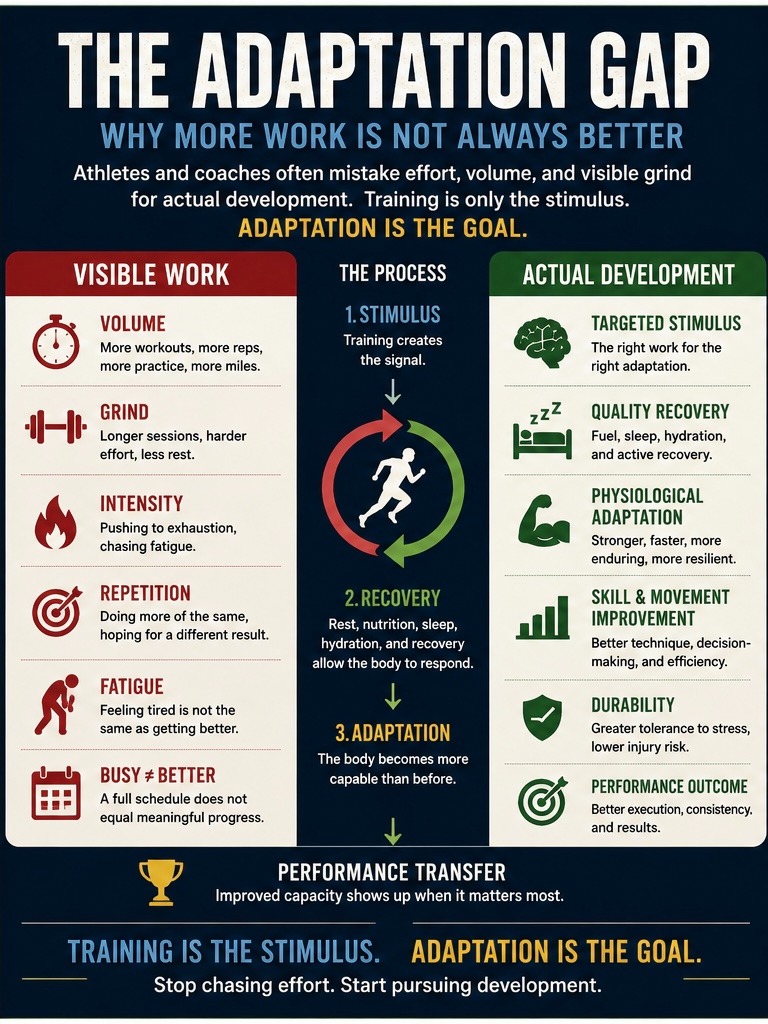
Training is only the stimulus. Adaptation is the goal.
That distinction matters because athletes and coaches often mistake the thing that initiates change for the change itself. A training session does not automatically make an athlete better. Practice does not automatically create skill. Conditioning does not automatically create durability. Lifting does not automatically create useful strength. Repetition does not automatically create transfer.
The body and brain must respond. Tissue must repair. Energy stores must be replenished. Movement patterns must become more efficient. Attention must become more stable. The athlete must recover enough to absorb the work, then return with a greater capacity than before.
Without that response, training becomes only stress.
The Culture of More
The simplest way to misunderstand training is to assume that more is always better.
More hours. More reps. More weight. More speed. More tournaments. More showcases. More miles. More swings. More shots. More film. More lessons. More intensity.
Sometimes more is necessary. Athletes do not develop without stress. Skill does not grow without repetition. Strength does not increase without loading. Endurance does not improve without challenging the aerobic system. Power does not emerge without asking the body to produce force quickly. No serious athlete can build capacity through comfort alone.
But “more” is useful only when it is connected to the right adaptation.
The question is not simply: Did the athlete work hard?
The better question is: What did the work ask the athlete to become?
That is where the gap opens. Many athletes can describe what they did. Fewer can describe what adaptation they were trying to create. They know they trained legs, hit balls, ran sprints, lifted heavy, practiced for two hours, played four games, or stayed late after practice. They may not know whether the goal was strength, power, mobility, endurance, coordination, decision-making, recovery capacity, tissue resilience, technical transfer, or competitive regulation.
When the adaptation is unclear, work becomes self-justifying.
The athlete feels serious because he is tired. The coach feels productive because the session was full. The parent sees effort. The team sees activity. But the body does not adapt to seriousness. It adapts to specific stress followed by sufficient recovery.
The Stimulus Is Not the Response
Training works because the body responds to imposed demands.
A strength program creates mechanical tension and neuromuscular demand. A conditioning session challenges energy systems. A mobility routine addresses usable range of motion. A speed session asks the nervous system to produce force quickly. A practice task challenges perception, movement, attention, and decision-making. Nutrition, sleep, hydration, and recovery help determine whether those stresses produce positive change or accumulating fatigue.
This is the part performance culture often underestimates.
The workout is not the adaptation. It is the request.
The body still has to answer.
If training stress is appropriate and recovery support is adequate, the athlete can improve. If stress is too low, adaptation may be minimal. If stress is too high, too frequent, poorly targeted, or unsupported by recovery, performance can decline. The athlete may feel committed while becoming less prepared.
That is the paradox of the grind.
A person can work extremely hard and still fail to improve if the work is poorly organized, poorly recovered from, or disconnected from the performance demand. The athlete may become tired rather than better. He may accumulate soreness rather than capacity. She may practice enough to reinforce the wrong pattern. A team may train hard enough to look committed and still arrive flat when the competition begins.
The question is not whether work matters.
It is whether the work is producing the intended response.
Recovery Is Not the Opposite of Training
One reason the adaptation gap persists is that recovery is often treated as passivity.
Training feels active. Recovery feels like stopping. Practice feels productive. Sleep feels ordinary. Conditioning looks like discipline. Hydration looks basic. Lifting looks serious. Eating well looks domestic. The visible work receives more respect than the invisible conditions that allow the work to take hold.
But recovery is not the opposite of training. It is part of the training process.
An athlete does not become stronger during the heaviest set. Strength increases through the body’s response after appropriate loading. Endurance improves as the cardiovascular and muscular systems adapt to repeated demand. Skill improves as the nervous system organizes perception and action across repetition, feedback, and consolidation. Training creates the signal. Recovery helps make the signal useful.
Nutrition belongs inside this same process. Food is not simply fuel before performance. It supports energy availability, tissue repair, immune function, hydration status, and adaptation to exercise. A poorly fueled athlete can still train hard, but the body may not be prepared to respond well. A dehydrated athlete can still compete, but decision-making, concentration, perceived exertion, and movement quality may suffer. An under-recovered athlete can still show up, but showing up is not the same as being ready.
The most serious athletes do not treat recovery as weakness.
They treat it as the place where training becomes performance.
The Specificity Problem
Adaptation is specific.
That is one of the most important principles in training and one of the easiest to ignore. The body adapts to the kind of stress it repeatedly experiences. Heavy resistance training may improve maximal strength. Sprint work may improve acceleration and repeated high-intensity capacity. Mobility work may improve usable range. Aerobic conditioning may improve fatigue resistance and recovery between efforts. Technical practice may improve skill if the practice environment actually resembles the demands of performance.
This is why training must be connected to the sport.
A football player, golfer, distance runner, tennis player, soccer midfielder, baseball pitcher, and aging recreational athlete do not all need the same training plan. They may share general needs — strength, mobility, coordination, endurance, recovery — but the emphasis, volume, timing, and application should reflect the demands of the sport and the individual athlete.
Specificity does not mean every exercise must mimic the sport. That is a common mistake. A golfer does not need every gym movement to look like a golf swing. A football player does not need every lift to look like a tackle. A soccer player does not need every conditioning activity to look like a match. General physical qualities matter.
But the plan must still answer the right question: What performance problem are we trying to solve?
Is the athlete unable to produce enough force? Unable to maintain quality late in competition? Unable to move through an efficient range of motion? Unable to recover between repeated efforts? Unable to tolerate the training load? Unable to repeat technique under fatigue? Unable to stay mentally clear when energy drops?
Training should be selected because it serves the adaptation, not because it looks demanding.
When Effort Becomes Identity
The adaptation gap is not only physiological. It is cultural.
Athletes often build identity around work. They want to be the kind of person who does extra. Coaches want teams that work hard. Parents want to see investment. Fans admire visible sacrifice. Social media rewards intensity. “No days off” is easy to understand. “Appropriate loading and recovery to support targeted adaptation” does not fit as well on a hoodie.
This can make better training emotionally difficult.
A smarter plan may sometimes look less heroic. It may require fewer reps, more rest, lower intensity, better sleep, more food, less tournament travel, a lighter practice day, a mobility block, or a recovery week. It may ask the athlete to stop chasing the emotional satisfaction of exhaustion and start respecting the slower process of adaptation.
That can feel like doing less.
In reality, it may be the more disciplined choice.
The serious athlete is not the one who always does the most. The serious athlete is the one who understands what kind of work is required, what kind of recovery makes that work useful, and what kind of adaptation must appear in performance.
The Better Question
The adaptation gap closes when athletes and coaches change the question.
Instead of asking only, “How hard did we work?” they should ask:
What are we trying to improve?
What stress will create that adaptation?
How much stress is enough?
What recovery is required?
How will we know whether the adaptation occurred?
How will it transfer into competition?
Those questions do not weaken training. They make training more serious. They turn effort into a method rather than a performance. They remind the athlete that fatigue is not the prize. Improvement is.
Hard work still matters. So does intensity. So does volume. So does sacrifice. But none of those are the final measure.
The final measure is whether the athlete becomes more capable.
Training is the stimulus. Recovery allows the response. Adaptation is the outcome.
That is the difference between looking committed and actually developing.
Selected References
Bompa, T. O., & Buzzichelli, C. (2019). Periodization: Theory and methodology of training.
Jäger, R., et al. (2017). International Society of Sports Nutrition position stand: Protein and exercise.
Kerksick, C. M., et al. (2018). ISSN exercise & sports nutrition review update: Research & recommendations.
Smith, M. F. (2010). The role of physiology in the development of golf performance.
Thomas, D. T., et al. (2016). Nutrition and athletic performance.
Wells, G. D., Elmi, M., & Thomas, S. (2009). Physiological correlates of golf performance.
Southland Storyworks
Narrative. Performance. Meaning.
Home-Sports
Inquiries
news@southlandstoryworks.com
Based in the American South
Submissions welcome via email
© 2026 Southland Storyworks-An independent publication exploring the psychological frameworks of competition.
Narrative architecture & performance psychology