
The Accountability Gap: Excuses, Attribution, and the Stories Athletes Tell After Failure
A formal examination of how athletes explain failure, protect identity, and either stall or accelerate growth through the stories they tell after competition. This piece explores self-handicapping, attribution theory, and performance accountability as tools for turning postgame explanations into meaningful improvement.
Steven Bradley
7/5/20263 min read


Failure in sport is rarely interpreted neutrally. Athletes do not simply lose, miss, collapse, or underperform; they explain. A poor outing becomes a product of difficult conditions, imperfect preparation, questionable officiating, nagging injury, poor timing, or unusual distraction. Some of these explanations may be true. Others may be partial truths. Still others function less as analysis than as protection. The athlete is not only reporting what happened; they are preserving a story about who they are.
That distinction matters because competitive performance is inseparable from identity. Athletes invest years building an internal and public sense of competence. When performance contradicts that identity, the mind often seeks a buffer. In psychological terms, this behavior aligns with self-handicapping, a pattern in which individuals create or emphasize obstacles that protect self-worth in the event of failure (Jones & Berglas, 1978). The athlete’s implicit argument becomes: I did not fail because I lacked ability; I failed because circumstances interfered.
This is not merely a weakness of character. It is a recognizable human response to threat. Sport exposes the self with unusual clarity. Scores, times, rankings, statistics, and video make performance visible. In team sports, responsibility can be distributed across teammates, coaches, systems, and strategy. In individual sports, the exposure is even sharper. The performer stands closer to the outcome. The temptation to soften that exposure through explanation is therefore understandable.
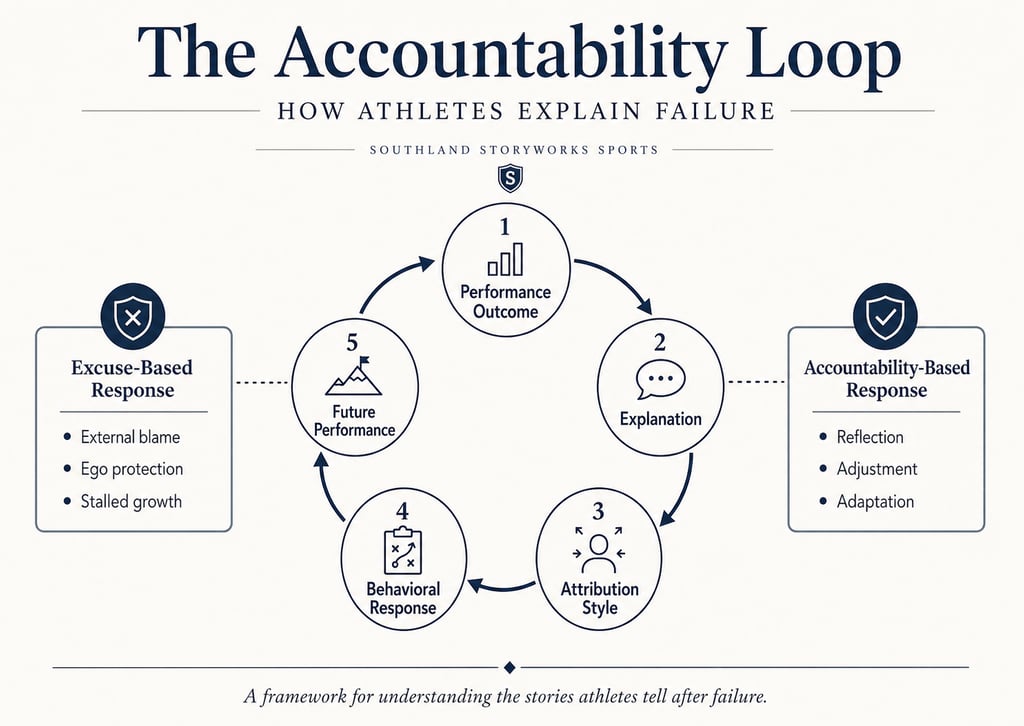
Attribution theory helps explain the pattern. Athletes often interpret success and failure in terms of causes that are internal or external, stable or unstable, controllable or uncontrollable (Weiner, 1985). A productive attribution might be, “I rushed my preparation and did not commit to the plan.” That explanation is internal, unstable, and controllable. It preserves agency. A less productive attribution might be, “The conditions were impossible,” or “Nothing went my way.” Those explanations may contain evidence, but if repeated habitually, they shift attention away from controllable improvement.
This is where sports narratives become consequential. Athletes are storytellers under stress. The postgame interview, the locker-room explanation, the private journal entry, and the conversation on the ride home all shape the athlete’s next response. A story built around external blame may protect confidence for a moment, but it can also delay growth. A story built around responsibility may sting initially, but it gives the athlete something to train.
The best performance cultures do not eliminate context. Weather matters. Injuries matter. Fatigue matters. Resources, travel, pressure, and personal circumstances matter. Accountability does not require pretending that external factors do not exist. Rather, it requires distinguishing between context and surrender. The disciplined athlete can acknowledge real constraints while still asking the more useful question: What part of this remains mine to address?
That question moves the athlete from excuse to analysis. “The crowd distracted me” becomes “I need a more durable attentional routine.” “The surface was poor” becomes “I need to adapt earlier to changing conditions.” “I was tired” becomes “My recovery plan failed before the competition began.” The explanation is not discarded; it is refined into a training target.
This shift is especially important for coaches, parents, and performance staff. The goal is not to shame athletes for making excuses. Shame usually produces defensiveness, not honesty. Instead, the goal is to help athletes audit their language. What excuses appear repeatedly? Are they physical, environmental, technical, social, psychological, or strategic? Do they point toward a controllable weakness? Do they reveal a preparation gap? Do they protect the athlete from a truth that must eventually be faced?
In that sense, excuses can become diagnostic tools. They reveal where identity feels fragile. They show which outcomes the athlete is unwilling to own. They expose the difference between performance reflection and performance avoidance. Used well, they become entry points into better coaching.
The mature athlete does not become great by never offering an excuse. That standard is unrealistic. The mature athlete improves by recognizing the excuse, testing it against evidence, and extracting a controllable lesson. The question is not simply, “Was the excuse true?” The better question is, “Does this explanation give me responsibility, clarity, and a path forward?”
Sport rewards talent, preparation, resilience, and adaptation. Excuses interfere with adaptation when they become a permanent substitute for feedback. They serve only to perform when they are converted into an honest evaluation. The athlete’s story after failure is therefore not a minor detail. It is part of the training environment.
Performance integrity begins when explanation becomes ownership. The athlete who learns to say, “That happened, and this is what I will do next,” has already taken the first step toward improvement.
Selected References
Jones, E. E., & Berglas, S. (1978). Control of attributions about the self through self-handicapping strategies: The appeal of alcohol and the role of underachievement. Personality and Social Psychology Bulletin, 4(2), 200–206. https://doi.org/10.1177/014616727800400205
Rotter, J. B. (1966). Generalized expectancies for internal versus external control of reinforcement. Psychological Monographs: General and Applied, 80(1), 1–28.
Snyder, C. R., Higgins, R. L., & Stucky, R. J. (1983). Excuses: Masquerades in search of grace. Wiley.
Weiner, B. (1985). An attributional theory of achievement motivation and emotion. Psychological Review, 92(4), 548–573. https://doi.org/10.1037/0033-295X.92.4.548
Southland Storyworks
Narrative. Performance. Meaning.
Home-Sports
Inquiries
news@southlandstoryworks.com
Based in the American South
Submissions welcome via email
© 2026 Southland Storyworks-An independent publication exploring the psychological frameworks of competition.
Narrative architecture & performance psychology