
Power Without Fluency
What Belgium Exposed About American Soccer
SPORTS
Steven Bradley
7/7/202612 min read
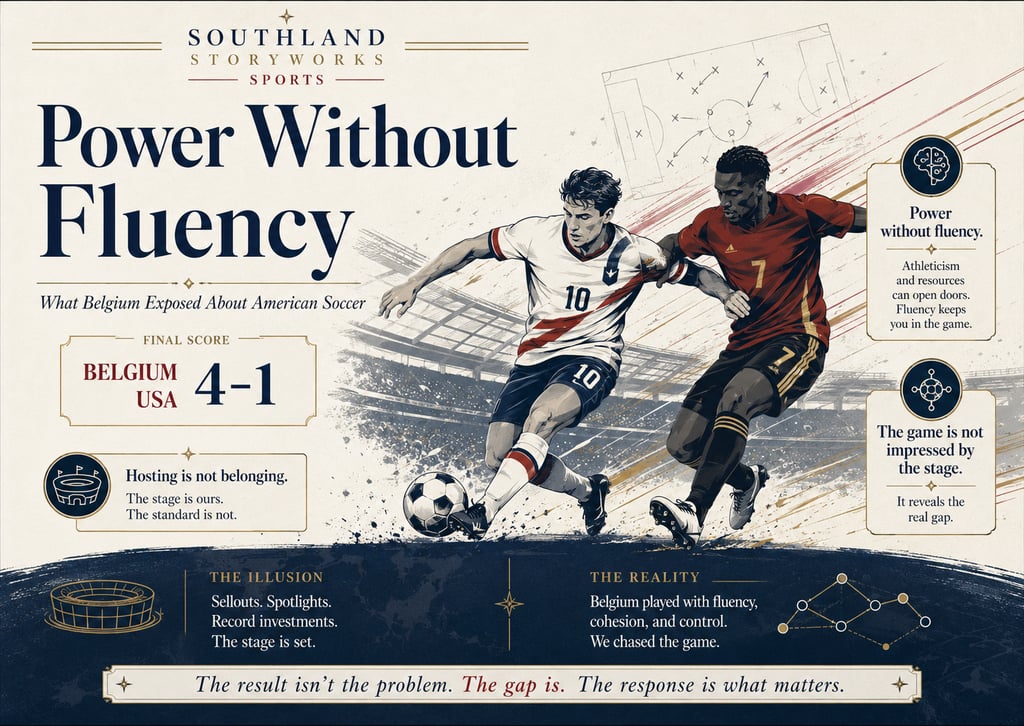
The United States did not exit its home World Cup with the dignity of a narrow defeat to a great side.
That would have been easier to explain. It would have fit the country’s preferred soccer narrative: progress, heartbreak, fine margins, another lesson learned against one of the sport’s giants. If Brazil, Argentina, France, Spain, or England had ended the American run with one moment of genius, the familiar language would have been available. Proud effort. Tough break. Growing game. Bright future.
Belgium took that story away.
The final was 4-1 in Seattle, and the score did not feel misleading. Belgium was good, organized, professional, and ruthless, as serious tournament teams often are. But this was not a performance that required the full mythology of European football to explain. Kevin De Bruyne did not start. Jérémy Doku did not start. Romelu Lukaku came off the bench. The decisive figure was Charles De Ketelaere, who scored twice and assisted another goal as Belgium punished American defensive errors and advanced to the quarterfinals.
That is what made the match so clarifying.
The United States did not lose because it encountered football’s outer limit. It lost because it faced a competent European side that understood the game better, punished mistakes more effectively, and carried itself with the adult assurance of a team that did not need the night to become historic to know what it was doing.
For the U.S., the night had been framed as something larger. A home World Cup. A round-of-16 match. A chance to validate years of rhetoric about growth, investment, European club experience, player development, and the long-awaited arrival of American soccer. The expanded format had already delivered one symbolic victory: a knockout-stage win over Bosnia-Herzegovina in a newly created Round of 32. The crowd was there. The spectacle was there. The political attention was there. The emotional hunger was there.
Then Belgium played the game.
And the game was not impressed.
I. The Difference Between Hosting and Belonging
The United States can stage global soccer. That much is no longer in doubt.
It has the stadiums, the security apparatus, the broadcast infrastructure, the corporate sponsors, the hospitality systems, the political access, the entertainment machinery, and the market size. It can sell the World Cup, package the World Cup, protect the World Cup, and turn the World Cup into a continental event. It can create the stage.
But staging the game and belonging to the game are different achievements.
That is the paradox Belgium exposed. The U.S. is powerful within soccer but still uncertain inside it. It can host the tournament better than almost anyone, but it has not yet built a national team capable of consistently moving through the sport’s most difficult competitive rooms. It can produce athletes who play at major European clubs, fill stadiums with red, white, and blue, and generate an enormous domestic media event. But when the match becomes compressed into decisions, spacing, timing, pressure, defensive recognition, and punishment of mistakes, the gap remains visible.
That gap is not simply technical. It is cultural.
The countries that naturally belong to the competitive heart of world football do not merely produce players. They produce shared fluency. They produce coaches, supporters, academies, neighborhood arguments, tactical language, inherited expectations, collective memory, and a public that understands the game’s rhythms. They can be irrational, sentimental, cruel, delusional, and unfair, but they are rarely naïve about the sport itself.
American soccer still often sounds as if it is translating football into a language it understands better: effort, belief, athleticism, opportunity, exposure, breakthrough, growth. Those are not useless words. They matter. But Belgium reminded the U.S. that world football eventually asks less sentimental questions.
Can you defend the second ball?
Can you survive the minute after scoring?
Can your goalkeeper manage pressure?
Can your older center back hold up when isolated?
Can your star change the game?
Can your team identify danger before the danger becomes a goal?
The U.S. had answers in moments. Belgium had answers across the match.
II. The New Knockout Win and the Old Measuring Stick
One of the strange effects of the expanded World Cup is that it creates new milestones before the sport has decided how much they mean.
The United States won a knockout game. That sentence is technically true. It beat Bosnia-Herzegovina in the Round of 32, a new stage created by the 48-team format. For a country that has spent decades measuring itself against the sport’s established nations, that result carried symbolic value. It ended a long wait for a knockout victory. It gave the home crowd something to celebrate. It allowed the tournament to feel, for a few days, like a national step forward.
But it did not answer the old question.
The old question was never whether the U.S. could beat Bosnia-Herzegovina at home in an expanded bracket. The old question was whether the United States could beat a serious European side in a match that felt like the World Cup as the rest of the world has long understood it: unforgiving, technical, tactically mature, emotionally exacting, and uninterested in American momentum.
Belgium answered that question.
The result did not erase everything the U.S. did well in the tournament. Three wins at a World Cup should not be dismissed entirely, and the team's support was genuine. But the scale of the defeat changed the meaning of the run. It suggested that the expanded format may have given American soccer a new line for the résumé without changing its underlying position in the hierarchy.
There is a difference between reaching a round and belonging there.
That distinction matters because American soccer culture is often tempted by ceremonial progress. It likes markers: more players in Europe, more MLS academies, more investment, more fans, more coverage, more credibility, more proof that the country is finally arriving. But the arrival is not declared. It is demonstrated under pressure against teams that know how to make your weaknesses matter.
Belgium did not merely eliminate the United States. It restored the measuring stick.
III. The Balogun Affair: Power Without Fluency
The Folarin Balogun controversy gave the match an almost novelistic layer.
Balogun had been shown a red card against Bosnia-Herzegovina, which normally would have meant an automatic suspension for the next match. Then, President Donald Trump reportedly called FIFA president Gianni Infantino to urge a review. FIFA ultimately lifted the suspension, allowing Balogun to play against Belgium. Belgium objected. FIFA rejected Belgium’s challenge. The episode became an international story before the ball was even kicked.
For American fans, the decision was easily absorbed into the language of justice. The red card was viewed by many as harsh or unfair, and Balogun had been one of the few U.S. players producing decisive moments. If the ban could be lifted, why not lift it? If the country had influence, why not use it?
But from the outside, the episode looked different. It made the host nation’s political power visible within the tournament's disciplinary machinery. It raised questions about fairness, process, and FIFA’s credibility. It also placed American soccer in an awkward position, requiring an extraordinary institutional intervention before a match intended to demonstrate competitive readiness.
Then Belgium won 4-1.
That is what makes the sequence symbolically brutal. The U.S. got its striker back. It got the ruling. It caught the president's attention. It got the full treatment as a host-country priority. And none of it solved the football problem.
This is the difference between power and fluency.
Power can get a phone call answered. Power can elevate a controversy. Power can apply pressure to institutions. Power can make a disciplinary decision into a geopolitical drama. But power cannot mark De Ketelaere in the box. It cannot prevent a goalkeeper’s mistake. It cannot make a defensive line recognize danger a half-second earlier. It cannot give the national team the accumulated football intelligence that other countries have built over generations.
The Balogun affair may be remembered less for whether FIFA’s decision was technically defensible than for what followed. The U.S. entered the match with its leading scorer restored. Belgium entered with irritation. The game then reduced the controversy to irrelevance.
That is one of soccer’s harsher truths. Institutional power may shape the conditions around a match. It cannot play the match for you.
IV. Pulisic and the Burden of the American Star
Christian Pulisic has carried a strange burden for most of his public life.
He is a very good player who has often been asked to symbolize something larger than his actual role. He has had to be proof of American development, proof of European credibility, proof that the country could produce a genuine attacking player, proof that the U.S. was no longer merely athletic and earnest. He has played for major clubs, produced important moments for the national team, and given American soccer a star around whom it could build belief.
But the World Cup is cruel to symbolic players.
Pulisic finished the tournament without a goal. Against Belgium, he was injured in the second half and eventually replaced. His tournament did not become the home-soil coronation the American soccer imagination wanted. It became, instead, a reminder of the danger of asking one player to carry a national myth.
This is not an argument that Pulisic failed alone. He did not. Soccer is too interconnected for that kind of simplicity. A winger or attacking midfielder depends on buildup, movement, spacing, tactical structure, service, transition moments, and teammates who can occupy defenders to create usable space. Pulisic’s quiet tournament says something about him, but it also says something about the team around him.
Still, his non-factor status matters because American soccer has often needed stars to do cultural work. Landon Donovan had to carry the post-2002 possibility of belief. Clint Dempsey had to carry defiance. Pulisic has had to carry legitimacy. Each generation produces a figure onto whom the country projects its ambitions for the next stage.
The problem is that world football does not reward symbolism by itself.
Belgium did not need De Ketelaere to be a national metaphor. It needed him to arrive in the box, finish chances, combine with teammates, and punish defensive uncertainty. Lukaku did not need to explain Belgium’s footballing identity. He needed to enter late and score. De Bruyne could sit out because Belgium did not make its most famous player the entire story.
That is one mark of a more mature football nation. Its stars matter, but the system does not collapse into the symbolism of one man.
The United States is not there yet.
V. The Fan Problem Is Also a Fluency Problem
The Belgium match not only exposed the team, but also the coach. It also exposed the public conversation around the team.
For much of the previous week, American soccer discourse had been consumed by the Balogun red card. Many fans insisted that the decision was incomprehensible, corrupt, anti-American, or proof that the world did not want the U.S. to advance. Some of that anger was natural. Fans defend their players. National tournaments create emotional distortion. Red cards always generate arguments.
But the larger pattern was revealing.
American fans often want soccer to behave more like the American sports they understand better. They want officiating explanations to produce final moral clarity. They want procedural fairness to resemble replay review. They want physical contact interpreted through sports cultures that reward collision differently. They want knockout success to fit familiar narratives of clutch performance, momentum, and destiny.
Soccer resists that.
It is not that American fans are uniquely irrational. Football supporters everywhere are irrational. Every country has grievances, conspiracies, complaints, delusions, and selective memories. But countries with deeper football cultures tend to possess a more practiced irrationality. Their arguments rest on a shared understanding of the game’s logic. They may rage at a red card, but they usually understand the category of the offense. They may blame the referee, but they also know when the center backs have been poor.
The American conversation still too often skips the football and goes directly to the grievance.
That matters because fan literacy shapes media literacy, and media literacy shapes national expectations. If the public conversation cannot distinguish between injustice and unfamiliarity, between bad luck and bad defending, between exposure and development, then the country’s soccer culture remains emotionally louder than it is analytically fluent.
Belgium did not care about the discourse. It simply played through it.
VI. The Development Problem Beneath the National Team
The temptation after a World Cup exit is to make the discussion entirely about the manager, the lineup, the goalkeeper, the star, the missed chance, the red card, or the federation. Those questions matter. They are part of the immediate autopsy. But a 4-1 defeat at home to Belgium points toward something deeper than one night’s selections.
The United States has spent decades trying to solve soccer as a development problem. More academies. More coaching education. More professional pathways. More European transfers. More MLS investment. More youth participation. More data. More scouting. More attention. More seriousness.
All of that has produced better players. It has not yet produced a true footballing ecosystem.
That difference is crucial.
An ecosystem is not only a pipeline. A pipeline moves selected players from youth levels to professional levels. An ecosystem creates the conditions in which players, coaches, families, fans, schools, clubs, journalists, and communities understand the game together. It develops not just talent, but taste. It teaches people what good looks like before it becomes obvious. It produces informal play, tactical conversation, coaching density, competitive humility, and the kind of shared football memory that cannot be imported quickly.
American soccer has often tried to compensate for the absence of that ecosystem with structure. Travel teams, pay-to-play clubs, showcases, academies, rankings, tournaments, elite platforms, recruiting pathways, federation initiatives. The country is excellent at building systems around opportunity. It is less clear that those systems consistently produce the fluency the game demands at the highest level.
This is where the national team becomes a mirror.
The U.S. had players with European club experience. It had a famous manager. It had home crowds. It had institutional attention. It had a favorable enough tournament path to create belief. But against Belgium, the familiar weaknesses returned: defensive fragility, lapses after emotional moments, difficulty controlling game state, dependence on individual sparks, and a gap between American optimism and football reality.
The lesson is not that the U.S. produces bad players. It does not. The lesson is that producing good players is not the same as producing a team capable of repeatedly beating serious football nations under tournament pressure.
That is the next developmental frontier.
VII. Belgium as the Perfect Opponent
Belgium was an almost perfect opponent for this reckoning because Belgium was good enough to expose the United States without being so great that the loss could be mythologized.
This was not peak Spain passing the U.S. into exhaustion. It was not Messi’s Argentina bending the tournament around one final act of genius. It was not France overwhelming the match with Mbappé’s speed and depth of talent. It was Belgium: experienced, capable, occasionally brilliant, but not untouchable.
That makes the defeat harder to soften.
If the United States wants to be more than a respectable participant, Belgium is exactly the kind of team it eventually must beat. Not every time. Not easily. But sometimes, especially at home, especially with its best generation in years, especially when the opponent does not begin with all its most famous attacking weapons on the field.
Instead, Belgium looked like the more mature football country.
It responded immediately after conceding. It punished mistakes. It pressed effectively. It used diagonals and crosses to expose defensive uncertainty. It allowed the American crowd to rise, then quieted it. It did not need to dominate every phase aesthetically. It simply understood which moments mattered and acted decisively within them.
That is tournament football.
The U.S. still too often treats the World Cup as an emotional test. Belgium treated it as a professional one.
VIII. The 2030 Problem
The loss also complicates the future.
This American generation has long been discussed as the one that would lift the national team into a new era. Pulisic, Tyler Adams, Weston McKennie, Antonee Robinson, Tim Weah, Sergiño Dest, Folarin Balogun, Gio Reyna, Yunus Musah, and others gave the program a level of club pedigree and technical ability that previous generations did not possess in the same concentration.
But 2026 was the home World Cup. It was supposed to be the moment when promise met stage. By 2030, many of the central figures will be in or near their thirties. Some may still be effective. Some may not. Soccer careers age unevenly. Injuries, club situations, managerial changes, and form will intervene.
The deeper concern is whether the next wave clearly looks better.
That is not obvious. The U.S. will continue to produce players. It will continue sending some to Europe. MLS academies will continue improving. But the question is not whether there will be names. There will always be names. The question is whether the next generation changes the competitive equation.
After Belgium, that question feels more severe.
If the home World Cup, expanded field, political attention, best-known generation, and national momentum produced a 4-1 round-of-16 exit, then the problem cannot be explained away as a lack of exposure. The U.S. has exposure. It has access. It has resources. It has belief.
What it still lacks is fluency.
Conclusion: The Game Is Not Impressed by the Stage
The 2026 World Cup did not prove that America cannot host the world’s game. It proved the opposite. The United States can host it, sell it, broadcast it, celebrate it, and surround it with scale. It can bring the tournament into enormous stadiums and make it feel like a national event.
But Belgium showed that staging the World Cup and belonging to it are different things.
Belonging is not achieved through market size. Home crowds do not grant it. European club résumés do not secure it. Presidential phone calls do not produce it. It is not created by an expanded bracket or a newly available knockout win. It is earned in the details the game never stops measuring: pressure, recognition, timing, decision-making, composure, defensive reliability, attacking clarity, and collective understanding.
The United States has power around the game.
It does not yet have fluency inside it.
That is what Belgium exposed. Not that American soccer has made no progress. It has. Not that the sport cannot grow in the country. It already has. Not that the U.S. will never become a serious World Cup nation. It may.
But the next step is not a slogan, not a marketing campaign, not a generational label, and not another declaration that soccer has finally arrived.
The next step is harder and less theatrical.
America must learn the game deeply enough that the stage no longer feels bigger than the football.
Selected References
Associated Press. (2026, July 7). Belgium beats US 4-1 to reach World Cup quarterfinals, taking advantage of defensive lapses.
Reuters. (2026, July 6). Trump intervention causes World Cup storm as FIFA clears US striker Balogun to face Belgium.
Reuters. (2026, July 6). FIFA rejects Belgium challenge over US striker Balogun’s eligibility for World Cup clash.
U.S. Soccer. (2026, July 7). USMNT vs. Belgium: Match recap & highlights, FIFA World Cup 2026.
The Guardian. (2026, July 6). Ragged USA crash out of World Cup with last-16 defeat to Belgium.
Southland Storyworks
Narrative. Performance. Meaning.
Home-Sports
Inquiries
news@southlandstoryworks.com
Based in the American South
Submissions welcome via email
© 2026 Southland Storyworks-An independent publication exploring the psychological frameworks of competition.
Narrative architecture & performance psychology