
After America
10 Reasons the World Cup Is Just Getting Good
SPORTS
Steven Bradley
7/8/202613 min read
This is not a conversion attempt.
If someone truly does not like soccer, that is fine. Every sport has its unbelievers. Baseball has people who find it too slow. Golf has people who see only grass and waiting. Basketball has people who think the first three quarters do not matter. In football, some people cannot get past the stoppages. Soccer has people who will always see too few goals, too much passing, too many whistles, too much simulation, too much waiting for something that may never arrive.
Let them go in peace.
This is not for them.
This is for the American sports fan who was willing to care while the United States was still alive, who watched the Round of 32 win over Bosnia and Herzegovina, who talked himself into the possibility that a home World Cup might become a national soccer breakthrough, who felt the air leave the room when Belgium beat the USMNT 4-1 in Seattle and sent the co-hosts out of the tournament. Reuters described the defeat as a dominant Belgium performance, with Charles De Ketelaere scoring twice and the United States’ campaign ending in the Round of 16.
That disappointment was real. It should be. The U.S. had the stage, the crowd, the investment, the coach, the growing talent pool and the rare chance to turn a home tournament into something larger than a respectable run. Instead, the American story ended before the quarterfinals.
But the World Cup did not end.
In fact, the tournament may just now be becoming itself.
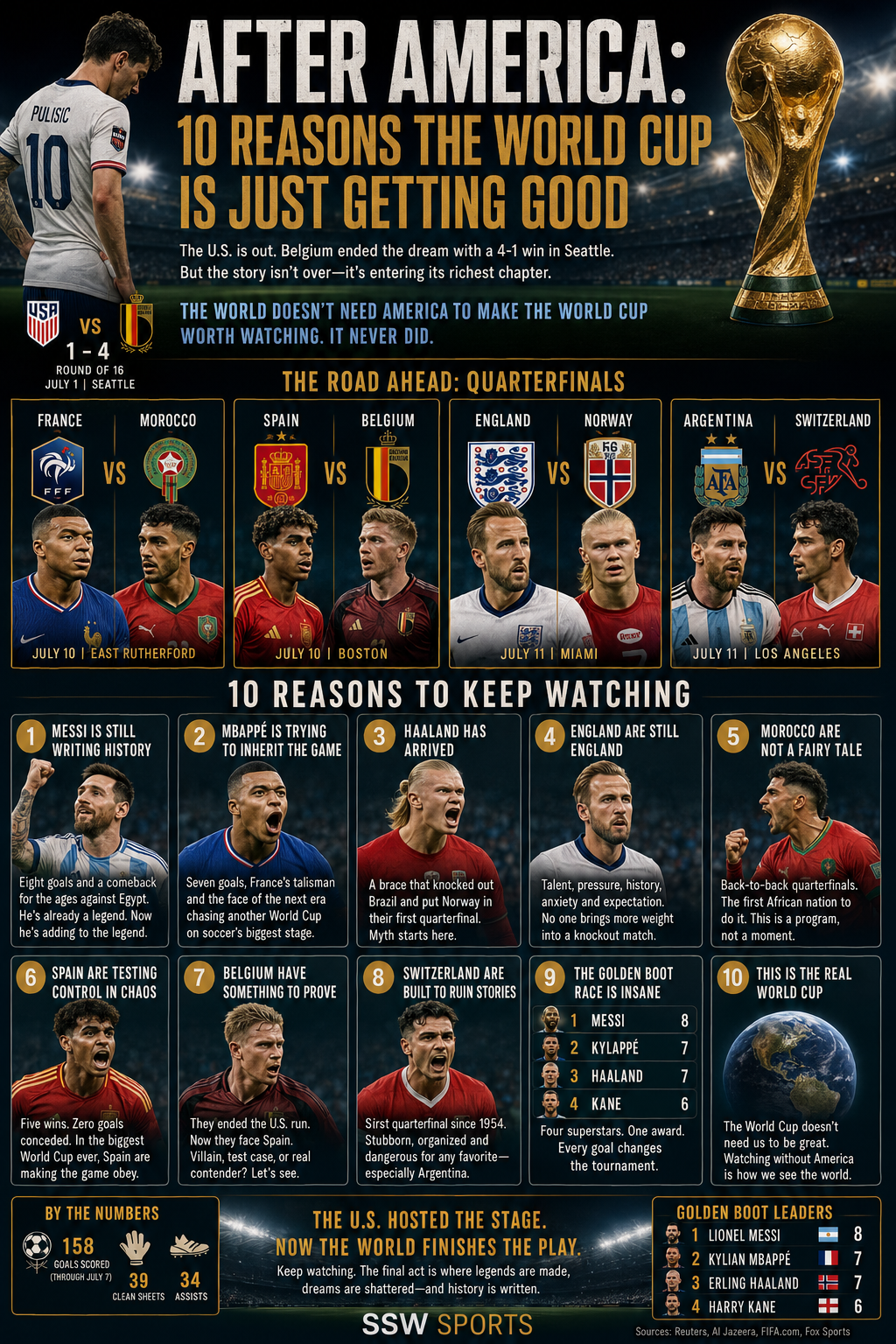
The quarterfinal field is loaded: France-Morocco, Spain-Belgium, England-Norway and Argentina-Switzerland. The defending champion is alive. The best player of the last 20 years is alive. The best player of the next 10 may be alive. The most terrifying striker in the club game finally has a World Cup platform. England are still carrying the sport’s heaviest national neurosis. Morocco are proving their 2022 run was not a one-off. Spain have yet to concede. Switzerland have reached their first World Cup quarterfinal since 1954.
So yes, the U.S. is gone.
That is not the end of the tournament.
It may be the beginning of the part Americans most need to watch.
1. Because Messi is still alive, and that should not be treated casually
Lionel Messi does not need this.
That is what makes it so compelling.
He has already won the World Cup. He has already settled the argument that followed him for most of his career. He has already carried Argentina to the summit. He has already moved beyond the anxious old debate about whether a player of impossible beauty could also win the hardest international prize. The trophy came in Qatar. The ending arrived. The book had its final chapter.
And yet here he is, still adding pages.
Argentina were almost gone against Egypt. They trailed 2-0. The holders were heading toward one of the great World Cup exits. Then Messi did what Messi has done for so long that the danger is treating it as normal. He helped bend the match back toward Argentina. Reuters reported that he scored the equalizer and delivered the cross that helped set up Cristian Romero’s goal in Argentina’s late 3-2 comeback.
He now leads the Golden Boot race with eight goals, ahead of Kylian Mbappé and Erling Haaland on seven.
But the goals are not the whole point.
The point is that Messi is still able to make a World Cup feel like it is happening around him. He is older now. He does not move through matches with the same constant electricity. The game does not bend to him for 90 minutes the way it once did. But the emotional geometry remains. When Argentina need something, the ball still seems to understand where history wants it to go.
That is reason enough to keep watching.
We are not watching Messi chase proof anymore. We are watching him chase the impossible luxury of adding wonder after the argument has already ended.
2. Because Mbappé is trying to inherit the tournament in real time
If Messi is the memory of the World Cup, Kylian Mbappé is its immediate future, trying to arrive early.
That sounds strange because Mbappé is not new. He won the tournament as a teenager in 2018. He scored a hat trick in the 2022 final. He already owns more World Cup moments than most legendary players ever get. But this tournament still feels like a hinge for him.
Messi’s World Cup legacy has been about completion. Mbappé’s is about accumulation.
France are alive again. Mbappé has seven goals. Didier Deschamps’ team has not always played with overwhelming beauty, but they remain brutally difficult to remove from tournaments. Reuters reported before the Morocco quarterfinal that France lead the tournament with 14 goals, with Mbappé at the front of an attack that also includes Ousmane Dembélé, Michael Olise and Bradley Barcola.
That is the danger of France. They can look ordinary for long stretches and still carry more match-winning options than almost anyone else. They can be conservative without being harmless. They can let a game sit there, apparently unresolved, and then Mbappé can turn one run, one penalty, one transition, one moment of panic into a new national memory.
For casual American fans, this is the closest soccer has to the feeling of watching a superstar wide receiver, sprinter and assassin occupy the same body. Mbappé does not always need volume. He needs space. The opponent’s entire defensive psychology changes because of what might happen if he gets it.
This is not only France trying to win another World Cup.
It is Mbappé trying to build a World Cup résumé that can eventually stand beside anyone’s.
3. Because Haaland finally has a World Cup story
Erling Haaland has spent years becoming inevitable in club football.
He scores in ways that make the sport feel less like invention than force. He is not a dribbler in the Messi tradition or a wide destroyer in the Mbappé tradition. He is a finishing event. He turns deliveries into consequences. He makes the box feel like a trap the defense has already stepped into.
But until this tournament, Haaland did not have a World Cup story.
That mattered. The World Cup is not the same as club dominance. It does not care how many goals a player scores for Manchester City if his country never gives him the stage. The sport’s deepest mythology still runs through nations: Pelé in yellow, Maradona in blue and white, Zidane in French blue, Ronaldo with Brazil, Messi with Argentina, Mbappé with France. Club football can make a player rich, famous and tactically refined. The World Cup gives him a different kind of permanence.
Now Haaland has entered that conversation.
Norway shocked Brazil 2-1 in the Round of 16, with Haaland scoring twice late to send the five-time champions home and put Norway into a World Cup quarterfinal.
That is not just a result. That is a myth-making event.
Brazil are never merely an opponent at the World Cup. They are the tournament’s oldest symbol of beauty, pressure, expectation and global imagination. To score twice against Brazil and remove them from the bracket is to do something club football cannot replicate.
Now Norway face England. Haaland versus England is almost too clean: the Premier League’s most terrifying scorer, carrying a nation that rarely owns this stage, against the country whose domestic league helped make him a global figure.
Club football made Haaland inevitable.
The World Cup is giving him the one thing inevitability cannot buy: national myth.
4. Because England are still England
England do not merely play knockout matches.
They bring a national weather system into them.
That is one of the great gifts of watching England at a World Cup. The team can be talented, organized, rich with attackers, technically superior to most opponents and still somehow surrounded by dread. No country has better turned quarterfinal football into a psychological condition.
England are alive after beating Mexico 3-2 at the Azteca, with Jude Bellingham and Harry Kane again central to the performance. Sky Sports described Bellingham and Kane as key figures in the win, while also noting the defensive effort that carried England through a difficult Round of 16 match.
Now comes Norway.
On paper, England should feel confident. Kane has six goals. Bellingham has been one of the tournament’s most complete forces. The squad has enough quality to win the whole thing. But England rarely experience opportunity as peace. They experience it as pressure, inheritance, trauma and public argument.
That is what makes them watchable.
Every England knockout match carries several games at once. There is the tactical game, the emotional game, the media game, the historical game, the “is this finally the year?” game, the “of course this is how it ends” game. England can be winning and still feel haunted. They can be favorites and still feel like they are walking toward a trap.
For American fans who enjoy the psychological circus of the Dallas Cowboys, the New York Yankees, Notre Dame football or any team whose brand makes every failure louder, England should make immediate sense.
They are not just trying to beat Norway.
They are trying to survive being England.
5. Because Morocco are not a fairy tale anymore
The lazy word is “Cinderella.”
It should be retired.
Morocco’s 2022 World Cup run was historic. It was emotional. It was the first African semifinal appearance in tournament history, and it carried all the power of a barrier being broken. At the time, surprise was part of the story. Morocco had disrupted the expected order.
But the second run changes the meaning of the first.
Morocco beat Canada 3-0 in the Round of 16, with Azzedine Ounahi scoring twice, and became the first African nation to reach the World Cup quarterfinals more than once. It is Morocco’s second consecutive appearance in the last eight.
That is not a fairy tale.
That is program identity.
The difference matters. A fairy tale implies magic, luck, temporary enchantment, something fragile and unlikely. Morocco are becoming something sturdier than that. They have organization. They have belief. They have continuity. They have Achraf Hakimi, Brahim Díaz, Ounahi and a team structure that has now survived two World Cup cycles well enough to make elite opponents uncomfortable.
Now they get France, which is exactly the kind of match that can turn respect into something more permanent.
The 2022 semifinal already linked these teams in World Cup memory. This quarterfinal gives Morocco a chance not only to repeat its past, but also to revise the hierarchy. France are not just a football opponent. They are a former colonial power, a diaspora mirror, a talent pipeline, a national team with deep North African connections, and a giant of modern tournament football.
That is why this match matters beyond the bracket.
The first run made Morocco a story.
The second makes them a standard.
6. Because Spain are trying to prove control still works in chaos
The expanded World Cup is a bigger, messier, louder tournament.
Forty-eight teams. More matches. More travel. More variables. More knockout rounds. More possibilities for shocks. More ways for a favorite to be dragged into the mud by format, fatigue, weather, travel, penalty kicks or one chaotic transition.
Spain have responded by trying to remove chaos from the game.
They have reached the quarterfinals without conceding. Unai Simón set a World Cup scoreless-streak record earlier in the knockout rounds, and Spain then eliminated Portugal 1-0 with a stoppage-time goal by Mikel Merino.
That is the tension Spain bring to this tournament. They are not necessarily the loudest team. They are not the sentimental favorite. They do not have the Messi farewell aura, the Mbappé inheritance story, the Haaland breakthrough, or the England anxiety machine. Their case is colder.
Spain’s case is that control still wins.
The ball moves. The spacing holds. The midfield dictates. The opponent waits, chases, shifts, and eventually has to solve a problem that is not emotional but structural. Spain ask whether you can live without the ball and then punish the moment you cannot.
This is a particularly interesting question in this World Cup because the tournament itself has become more chaotic. Expansion has created a larger field and a longer route to the title. Researchers have already raised concerns about the complexity and competitive quirks of the 48-team knockout structure, especially the global ranking of third-place teams and the bracket’s many possible configurations.
Spain are the opposite argument.
The tournament can expand. The bracket can grow. The noise can multiply.
The ball can still be made to obey.
7. Because Belgium are the villain America accidentally made interesting
Belgium were supposed to be the ending for American viewers.
They knocked out the U.S. They punished defensive mistakes. They turned the home tournament into a postmortem. They made the Balogun controversy feel irrelevant by simply being better on the night. Reuters reported that Belgium’s 4-1 win ended the United States’ World Cup journey and sent Belgium into a quarterfinal against Spain.
That would normally be enough for American fans to change the channel.
But it should do the opposite.
Belgium now become the test of what the U.S. loss meant. Were Belgium genuinely dangerous, revived and capable of troubling a favorite? Or were they simply the team that revealed how far the U.S. still had to go?
Spain will answer that question.
That makes Belgium useful. They are no longer only the team that ended the American story. They are the measuring stick by which that ending can be understood. If Belgium push Spain, the U.S. loss looks different. If Spain handle Belgium calmly, the American performance looks more damning. Either way, the next match gives meaning to the last one.
There is also something interesting about Belgium themselves. This is not the old golden generation at its peak. That version of Belgium carried years of expectation and never quite found the tournament ending it wanted. This Belgium are stranger: less romantic, less glamorous, but still dangerous enough to score four against the host nation and make Spain take them seriously.
For American viewers, Belgium are the grudge-watch.
If Belgium killed the American story, Spain will tell us whether Belgium were the story or merely the instrument.
8. Because Switzerland are trying to turn stubbornness into history
Switzerland are not the obvious neutral’s choice.
They do not arrive with Messi’s romance, Mbappé’s electricity, Haaland’s force, England’s melodrama, Morocco’s historic momentum or Spain’s aesthetic clarity. They are not the team most casual viewers circle first.
That is exactly why they matter.
Every World Cup needs a team like Switzerland: organized, resistant, unglamorous in the best way, capable of taking the favorite’s beautiful story and making it deeply inconvenient. They are the team that turns a romantic bracket into a problem set.
Switzerland beat Colombia on penalties after a 0-0 draw to reach their first World Cup quarterfinal since 1954. Reuters reported that goalkeeper Gregor Kobel saved Colombia’s final penalty and that Switzerland converted all four of theirs to set up the Argentina match.
Now they face Messi.
That is the kind of match the World Cup does beautifully. One side carries the global story. The other carries the capacity to ruin it. Argentina will bring the crowd, the mythology, the Golden Boot leader, the defending champion’s aura and the feeling that the tournament is waiting to see how far Messi can drag one more chapter.
Switzerland bring the nuisance.
That is not an insult. It is a compliment. Tournaments are not built only from beauty. They are built from resistance. The favorite must be tested by something more serious than admiration. Switzerland give Argentina that.
Every World Cup needs one team that seems designed not to inspire the neutral, but to test whether the favorite deserves the story.
9. Because the Golden Boot race is absurdly good
Sometimes the simplest reason is also the best one.
The scoring race is ridiculous.
Messi has eight. Mbappé has seven. Haaland has seven. Kane has six. All four are still alive.
That is almost too neat. It sounds like something a tournament organizer would invent if it were trying too hard. The old king, the new king, the cyborg striker and England’s captain are all close enough that every remaining match carries a second scoreboard.
But the Golden Boot race is not just a statistical side plot. It is four different versions of greatness keeping score against one another.
Messi represents memory, genius and the late-career miracle. Mbappé represents succession, speed and World Cup inevitability. Haaland represents pure finishing force, finally translated onto the national stage. Kane represents elite consistency under England’s impossible emotional burden.
Each goal now changes more than a leaderboard. It changes the tournament’s interpretation.
If Messi wins the Golden Boot and Argentina go deep, the story becomes almost mythologically excessive: the player who had nothing left to prove proves something anyway. If Mbappé wins it and France lift the trophy, the inheritance becomes official. If Haaland wins it, Norway’s tournament becomes one of the great striker-led national runs. If Kane wins it and England finally break through, a lifetime of English pressure collapses into release.
That is reason enough to watch even if you do not care about formations, pressing triggers, xG or tournament structure.
The world’s best finishers are still keeping score.
10. Because watching without the U.S. is how you actually understand the World Cup
This is the most important reason.
American viewers often watch the World Cup as a referendum on American soccer. That is understandable, especially in a home tournament. How far can the U.S. go? Has the player pool improved? Has the country arrived? Is the sport finally breaking through? Can a host nation turn attention into permanence?
Those questions are fair.
They are also small compared to the tournament itself.
The World Cup is not valuable only when it measures the United States. It is valuable because it forces Americans into a sporting culture where they are not the default center. That is rare for American sports fans. Most of the American sports calendar is domestically arranged, commercially dominant and culturally self-contained. The Super Bowl crowns a world champion without needing the world. The NBA is global in talent but American in institutional control. College football is almost aggressively local and national at the same time.
The World Cup is different.
It does not need America to remain important. It can be hosted in America, sponsored through America, broadcast to America and played in American stadiums, and still not belong primarily to America. That is not a weakness. It is the point.
Once the U.S. is eliminated, American fans have a choice. They can treat the tournament as over because the local stake is gone. Or they can keep watching and experience the thing that makes the World Cup unlike anything else: other people’s histories becoming the center of the world for a few days at a time.
Argentina’s anxiety is not ours. England’s dread is not ours. Morocco’s rise is not ours. France’s expectation is not ours. Norway’s breakthrough is not ours. Switzerland’s stubbornness is not ours. Spain’s control is not ours. Belgium’s proof-of-life is not ours.
That is why it is worth watching.
The World Cup is no less meaningful because America is gone.
It may be the rare sporting event that becomes more itself when Americans stop asking what it says about us.
The Tournament Does Not Need Us
The U.S. exit hurt because it was supposed to be different.
That is part of sports. Hope creates the terms for disappointment. The American team had a chance to turn a home World Cup into a national moment, and Belgium took that chance away. The reaction was always going to include frustration, jokes, backlash, defensiveness and the familiar voices announcing that soccer is boring now that the Americans are out.
But the tournament has entered its richest stage.
Messi is still alive. Mbappé is still alive. Haaland is still alive. Kane and Bellingham are still alive. Morocco are still alive. Spain have still not conceded. Switzerland are still testing the bracket. Belgium are still carrying the meaning of the U.S. exit into a match against one of the tournament’s best teams.
That is not a dead tournament.
That is a tournament with its best arguments still on the table.
So keep watching — not because you owe soccer anything, and not because the World Cup needs American permission to matter. Keep watching because the final act is where sporting history hardens. The stories still alive are too good to abandon just because ours ended early.
The United States hosted the stage.
Now the world gets to finish the play.
Selected Sources
Al Jazeera. World Cup 2026 quarterfinals: Full schedule and Egypt FIFA dispute.
Al Jazeera. Who is leading the race for the FIFA World Cup 2026 Golden Boot award?
FIFA. FIFA World Cup 2026 knockout stage and tournament format.
Reuters. Belgium end U.S. World Cup dreams with 4-1 rout amid Balogun row.
Reuters. France must be even more efficient in attack against Morocco, says Deschamps.
Reuters. De la Fuente sings Lamine’s praises as Spain reach World Cup quarter-finals.
Reuters. Switzerland edge Colombia on penalties to reach first World Cup quarter-final since 1954.
Yahoo Sports. World Cup 2026: Erling Haaland scores twice and Norway shocks Brazil 2-1 to advance to quarterfinals.
Southland Storyworks
Narrative. Performance. Meaning.
Home-Sports
Inquiries
news@southlandstoryworks.com
Based in the American South
Submissions welcome via email
© 2026 Southland Storyworks-An independent publication exploring the psychological frameworks of competition.
Narrative architecture & performance psychology